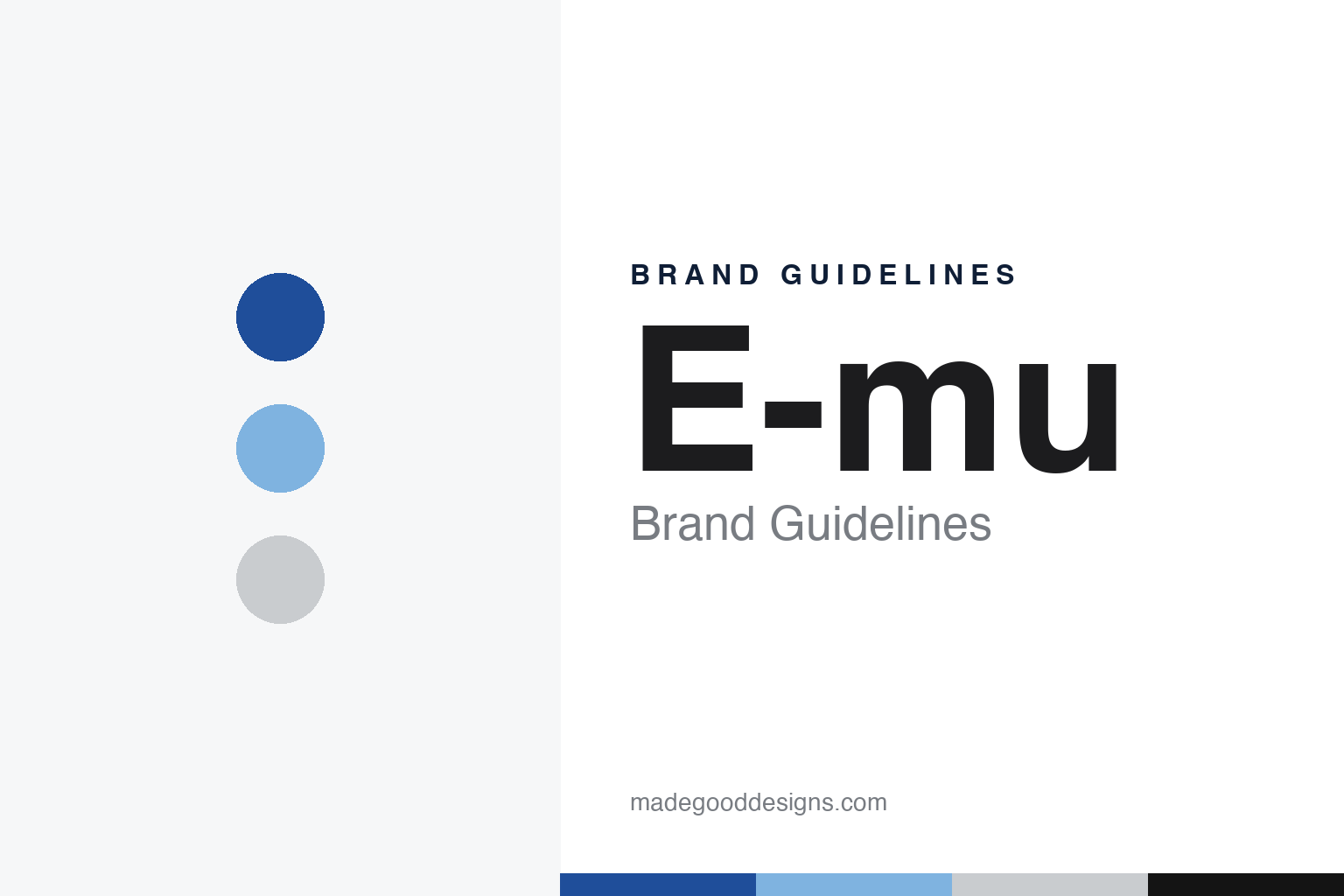
E-mu Brand Guidelines
The California sampler maker that put sampling within musicians’ reach.
Aa
Two constants: an Emu blue, sky and stainless palette and an engineering sans register. Abstract homage — not an E-mu product or mark; no instrument, logo or nameplate is reproduced.
Eµ Systems
A student project, a name for an invoice.
E-mu began as a student project. Dave Rossum was a graduate student at the University of California, Santa Cruz when the university’s new Moog modular synthesizer arrived, and in 1971 he and two friends from Caltech, Steve Gabriel and Jim Ketcham, built a prototype synthesizer of their own, English Wikipedia says. Parts suppliers needed a company name on the invoices, so Rossum came up with Eµ Systems, short for “Electronic Music Systems,” Sound On Sound reported in 2002. That summer Rossum’s high-school friend Scott Wedge joined, and when the others moved on the two of them carried the project forward.
Rossum and Wedge formed the company as a 50/50 partnership in November 1972, working from Rossum’s apartment in Santa Clara; Sound On Sound calls them the founders, and Wedge became president. Its first proper product, the Modular System of 1973, borrowed from Moog and ARP designs but looked like a laboratory instrument, with quarter-inch-thick stainless-steel front panels, “each with an Emu blue border,” Sound On Sound wrote. About 125 complete systems were sold over eight years.
The firm earned more from ideas than from its own instruments in the 1970s. Its digitally scanned polyphonic keyboard was licensed by Tom Oberheim for his Four Voice and Eight Voice synthesizers, and Rossum worked with Dave Smith of Sequential Circuits on the Prophet-5, which paid E-mu a royalty until Smith changed chip suppliers in 1980. E-mu moved from the apartment to a house in Santa Cruz, then, in December 1985, to larger premises in Scotts Valley, which remained its base.
Colour
The Emulator, the Drumulator and the SP-1200.
E-mu’s big turn came in 1980. Its Audity, a polyphonic synthesizer with a dark and light blue acrylic control panel and a blue display, was shown at that year’s AES convention, but its projected retail price of $69,200 killed it within months, and the prototype went to the Audities Foundation in 1995. At the same show the team saw the Fairlight CMI, and decided to build an affordable sampler. The Emulator was launched at the Winter NAMM show in 1981; the first unit shipped to Stevie Wonder that June, Sound On Sound reported. At $7,900, books including Julian Colbeck’s Keyfax note, it cost a fraction of the roughly $30,000 Fairlight. Sales stalled at first; a revised model with a built-in sequencer, a factory library of more than 100 disks and a 20 percent price cut then sold more than 400 in two years, the magazine reported.
A run of influential machines followed. The Drumulator of 1983, priced at $995, sold nearly 10,000 units in two years. The Emulator II of 1984, at $7,995, became “the sampler of the mid-’80s,” in Sound On Sound’s words, selling about 3,000. The Emax of 1986 brought similar sampling to musicians for about $3,000. The 16-bit Emulator III of 1987 cost $15,000 and was hurt by early hardware faults. The Proteus sound module, launched at Winter NAMM in 1989, had a back-order of 5,000 within days.
The machine most often linked with the name is the SP-1200, a sampling drum machine designed by Rossum and launched at the summer NAMM show in 1987. Its 12-bit, 26.04 kHz sampling and analogue filters gave it a gritty sound that hip hop producers sought out; English Wikipedia lists Public Enemy’s It Takes a Nation of Millions to Hold Us Back (1988) among the records made with it. E-mu dropped it in 1990, reissued it in a black case in 1993, and built a final batch in 1998, Sound On Sound reported.
Typography
Design and documentation.
Digital sampling and synthesis reached recording studios in the late 1970s and 1980s. Fairlight, founded in Sydney in 1975 by Peter Vogel and Kim Ryrie, introduced its CMI in 1979; New England Digital, founded in Vermont in 1976 by Sydney Alonso and Cameron Jones, built the Synclavier; and Wolfgang Palm’s PPG, in Hamburg, introduced wavetable synthesis in 1979, English Wikipedia says.
American makers brought prices down. E-mu, whose name Dave Rossum coined in 1971 and which he and Scott Wedge formed as a partnership in 1972, moved from modular synthesizers to samplers; Ensoniq, of Malvern, Pennsylvania, launched its Mirage sampler in 1985 at $1,695; Kurzweil, founded in 1982, launched its K250 in 1984; and Alesis, formed in Hollywood by Keith Barr in 1984, Mix reported, launched the ADAT recorder in 1991.
Few stayed independent. PPG closed in 1987, and New England Digital in the early 1990s. Creative Technology of Singapore bought E-mu in 1993 and Ensoniq in 1998, and merged them. The Korean piano maker Young Chang bought Kurzweil in 1990; Hyundai Development Company bought Young Chang in 2006, and the group, renamed HDC Young Chang in 2018, is based in Incheon; Kurzweil’s own website names no parent company today.
Some names returned. Blackmagic Design, the Australian video company, bought Fairlight in 2016 and sells Fairlight consoles. Cameron Jones bought back the Synclavier trademark, and his Synclavier Digital released the Regen synthesizer in 2022. Jack O’Donnell bought Alesis in 2001; it belongs to his inMusic group of Cumberland, Rhode Island.
This guide sets out what can be checked about each brand — who founded it, who owns it, and what it says about where its products are made — and marks clearly what rests only on the company’s own word.
Aa
An engineering sans — the register of a laboratory panel. (Specimen set in Archivo, a sans STAND-IN; NOT the E-mu logo.)
E-mu
From Scotts Valley to Creative.
The company did not stay independent. Creative Technology, the Singapore maker of Sound Blaster cards, signed a licensing deal with E-mu in July 1992, and the acquisition went through in March 1993, making E-mu a Creative subsidiary, Sound On Sound reported. E-mu’s chips went into Creative’s sound cards, and Rossum later became Creative’s chief scientist, English Wikipedia says. In 1998 Creative bought Ensoniq, another synthesizer and sampler maker, and merged it into E-mu. In 2001 E-mu downsized “and started manufacturing in China,” Sound On Sound reported in 2002.
The later products were mostly software and computer audio: the Emulator X software sampler of 2004, a line of “Digital Audio Systems” sound cards from 2003 to 2007, and controller keyboards up to about 2010, according to English Wikipedia. In a copy archived in January 2026, emu.com showed two headphone models, the E-MU Teak and E-MU Walnut, under the name E-MU Systems Pte. Ltd.; in October 2026 the site showed a maintenance page. The SP-1200 came back in 2021, but not from E-mu: Rossum’s own company, Rossum Electro-Music, which he co-founded in 2015 with former E-mu colleague Marco Alpert, announced a reissue with twice the sampling time and an all-metal case, GearNews reported in November 2021.
For a design guide, E-mu shows how a technical brand can be defined by its machines’ sound and the plain look of its panels. Compare Sequential, whose Prophet-5 Rossum helped design, and Oberheim, which licensed E-mu’s keyboard. For this guide we use blue, sky blue and stainless grey with a sans, an unofficial interpretation; no product or logo is reproduced.
Explore & save
Keep E-mu’s identity on hand — save it to a board in the Made Good inspiration library.
E-mu identity set
Pin the E-mu blue, sky and stainless palette and the engineering sans register to your own board.