Solid State Logic Brand Guidelines
The Oxfordshire organ-switch firm that built the 1980s studio console.
Aa
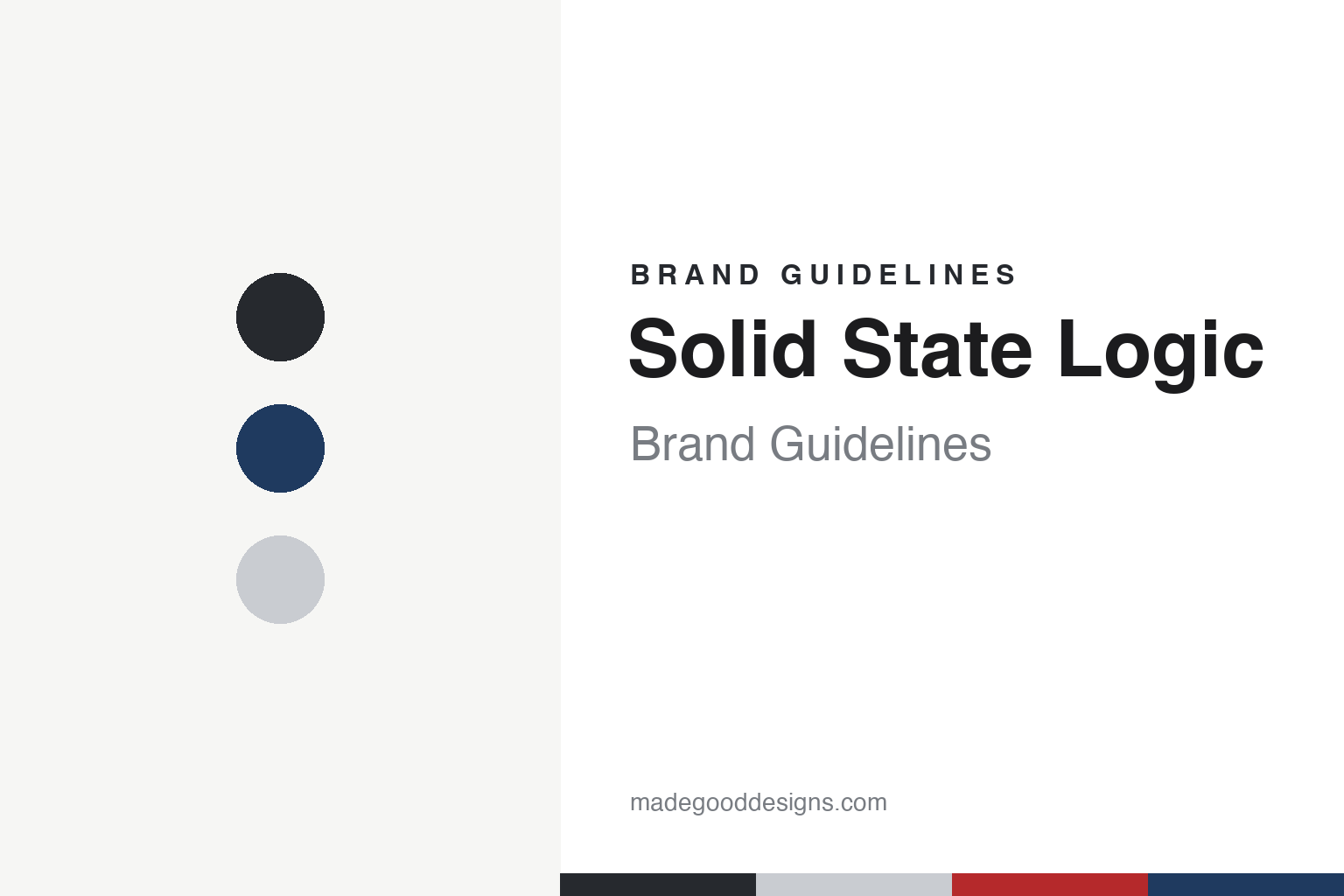
Two constants: a charcoal, grey, blue and red palette and an engineering sans register. Abstract homage — not a Solid State Logic product or mark; no console, logo or nameplate is reproduced.
Organ switches
From church organs to a studio in Stonesfield.
Solid State Logic was founded in 1969 by Colin Sanders, and its name describes its first trade. The company says its first products were switching systems for pipe organs, and that Sanders coined the phrase “Solid State Logic” to describe them; English Wikipedia adds that it was explaining transistor and FET switching to organ builders. The organ business stayed with SSL for more than three decades: Wikipedia says the division was sold in 2002 and now trades as Solid State Organ Systems, a separate company.
The consoles came out of a studio. Sanders started Acorn Studios in Stonesfield, the Oxfordshire village where he lived, and began building his own mixing desks, the company says. It dates the first A Series console to 1976 — two were made and sold — and says the SL 4000 B Series followed the same year, joining an in-line console to a computer for fader automation and tape-machine location; an older version of SSL’s website, archived in 2002, dated the B Series to 1977. Six B Series desks were built, and Wikipedia says the first went to Abbey Road Studios.
The SL 4000 E Series of 1979 made the company. It added Total Recall, which stored the position of every rotary control on a floppy disk and guided the engineer in resetting them by hand, and Wikipedia describes it as the first console with a compressor and gate on every channel plus a master bus compressor; it also credits the E Series equaliser to a collaboration with George Martin, which we give as Wikipedia’s account. SSL’s 2002 website said the E Series won a UK Design Council Award in 1981, the year of its first Queen’s Award for export. Sanders was appointed CBE in the 1986 Birthday Honours as managing director of Solid State Logic Ltd, and that year, the company says, it moved to Begbroke Manor, adding a 4,000-square-metre manufacturing building that opened in 1988.
Colour
Carlton, 3i, a musician, then a group.
SSL has changed hands several times. By 1989 it belonged to United Engineering Industries, the group that also owned Quantel, and that year Carlton Communications bought UEI, according to English Wikipedia, citing The Guardian. Ten years later Carlton let it go: in December 1999 The Guardian reported that Carlton had sold Solid State Logic to the investment firm 3i for £43.5m, one of the first sales after Carlton promised to dispose of non-core businesses. In 2005 SSL sold its APT audio-coding business, the home of the aptX codec, in a management buyout, Mix reported.
In June 2005 a press release announced that the company’s assets had been bought by a joint venture formed by the musician Peter Gabriel and the American broadcast entrepreneur David Engelke, and that SSL would “continue to design and manufacture mixing consoles and related audio technology at its Begbroke, Oxford headquarters.” Gabriel said Real World, his studio in Wiltshire, had “enjoyed a close relationship with the company for many years.” In 2018 James Gordon, chief executive of the buyer that came next, told SonicScoop that 2005 was “probably the darkest time in its history.”
That buyer was Audiotonix, the British group formed in 2014 from Allen & Heath, Calrec and DiGiCo. SSL announced the deal on 19 December 2017, describing Gabriel as its majority shareholder; he became an investor in Audiotonix and said his relationship with SSL had begun “as a user, a customer and then as part owner.” Audiotonix itself has since passed between investors: its website says the French firm Ardian took a majority stake from Astorg in December 2019, and that in 2024 it agreed a further investment from PAI Partners, with Ardian and Astorg keeping minority stakes. Under the group, SSL bought the American console maker Harrison in April 2023, Sound On Sound reported.
Typography
Consoles, recall and the studio trade.
The seven makers in this guide build recording-studio equipment, from large mixing consoles to desktop interfaces.
Solid State Logic, founded by Colin Sanders in 1969, says its headquarters has been at Begbroke Manor, near Oxford, since 1986; it was bought in 2017 by Audiotonix, a British console group that says it agreed new investment from PAI Partners in 2024, with Ardian and Astorg keeping minority stakes. AMS Neve, formed by Siemens in 1992 from Neve Electronics and Advanced Music Systems, says it has been privately owned since 1996 and makes its products in Burnley, Lancashire.
In the United States, API, formed in 1969, is in Jessup, Maryland, and is owned by its president, Larry Droppa, according to English Wikipedia. Rupert Neve Designs, founded in 2005 by Rupert Neve, Evelyn Neve and Josh Thomas, is in Wimberley, Texas; MOTU says it is based in Cambridge, Massachusetts. Apogee Electronics was acquired in November 2025 by Rockforce Tech Holding Inc., the parent of Manley Labs, and says it will stay in Santa Monica.
Behringer, founded by Uli Behringer in 1989, is part of his Music Tribe group, and its own timeline marks 25 years of production in China; English Wikipedia places its Music Tribe City factory in Zhongshan, Guangdong.
Rupert Neve Designs says its products are designed, manufactured and tested in the USA. Solid State Logic, API, MOTU and Apogee do not say, on the pages we checked, where their current products are made, and we have not guessed.
This guide sets out what can be checked about each brand — who founded it, who owns it, and what it says about where its products are made — and marks clearly what rests only on the company’s own word.
Aa
An engineering sans for a console maker. (Specimen set in IBM Plex Sans, a sans STAND-IN; NOT the Solid State Logic logo.)
Solid State Logic
Recall, awards and a famous accident.
The SL 4000 line spread through the studio trade in the 1980s. English Wikipedia lists rooms including the Power Station, Sarm and Larrabee, and engineers including Bob Clearmountain and Trevor Horn; it also reports that in 1996 Billboard’s Studio Action Chart credited SSL consoles with 83 per cent of that year’s number-one singles. One of its best-known sounds was an accident. At Virgin’s Townhouse Studios in London, Wikipedia says, citing Mix, the engineer Hugh Padgham found that the B Series “Listen Mic” talkback circuit, with its heavy compression and gating, turned Phil Collins’s drums into the gated reverb heard on Peter Gabriel’s “Intruder” in 1980 and Collins’s “In the Air Tonight” in 1981.
The analogue line continued with the SL 9000 J of 1994, the first console with what SSL calls its SuperAnalogue design, a capacitor-free signal path; the company says its 1,000th analogue console was installed at the Townhouse that year. Digital A Series consoles served post-production and broadcast in the 1990s, followed by the C Series from 2003, the AWS 900 analogue console and workstation controller in 2004, Duality in 2006, the L500 live console in 2013 and System T for broadcast in 2016. More recently SSL has made smaller products for home and project studios, including the SSL 2 and SSL 2+ USB audio interfaces.
The recognition is documented. The Recording Academy gave SSL a Technical Grammy in 2004, and the TEC Awards’ TECnology Hall of Fame inducted the SL 4000 series in 2004 and the AWS console in 2018. Wikipedia lists Queen’s Awards in 1981, 1993 and 2020. On where things are made, the 2005 press release and the company’s 2006 website described manufacturing at Begbroke; today SSL says its UK headquarters are still there, but its history page does not say where each current product is built.
For a design guide, Solid State Logic shows how a technical feature — a console that could remember itself — can become a brand. Compare Neumann, a studio name that now sits inside a larger group, and Mackie, another mixer brand that has changed owners. For this guide we use charcoal, panel grey, a deep blue and a channel red with a sans, an unofficial interpretation; no product or logo is reproduced.
Explore & save
Keep Solid State Logic’s identity on hand — save it to a board in the Made Good inspiration library.
Solid State Logic identity set
Pin the Solid State Logic charcoal, grey, blue and red palette and the engineering sans register to your own board.