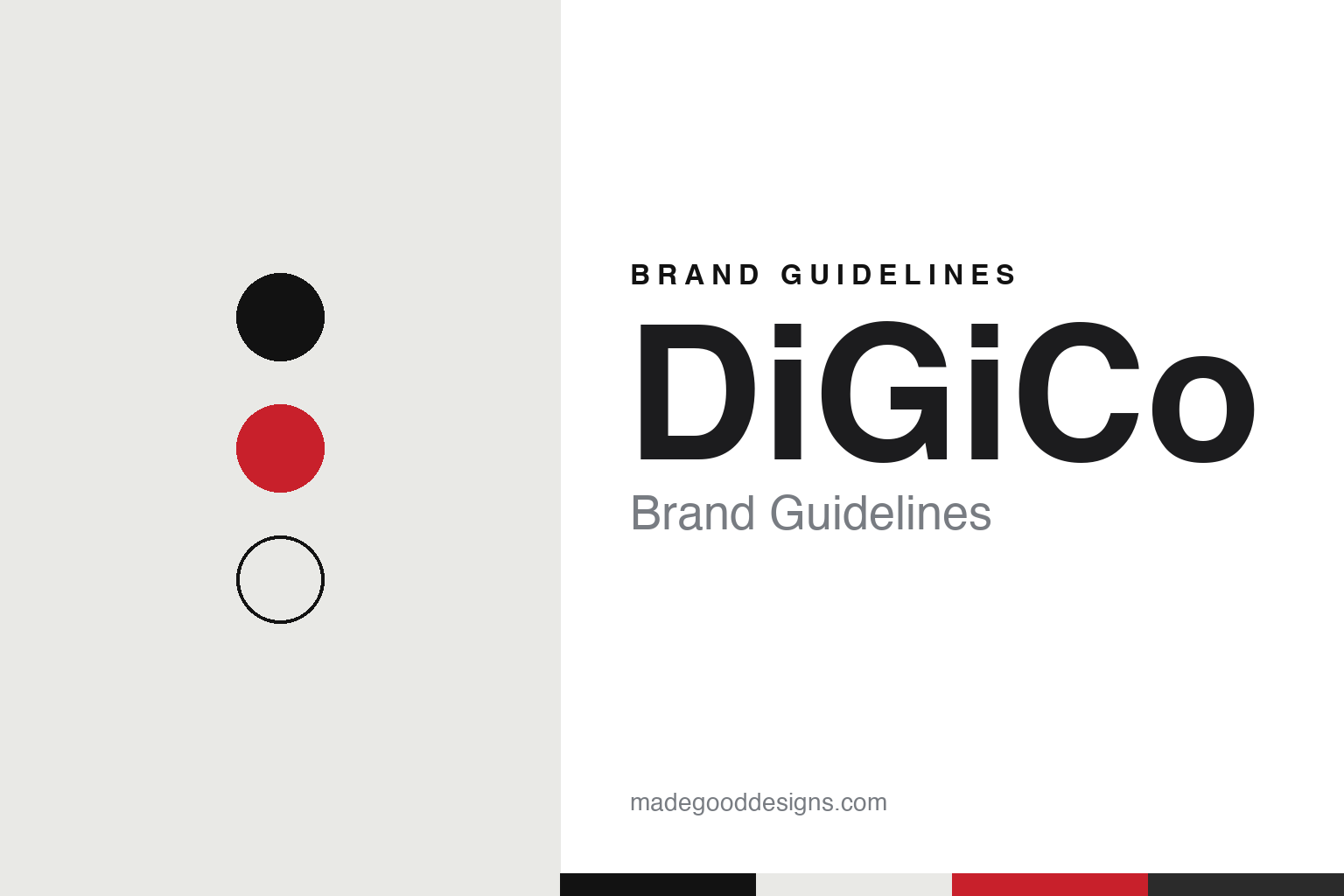
DiGiCo Brand Guidelines
The Chessington desk maker that grew out of Soundtracs.
Aa
Two constants: a DiGiCo black and red palette and an Engineered sans register. Abstract homage — not a DiGiCo product or mark; no console, logo or nameplate is reproduced.
Out of Soundtracs
A new marque from an older console firm.
DiGiCo is a British maker of digital mixing consoles based in Chessington, Surrey, on the south-west edge of London. Sound On Sound, reviewing its S21 in April 2018, wrote that DiGiCo “were formed in 2002 with the purchase of Soundtracs,” an older British console maker; English Wikipedia gives the same year. The company’s own website in 2003, archived under its early address digiconsoles.com, described DiGiCo as “the new marque” created by industry professionals to fill a gap in the live-performance market for digital consoles, and called Soundtracs its “sister company,” whose platform it said was already used in more than 400 facilities.
Soundtracs’ own origins are told two ways. Sound On Sound says it was founded in the early 1980s by a group of recording engineers. FOH magazine, profiling the engineer John Stadius in December 2017, traces it to a company called Soundout Laboratories, which Stadius joined from the University of Surrey and which made consoles, amplifiers and speakers for the disco market before it was renamed Soundtracs; the trade magazine Resolution dated his arrival to 1978. We give both accounts.
Who founded DiGiCo is less clear than often stated. English Wikipedia names James Gordon as founder, without a citation. The group’s own biography of him says he was DiGiCo’s sales director before becoming managing director in 2007, and FOH reports that he met Stadius at Soundtracs in 1996. We found no source that names a founder, so we do not.
Colour
From the D5 to Quantum.
The technology came from Soundtracs. FOH credits Stadius with the Virtua, the company’s first fully digital console, launched at the Frankfurt Musikmesse in 1996, and the DPC-II of 1998, a large-format studio desk that could control up to 160 channels using floating-point SHARC processors. When the platform moved into live sound, Stadius told Resolution in 2006, the team chose optical fibre from the German firm Optocore, rather than computer network cable, for the long run from stage to mixing position.
The first DiGiCo-branded product was the D5 Live of 2002, followed by the DS00 for broadcast and post-production, the D5T for theatre and the D1. The theatre software was developed with Andrew Bruce, founder of the London sound company Autograph, English Wikipedia says, and DiGiCo desks went on to run West End and Broadway musicals including Les Misérables and Mamma Mia!.
In 2007 came the SD7, the first console built on what DiGiCo calls Stealth Digital Processing: instead of racks of conventional DSP chips, a single large FPGA, a programmable chip whose function can be changed by software after it is installed. Smaller SD models followed; with the Israeli plug-in maker Waves it launched the DiGiGrid interfaces in 2013; the lower-priced S21 and S31 arrived in 2016, and from 2020 the Quantum range, which renamed upgraded SD desks as the Quantum 5 and Quantum 7. In September 2026 DiGiCo launched the Quantum638, which it says is “built from the DNA” of the SD7 and SD5. Stadius, its technical director, received the Parnelli Audio Innovator Award in January 2018.
The desks travel well beyond the theatre. English Wikipedia, citing Mix and Sound & Video Contractor, lists DiGiCo consoles on tours by Barbra Streisand, Iron Maiden and the Black Keys, at the Grammy Awards, on The Tonight Show Starring Jimmy Fallon — reported in 2020 to be using three SD7s — and at the Super Bowl LVI half-time show in 2022. Concert halls including Philadelphia’s Kimmel Center and the Minnesota Orchestra’s Orchestra Hall have installed them too.
Typography
Consoles and their owners.
The mixing consoles and processors behind concerts, theatres and broadcast studios come from a small number of makers, and most of them now sit inside larger groups.
The biggest of those groups is Audiotonix, formed in 2014 by combining Allen & Heath, Calrec and DiGiCo, according to Wikipedia, citing The Wall Street Journal. It bought Solid State Logic in 2017, and the investment firm Ardian took a majority stake in 2019, the Financial Times reported. In 2024 Audiotonix announced an agreement with the investment firm PAI Partners, with Ardian and Astorg keeping minority stakes. DiGiCo gives its address as Chessington, in Surrey; Calrec’s is a mill in Hebden Bridge, West Yorkshire. Harrison, which presents itself as a Nashville brand, was bought by Solid State Logic, which announced the deal in April 2023; Harrison’s own history gives 2022.
Soundcraft, founded in Britain in 1973 by Phil Dudderidge and Graham Blyth, describes itself as part of Harman’s professional division. Samsung Electronics completed its purchase of Harman in 2017.
Midas and Klark Teknik have shared owners since Klark Teknik, of Kidderminster, bought Midas in 1987. Since December 2009 both have belonged to Music Group, now Music Tribe, the company chaired by Uli Behringer and based in Makati, in the Philippines; Midas says it opened a research centre in Manchester.
Lawo, of Rastatt in Germany, was founded in 1970 by Peter Lawo, according to Wikipedia; its website lists his son Philipp on the supervisory board. We found no outside group owner in the sources we checked.
This guide sets out what can be checked about each brand — who founded it, who owns it, and what it says about where its products are made — and marks clearly what rests only on the company’s own word.
Aa
An engineered sans — a brand name set in mixed case. (Specimen set in Inter Tight, a sans STAND-IN; NOT the DiGiCo logo.)
DiGiCo
A console firm at the centre of a group.
DiGiCo’s ownership has changed several times. Audiotonix, its parent, says a management buyout funded by Mobeus took place in 2007 and a second, backed by the private-equity firm Livingbridge, in 2011. In August 2014 it was bought by funds managed by Epiris, formerly Electra Partners, which had acquired Allen & Heath in 2013 and Calrec in March 2014; Electra Private Equity’s 2017 half-year report says the three formed a group valued at £143 million, later renamed Audiotonix, with DiGiCo’s chief executive, James Gordon, as group chief executive. Epiris sold in 2017 to the French firm Astorg; Ardian bought a majority stake in December 2019; and in 2024 Audiotonix announced an agreement for investment from PAI Partners, with Ardian and Astorg keeping minority stakes. DiGiCo itself bought KLANG:technologies in 2018 and Fourier Audio in 2023.
We found no statement on DiGiCo’s website about where its consoles are built. Electra’s report says the group had several UK manufacturing sites and moved “all high-volume manufacturing” to an outsourced partner in China, but does not say which brands that covered, so we draw no conclusion for DiGiCo. The look of the desks is mostly black; Sound On Sound singled out the SD9’s “striking red bumpers,” which is where our red comes from. Its awards are better documented: a Queen’s Award for Enterprise for innovation in 2005, recorded in the London Gazette, and another for international trade in 2011, English Wikipedia says.
For a design guide, DiGiCo shows how a brand can be built on one interface idea carried from desk to desk. Compare Allen & Heath, its sister brand in Audiotonix, and Solid State Logic, which joined the group in 2017. For this guide we use near-black and a signal red with a sans, an unofficial interpretation; no product or logo is reproduced.
Explore & save
Keep DiGiCo’s identity on hand — save it to a board in the Made Good inspiration library.
DiGiCo identity set
Pin the DiGiCo black and red palette and the Engineered sans register to your own board.