Bock Audio Brand Guidelines
The studio tech who turned vintage-mic repairs into new valve microphones.
Aa
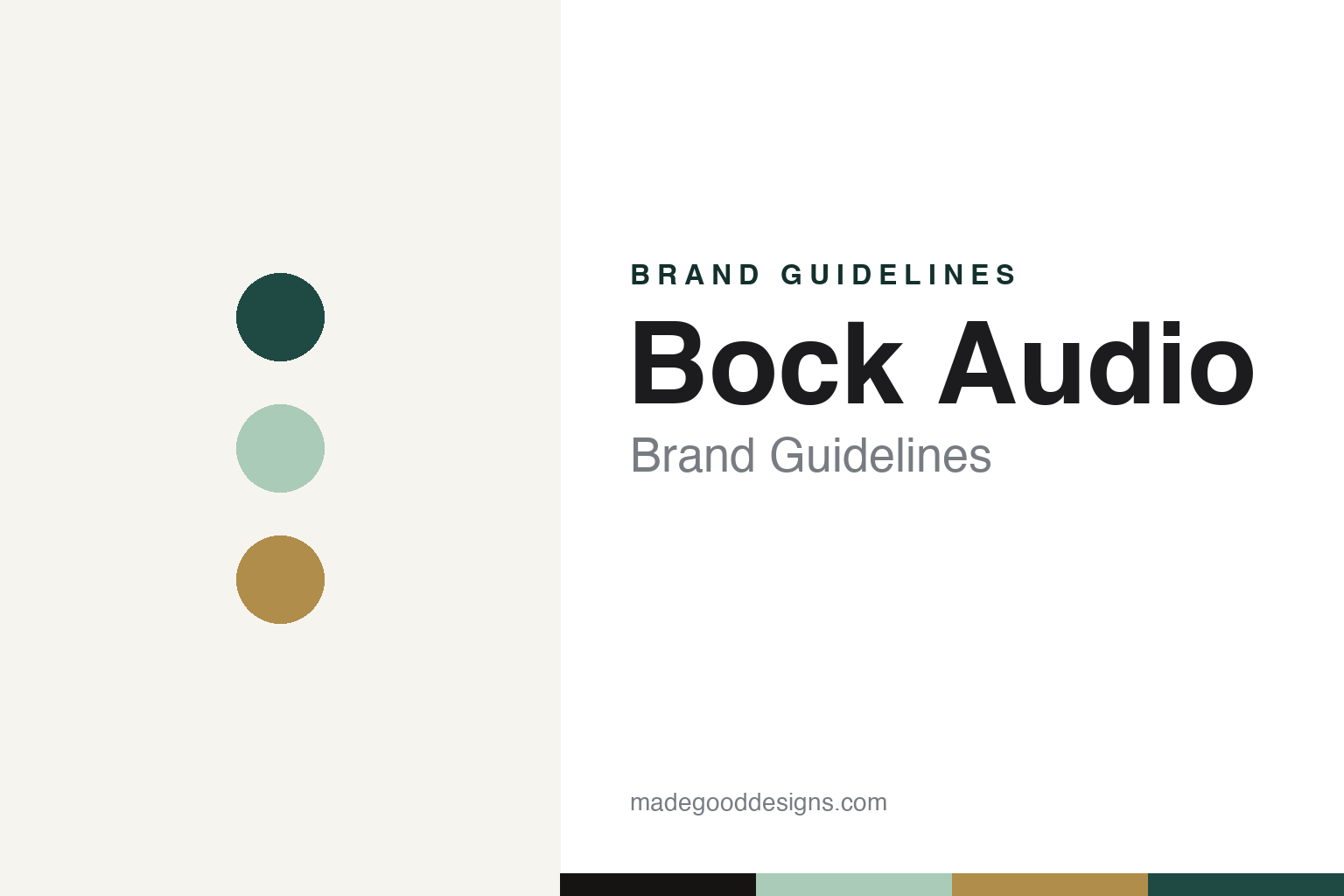
Two constants: a Bock Audio teal, surf green and brass palette and a condensed sans register. Abstract homage — not a Bock Audio or Universal Audio product or mark; no microphone, logo or nameplate is reproduced.
Soundelux
A studio technician who learned microphones by fixing them.
Bock Audio is the work of one man, David Bock, and its story begins in other people’s studios. Bock was chief technician at Hyde Street in San Francisco, the Hit Factory in New York and Ocean Way in Los Angeles, Tape Op reported in 2016; his own website placed that work in “the heyday of the 80s and 90s” and described it as maintaining, repairing and tweaking the vintage microphone collections that engineers used every day. Knowing “what made two great vintage mics sound different from each other,” the site said, proved invaluable when he came to design his own.
In the 1990s that knowledge turned into manufacturing. Soundelux Microphones grew out of Soundelux, the Hollywood post-production sound company. Tape Op dates it to 1995 and says Bock co-founded it “with one of the owners of Soundelux”; English Wikipedia’s article on the sound editor Wylie Stateman names Stateman and his partner Lon Bender as co-founders with Bock, in a passage that cites no source. Bock’s own website later gave Soundelux Microphones’ run as 1996 to 2006, so we note the difference. The site called the idea “new vintage microphone production”: it began with the U95 and grew to include the Soundelux 251, E47 and E49.
The microphones found an audience. Reviewing the e49 and e250 in its January/February 2005 issue, Tape Op wrote that in “ten short years” Bock had built a reputation as “a builder of some of the best sounding mics you can buy,” and judged the e49 a remake of a classic “at about half the price you would pay for an original M 49.” Soundelux itself changed hands in 2000, when Liberty Media bought it; Wikipedia says the microphone business was part of that sale. In 2006, Tape Op later reported, Bock “parted ways with Soundelux, taking all of his work with him”; in 2018 the magazine described the original Soundelux Microphones company as having since been “shut down.”
Colour
Built five or ten at a time, the company says.
Bock says he formed Bock Audio in 2007 “to carry on his personal designs developed over the past ten years.” Its first website, archived in 2009 under the name Bock Audio Designs, described “a Southern California company hand building high end custom microphones for the recording industry,” sold to dealers through TransAudio Group, whose founder Brad Lunde, it said, had recognised Bock’s ability “to engineer to a ‘sound.’” The pitch was blunt: “Many modern mic makers just build a mic and then try to sell its sound. David Bock finds out what sound people want, then builds a mic to sound that way.”
The range stayed small. The 2009 site listed the 195, 151, 251 and 5-ZERO-7; by 2011 the 241 had replaced the 151, and an iFET followed. Several descended from Soundelux designs. Tape Op, reviewing the IFET in 2016, called it an updated “reissue” of the Soundelux ifet7, first released in 2002, with a more reliable switch and an aluminium base in place of brass, and noted that Bock Audio would service the older Soundelux mics. Bock also revived the old name: by 2018 a Soundelux USA U99 multi-pattern valve microphone was on sale, and Tape Op reviewer Thom Monahan, who had bought an original Soundelux U99 in 2001, called the new one “a lot of microphone for the price.” Bock’s website said Soundelux USA mics were built “in the same facility by the same people who build Bock microphones.”
The company described its methods in detail, and these are its own claims. Its site said the mics were built by hand “5 or 10 at a time”; that inside were all-brass, hand-tensioned capsules with 6-micron diaphragms, “multisectioned Bock design transformers” and inductor-based power supplies; that the 251 used a “proprietary hand-made German capsule” and a new-old-stock 6201 valve; and that its “owner is in his lab every day, touching every microphone.” “No shareholders or committees here,” it added. Bock Audio also offered repairs to classic condensers, listing the U47, M49, U67, ELA M 251, C12 and C24 among the models it serviced.
Typography
Valves, ribbons and new owners.
This round turns to six more microphone makers: boutique valve and ribbon designers in California, a British maker on the Dorset coast, and a brand made in Russia.
Four are in California. AEA is in Pasadena and says its microphones are “handcrafted” there. Mojave Audio, which says it was co-founded in 2005 by the producer Dusty Wakeman and the designer David Royer, calls itself “family-owned” and based in Los Angeles. Josephson Engineering says it began in San Jose in 1988, moved to Santa Cruz in 2000, and designs and makes all its products there. Bock Audio, which David Bock says he formed in 2007 after co-founding Soundelux Microphones, designs the valve and FET microphones that Universal Audio has sold since 2022, which UA says it hand-builds at its Santa Cruz custom shop.
Sontronics is in Poole, Dorset, and its website names Omnisonic International Ltd. Soyuz is in Tula, Russia; English Wikipedia, citing Reuters, says it was founded in 2013 by the American singer David Arthur Brown and the Russian entrepreneur Pavel Bazdyrev.
This guide sets out what can be checked about each brand — who founded it, who owns it, and what it says about where its products are made — and marks clearly what rests only on the company’s own word.
Aa
A condensed sans — the narrow, technical register of a microphone spec sheet. (Specimen set in Barlow Semi Condensed, a sans STAND-IN; NOT the Bock Audio or Universal Audio logo.)
Bock Audio
From a small workshop to Universal Audio’s Custom Shop.
The biggest change came through Universal Audio, the Scotts Valley, California company that Bill Putnam Jr. and Jim Putnam refounded in 1999, according to English Wikipedia. The US retailer Vintage King says UA “enlisted David Bock of Bock Audio” in 2020 to design a line of tube and FET condensers. In February 2022 UA’s website promised “UA Bock Series Microphones Coming Fall 2022,” and by November 2022 it listed three: the UA Bock 251, a flagship valve mic modelled on the ELA M 251, with a German-made CK12 capsule and a Cinemag transformer; the UA Bock 167, after the U67; and the FET UA Bock 187, after the U87. UA says each is “handmade in Santa Cruz, California, to the exacting specifications” of David Bock, at its Custom Shop. Tape Op reviewed the 251 in 2024, calling it “an insanely good vocal mic” and describing its “light surf green gloss automotive finish.”
What that arrangement means for Bock Audio as a company is less clear. We found no published report that UA bought Bock Audio, and UA’s pages present the mics as David Bock designs rather than as an acquisition. What the web archive does show is that Bock Audio’s own website, last captured working in late 2022 and early 2023, was redirecting visitors to UA’s microphone pages from November 2023 until at least September 2026. In October 2026 the old bockaudio.com address led instead to an unrelated gambling site, so we do not link to it, and we do not read it as evidence about the business.
For a design guide, Bock Audio shows how one engineer’s name can travel — from Soundelux, to his own small workshop, to a product line made by a much larger company. Compare Neumann, whose U47, U67 and U87 lie behind so many of these designs, and Warm Audio, another American maker of vintage-inspired microphones. For this guide we use a deep teal, surf green and brass with a condensed sans, an unofficial interpretation; no product or logo is reproduced.
Explore & save
Keep Bock Audio’s identity on hand — save it to a board in the Made Good inspiration library.
Bock Audio identity set
Pin the Bock Audio teal, surf green and brass palette and the condensed sans register to your own board.