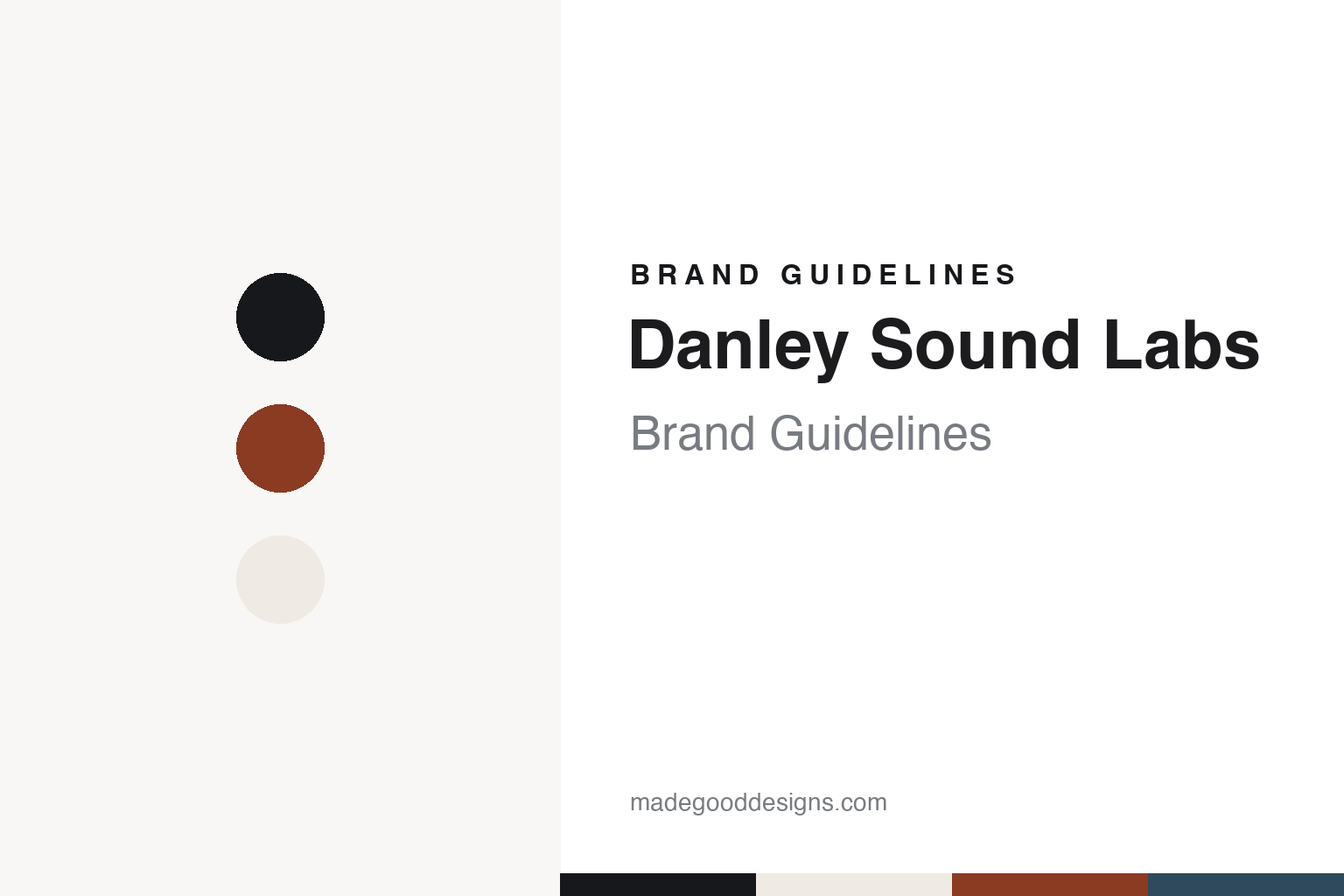
Danley Sound Labs Brand Guidelines
Tom Danley’s horn-loaded speakers from Gainesville, Georgia.
Aa
Two constants: a Danley black, clay and steel palette and an American gothic sans register. Abstract homage — not a Danley Sound Labs product or mark; no loudspeaker, logo or nameplate is reproduced.
From rockets to horns
An inventor from NASA work and a church-sound integrator.
Danley Sound Labs was founded in 2005 in Gainesville, Georgia, north-east of Atlanta, by the inventor Tom Danley and the entrepreneur Mike Hedden, according to the company and to English Wikipedia. Hedden had owned dB Audio & Video, a sound contractor that, English Wikipedia says, was the largest distributor of loudspeakers from Danley’s previous company. Its website now marks “20 Years of Innovation,” and the company still describes itself as “led by co-founders Tom Danley and Mike Hedden”: its team page lists Hedden as president and chief executive, with the title “Chief Steward in Charge,” and Danley as director of research and development.
Tom Danley came to loudspeakers from aerospace. ProSoundWeb’s 2011 profile says he worked for the NASA hardware contractor Intersonics from 1979 to 1996, building equipment for sounding rockets, zero-gravity flights and the space shuttle programme, and was awarded 17 patents there, among them the Servodrive subwoofer and acoustic levitation devices. English Wikipedia, citing Sound & Video Contractor, says Servodrive’s BassTech 7 subwoofer was used by Clair Brothers on the North American legs of the Jacksons’ Victory tour and U2’s Unforgettable Fire tour in 1984.
When Intersonics closed its audio division, Danley and a partner formed Sound Physics Labs, which bought Servodrive. There he designed the SPL-td1, a horn with several drivers feeding one mouth, and in 2001 began the “Unity” horn later licensed to Yorkville Sound, English Wikipedia says. ProSoundWeb noted in 2011 that although the company was based in Gainesville, Danley did most of his work from the northern Illinois suburb where he grew up; English Wikipedia says he moved to Georgia in 2015.
Colour
Synergy Horns, Tapped Horns and a subwoofer in a container.
Danley’s products are built on a handful of named, patented ideas. The Synergy Horn combines drivers for different frequency ranges in one horn so they behave as a single point source; the first product, the SH100, was meant for churches of about 300 seats, the company says. The Tapped Horn subwoofer uses both sides of a driver inside a folded horn. The SH50, launched in November 2005, used both ideas. Later came the Shaded Amplitude Lens, patented in 2009, and Paraline, filed in 2011. In June 2026 the company launched Exodus, a modular system using what it calls its patent-pending Cohearix lens, in an installation series and a larger stadium series.
Its best-known stunt was the Matterhorn. TV Technology reported in March 2007 that the subwoofer, shown at the NSCA trade show, was built into an eight-by-eight-by-twenty-foot shipping container with its own generator, used 40 drivers and reached 12 Hz at minus 3 dB. English Wikipedia says it was designed to meet a military specification; the company calls it the “World’s Biggest Subwoofer.”
The Jericho Horn of 2010 took the horn approach to stadiums. In 2019 the company said a Jericho J3-94 could deliver “148dB of continuous” output at Louisiana State University’s Tiger Stadium. At Glastonbury in 2017, Audio Media International reported, Manchester’s Neuron Pro Audio used Jericho Horns, Pure Groove by Danley horns and 22 TH-118 subwoofers on the festival’s Temple stage.
Typography
Touring PA makers in context.
The makers in this guide share a market — loudspeakers for concerts, clubs and large venues — but not a pattern of ownership.
In the United States, EAW, founded in 1978 by Kenneth Berger and Kenton Forsythe, is headquartered in Franklin, Massachusetts. It was sold to Mackie Designs in 2000 and bought by Italy’s RCF group in 2018, which, EAW says, re-established it as an independently operated company. Danley Sound Labs, which says it was founded in 2005 by Tom Danley and Mike Hedden, is based in Gainesville, Georgia. Clair Global, begun by the brothers Roy and Gene Clair in 1966, is still headquartered in Lititz, Pennsylvania, and privately held, according to English Wikipedia.
In Europe, Turbosound traces its story to Tony Andrews’ festival sound systems of the early 1970s and became Turbosound Ltd in 1978, its website says; English Wikipedia reports that it was bought in 2012 by Music Group, now Music Tribe, Uli Behringer’s holding company in Makati, Metro Manila. Coda Audio is based in Hannover, Germany, and says it makes its drivers and cabinets in its own European factory.
VUE Audiotechnik, launched in San Diego in 2012 by EAW co-founder Ken Berger and Jim Sides, says it was acquired in 2024 by its long-standing Chinese distributor, C-VUE (Shanghai) Audio Technology, and closed its US office at the end of that year. Pioneer Pro Audio, launched by Pioneer in 2013, now belongs to AlphaTheta of Yokohama, a subsidiary of Japan’s Noritsu Koki.
This guide sets out what can be checked about each brand — who founded it, who owns it, and what it says about where its products are made — and marks clearly what rests only on the company’s own word.
Aa
An American gothic sans for an engineering-led maker. (Specimen set in Libre Franklin, a sans STAND-IN; NOT the Danley Sound Labs logo.)
Danley Sound Labs
Built in the USA, run by its founders.
Danley makes a point of building at home. A 2017 company release said that “like all Danley loudspeakers and subwoofers,” its GO-2-8CX speakers “are built in Georgia and North Carolina,” and a 2019 release said its SH and TH series are “each built in the USA.” The release concerned the USS Constitution, which the company calls the oldest active vessel in the US Navy: during its restoration the installer Audio Associates fitted nine GO-2-8CX speakers, chosen, the company says, because the ship’s old speaker model was no longer made in the United States. Its staff list includes production and crossover team leaders, but we have not seen an outside account of its factories.
The company remains in its founders’ hands as far as we can tell. We found no sale or outside owner in the sources we checked. Its 2021 “strategic alignment” with the German electronics maker Dynacord, then part of the Bosch Group, is a product partnership: Danley loudspeakers are powered and tuned by Dynacord amplifiers and processing, and Danley settings are built into Dynacord amplifiers. In 2026 the distributor HWPco became its sales representative in six south-eastern states.
Danley is open about its faith. Its stated vision begins “We will glorify God,” and it says a portion of the profit from each purchase goes to Water Mission, a Christian water charity. Houses of worship were its first market, the company says, before it moved into stadiums, arenas, theme parks, clubs and cinemas. In 2019 AVIXA, the audiovisual trade association, gave Tom Danley its Adele De Berri Pioneers of AV Award at InfoComm in Orlando, according to the company and English Wikipedia.
For a design guide, Danley Sound Labs shows how a founder’s inventions can become a brand vocabulary, with technologies named like products — Synergy, Tapped, Jericho — and a plain, engineering-led presentation. Compare Electro-Voice, Dynacord’s long-time sister brand, now with it under Keenfinity Group, and Funktion-One, another horn-loaded maker. For this guide we use black, a clay red and a steel blue with a sans, an unofficial interpretation; no product or logo is reproduced.
Explore & save
Keep Danley Sound Labs’s identity on hand — save it to a board in the Made Good inspiration library.
Danley Sound Labs identity set
Pin the Danley black, clay and steel palette and the American gothic sans register to your own board.