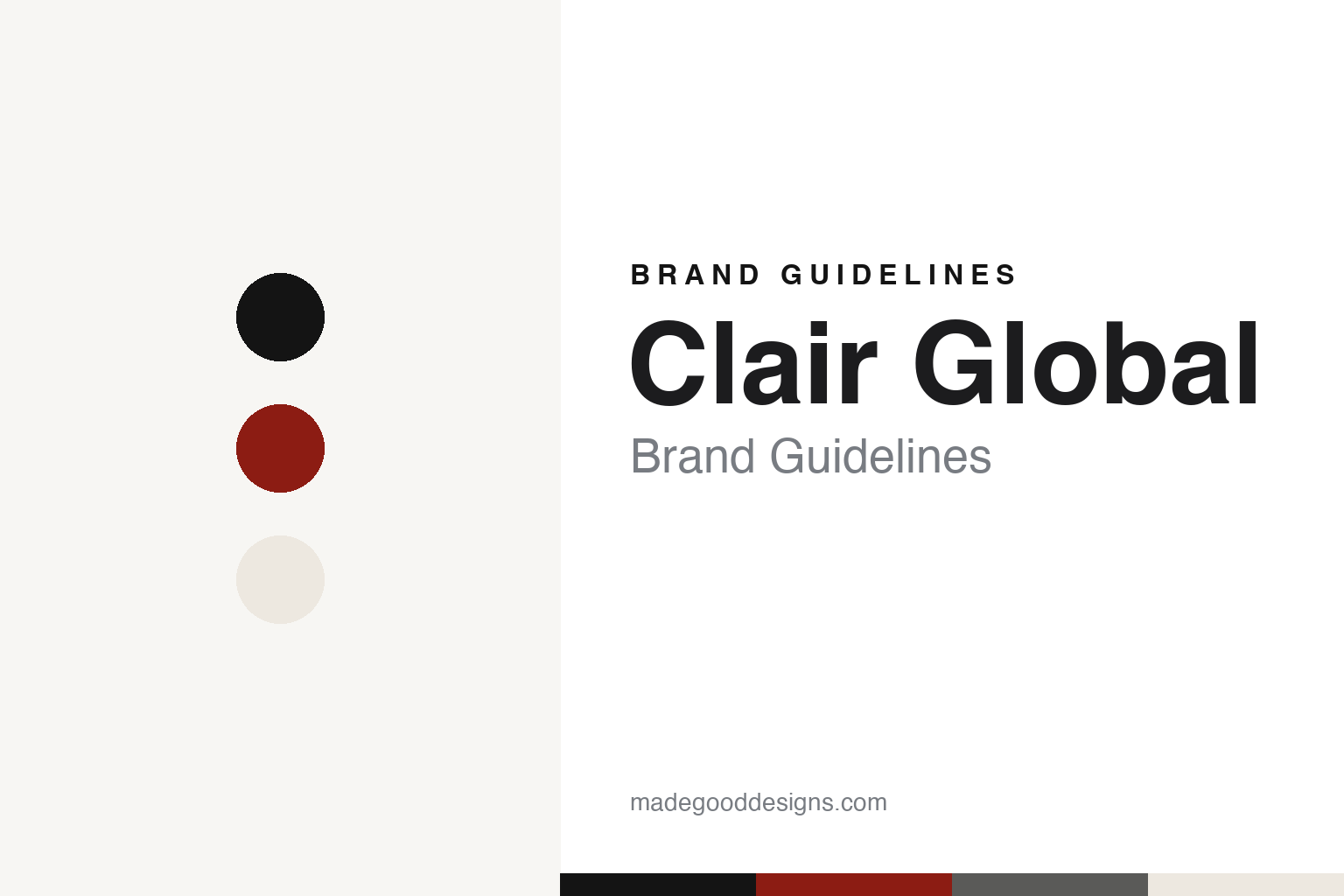
Clair Global Brand Guidelines
The Lititz brothers who took their own PA on tour.
Aa
Two constants: a Clair road-case black and brick red palette and an Industrial sans register. Abstract homage — not a Clair Global or Cohesion product or mark; no loudspeaker, logo or nameplate is reproduced.
The Clair brothers
A grocery family’s rented PA.
Clair began in Lititz, a small town in Lancaster County, Pennsylvania. English Wikipedia, drawing on trade-press profiles of the founders, says the brothers Roy and Gene Clair grew up there, where their parents owned a grocery store, and that their father bought them a small public-address system in 1955: a horn loudspeaker, a Stromberg-Carlson preamplifier, a 35-watt amplifier and a microphone. They rented it to bands, schools and churches and spent the money on more equipment. Their first business, Clair Reconing, repaired loudspeakers, which Wikipedia says taught them how much efficiency depends on design.
The break came in 1966. In the early 1960s Gene worked as a technician at Franklin & Marshall College in nearby Lancaster, and the brothers supplied sound for a concert there by Frankie Valli and the Four Seasons. The next night’s show in Allentown sounded poor, the band called the Clairs back, and the tour manager asked them to join the rest of the tour with their system, for $90 a show, Wikipedia says. It adds that “it is believed they were the first professional sound company to tour with a band”; the company itself is more modest, describing the brothers as launching “one of the first touring sound companies.” We use the company’s wording. In 1970 the business was incorporated as Clair Bros. Audio Enterprises, Inc.
Colour
From the S4 to Cohesion.
Clair built its own loudspeakers almost from the beginning. By 1968, Wikipedia says, its main system used custom dual-15-inch bass horns built in-house with Altec drivers; in 1970 it switched to JBL components. In 1974 came the S4, a single four-way cabinet weighing 425 pounds, 45 inches square so that two fitted side by side in a truck, with rigging built in to hang from an arena roof. Sources differ on the first hung system: Wikipedia credits Clair with the first hanging system for indoor arenas in 1972, while Clair’s Cohesion history says a hanging S4 system debuted on a Rolling Stones tour in 1975. Wikipedia also credits Clair with the first stage monitor, in 1970, and a 32-channel console, built in 1977 with Bruce Jackson of the Australian company JANDS.
The line continued, the company says, with the S4 Series II and the compact R-4 and P-4; the 12AM stage monitor at the end of the 1980s; and, in the 1990s, the i-Series line arrays, the i4, i3, i5 and iDL. Its current loudspeakers carry the name Cohesion. The first, the CO8, began as the iMicro in 2012, followed by the CO12, first deployed in 2015, and the CO10 in 2018. For a decade they were a private brand, available only through Clair’s rental business. On 15 November 2023 Clair announced that Cohesion would become a full product-development and manufacturing business, selling to selected installations as well. The release said the products are “designed and assembled at its headquarters in Lititz, Pennsylvania,” and claimed Cohesion was used by more than half of Pollstar’s top 50 grossing artists in 2022; both are the company’s statements.
The range has grown since: the CF Series point-source speakers, completed in August 2024, and Canvas, a simulation program for designing Cohesion systems, launched in July 2026. In March 2025 Cohesion said the CF Series had received a Good Design Award from The Chicago Athenaeum, and credited the visual work to Loft Design of Providence, Rhode Island, which had also shaped the look of the CO Series launch in 2023.
Typography
Touring sound and its makers.
The makers in this guide share a market — loudspeakers for concerts, clubs and large venues — but not a pattern of ownership.
In the United States, EAW, founded in 1978 by Kenneth Berger and Kenton Forsythe, is headquartered in Franklin, Massachusetts. It was sold to Mackie Designs in 2000 and bought by Italy’s RCF group in 2018, which, EAW says, re-established it as an independently operated company. Danley Sound Labs, which says it was founded in 2005 by Tom Danley and Mike Hedden, is based in Gainesville, Georgia. Clair Global, begun by the brothers Roy and Gene Clair in 1966, is still headquartered in Lititz, Pennsylvania, and privately held, according to English Wikipedia.
In Europe, Turbosound traces its story to Tony Andrews’ festival sound systems of the early 1970s and became Turbosound Ltd in 1978, its website says; English Wikipedia reports that it was bought in 2012 by Music Group, now Music Tribe, Uli Behringer’s holding company in Makati, Metro Manila. Coda Audio is based in Hannover, Germany, and says it makes its drivers and cabinets in its own European factory.
VUE Audiotechnik, launched in San Diego in 2012 by EAW co-founder Ken Berger and Jim Sides, says it was acquired in 2024 by its long-standing Chinese distributor, C-VUE (Shanghai) Audio Technology, and closed its US office at the end of that year. Pioneer Pro Audio, launched by Pioneer in 2013, now belongs to AlphaTheta of Yokohama, a subsidiary of Japan’s Noritsu Koki.
This guide sets out what can be checked about each brand — who founded it, who owns it, and what it says about where its products are made — and marks clearly what rests only on the company’s own word.
Aa
An industrial sans for a road-case company. (Specimen set in Archivo, a sans STAND-IN; NOT the Clair Global or Cohesion logo.)
Clair Global
A family business that keeps buying.
Clair has stayed in the family. In 1995, Wikipedia says, Gene Clair sold his share of the business to his son Troy Clair, who is named as president and chief executive in the company’s releases from 2017 to 2025, and as its owner in 2020. In October 2000 Clair bought Showco, its direct competitor,, and traded as ClairShowco. The name changed again to Clair Global, though sources differ on when: Wikipedia gives 2008, it cites a Pro Sound News report headlined “ClairShowco Rebranded As Clair” from 2011, and the company’s own timeline places the change in the 2000s. In 2022, announcing the purchase of Berlin’s Black Box Music, the company quoted Black Box Music’s founder, Thilo Goos, describing Clair as “a family business, not controlled by investors.”
Its own releases trace a run of acquisitions: the British firm Britannia Row Productions in 2017, Eighth Day Sound of Cleveland in 2020, ATK Audiotek in 2021, Black Box Music, now BBM Clair, in 2022, Sound Image in 2023, LD Systems of Houston in January 2025, the Dutch Ampco Flashlight Group in April 2025 and Clearwing of Milwaukee in August 2025. In 2014, with the stage builder Tait Towers, it opened Rock Lititz, a rehearsal campus in its home town. One name to keep apart: Clair Companies, the installation business that grew out of Clair and moved to nearby Manheim in 2009, is now a separate company, Wikipedia says.
For a design guide, Clair Global shows a brand built by service rather than by selling boxes, which turned its own loudspeakers into a product line only after half a century. Compare JBL, whose components went into the early S4, and VUE Audiotechnik, whose engineering chief came from Sound Image, now part of Clair. For this guide we use road-case black and a brick red with a sans, an unofficial interpretation; no product or logo is reproduced.
Explore & save
Keep Clair Global’s identity on hand — save it to a board in the Made Good inspiration library.
Clair Global identity set
Pin the Clair road-case black and brick red palette and the Industrial sans register to your own board.