CAD Audio Brand Guidelines
The Ohio microphone maker hidden in three letters.
Aa
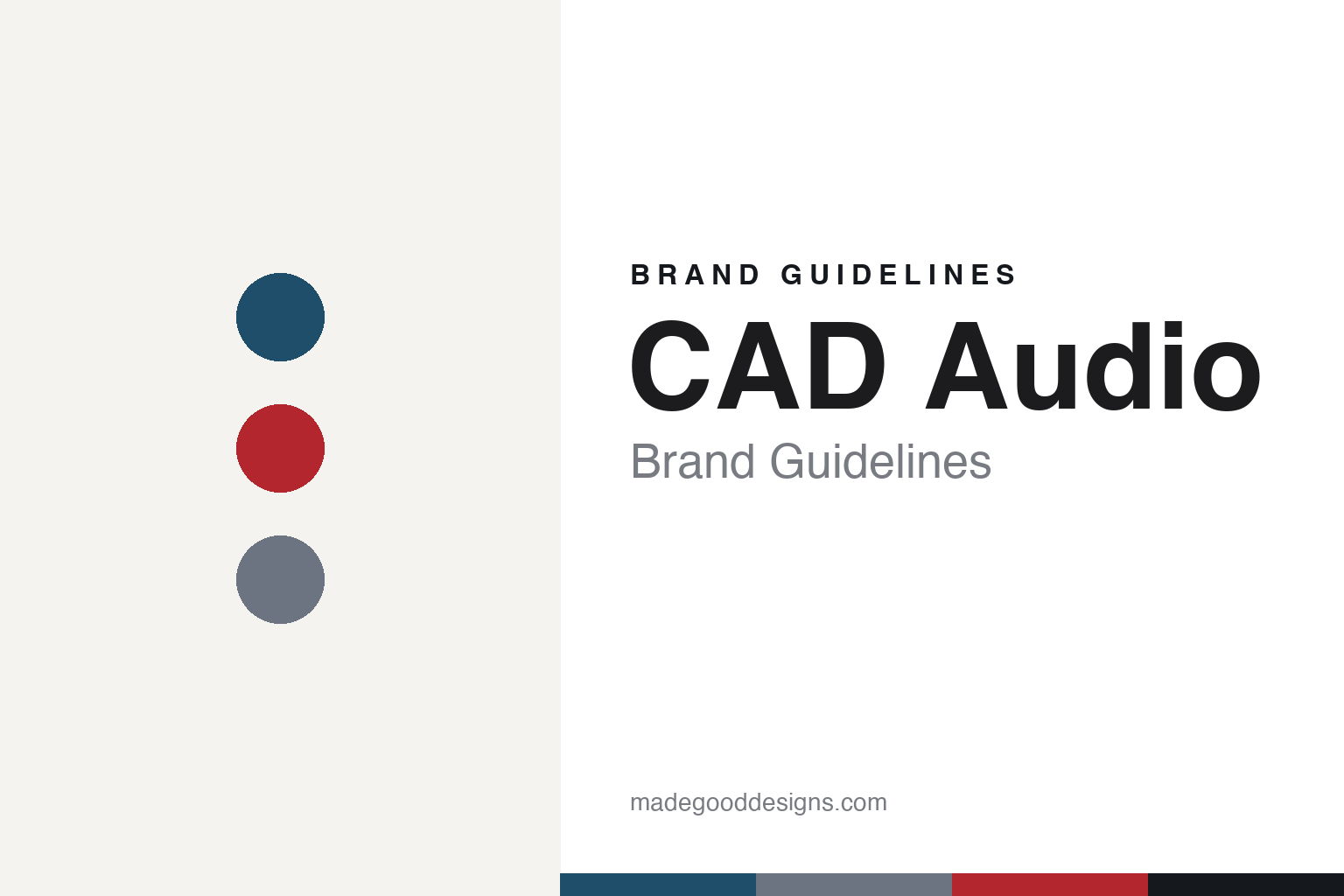
Two constants: a CAD Audio lake blue, steel and red palette and a Utilitarian sans register. Abstract homage — not a CAD Audio product or mark; no microphone, logo or nameplate is reproduced.
Astatic
Two radio amateurs and a static-free microphone.
CAD Audio’s story begins with another company. In 1930, English Wikipedia says, two amateur radio operators in Youngstown, Ohio, Creed M. Chorpening and F.H. Woodworth, began experimenting with microphones for their stations. A friend, Charles Semple of the Brush Development Company, showed them crystal pickups made with Rochelle salt, and the pair set up The Astatic Microphone Laboratory, with Semple as general manager. The company’s own history explains the name: the founders wanted a microphone free of static for their transmitters — hence “Astatic.”
Sources give two founding dates, and both can be traced. CAD’s website has said the business “took shape” in 1931 and incorporated in 1933; English Wikipedia, citing an archived Astatic history, dates the laboratory’s founding to 1933, although its infobox says 1931. Sound On Sound used 1931 in 2011.
Astatic’s first important product was the D-104 crystal microphone, introduced in 1933 and made in variations until 2001, according to English Wikipedia; radio amateurs and CB enthusiasts still use it. In late 1939 came the JT-30, a bullet-shaped microphone that became a favourite of blues harmonica players — Little Walter, James Cotton and Junior Wells among them, English Wikipedia says, citing harmonica handbooks. Hohner bought the moulds in 1999, and the last JT-30 derivatives were discontinued in 2013, after 74 years.
In early 1944 Astatic moved to Conneaut, in Ohio’s north-east corner on Lake Erie, and during the Second World War supplied microphones, pickups, crystal cartridges, hydrophones and sonar devices to the military, English Wikipedia says; the company’s own history adds a static-discharger for Army and Navy aircraft. After the war the laboratory became The Astatic Corporation.
Colour
A pro-audio division named for its town.
The CAD name comes from that town. Sound On Sound called the company “the Ohio manufacturer otherwise known as Conneaut Audio Devices” in 2000, and in 2011 gave its full name as Conneaut Audio Devices Professional Microphones, formed in 1988 as the pro-audio division of Astatic. CAD’s own history says the division was set up to design and manufacture microphones for recording and live sound, “segments not served by Astatic,” and that it began with a servo-circuit console and processing products before turning to studio microphones.
Those microphones were the Equitek series — the E100, E200 and E300 — which Sound On Sound dates to the early 1990s and which CAD says “literally defined the project studio revolution”; we give the second as the company’s claim. The magazine reviewed the original E100 in June 1997, and its later reviews trace the range: the VSM1 valve microphone in 1999; the VX2, a dual-valve flagship, in 2000; the M9 valve microphone in 2002; and the budget GXL series in 2006.
The company was reorganised as Omnitronics LLC in 2000, English Wikipedia says, and later combined CAD, Astatic and Omnitronics under the single brand CAD Audio, with Astatic surviving as a range of commercial microphones — hanging, gooseneck and boundary models for restaurants, airports, churches, schools and boardrooms, the company says. The Astatic CB-radio line went another way: it was sold to Barjan in 2006 and to DAS Companies, a distributor to truck stops, in 2012, which put the Astatic name on cables, meters and antennas, according to English Wikipedia.
Typography
American microphone makers.
The United States has microphone makers at every price. At one end are small workshops that build by hand or recreate classic studio designs; at the other are brands selling inexpensive microphones to home studios and podcasters. The seven makers here cover that range, spread across the country.
Two are small workshops in the West and South. Ear Trumpet Labs says it was founded in Portland, Oregon, by Philip Graham, a former software engineer, and that its microphones are handbuilt in Oregon. Wunder Audio says its showroom, the Wunderbar Room, is in Austin, Texas.
Two revive vintage designs in the East. Peluso Microphone Lab says John Peluso founded it in 2002 after decades of repairing vintage microphones, and calls FloydFest, held near Floyd, Virginia, its local festival. Telefunken Elektroakustik, founded in 2001, says it assembles its microphones in South Windsor, Connecticut, under the name of the German radio company Telefunken.
Three are larger brands. CAD Audio grew out of Astatic, the Ohio microphone maker founded in the 1930s, which formed CAD as a division in 1988, according to English Wikipedia; its website now gives an address in Berlin, Connecticut, and names JAM Industries USA in its footer. MXL is a brand of Marshall Electronics, which gives its headquarters as Torrance, California. Samson, with a mailing address in Hicksville, New York, says it began with wireless systems in 1980.
This guide sets out what can be checked about each brand — who founded it, who owns it, and what it says about where its products are made — and marks clearly what rests only on the company’s own word.
Aa
A utilitarian, radio-era sans. (Specimen set in Archivo, a sans STAND-IN; NOT the CAD Audio logo.)
CAD Audio
From Ohio to Connecticut.
Where CAD microphones are made has changed over the years, and the record is patchy. In 2000 Sound On Sound described capsules “manufactured and damped by hand at the company’s clean-room facility in their Ohio factory.” In 2006 it called the GXL range “Chinese-built,” and in 2011 it reported that production of the Equitek E100 had moved to China in 2003, while the redesigned E100S was “engineered and built entirely in the USA.” The website says CAD “designs and manufactures” microphones; we found no current statement of where today’s models are made, so we do not give one.
Ownership is also less clear than it looks. For years CAD gave its address as Solon, Ohio, a Cleveland suburb, and its press releases as late as 2022 were datelined Cleveland. Archived versions of its website show the Solon address until September 2025 and an address in Berlin, Connecticut, from October 2025; since mid-2026 the site’s footer has read “CAD Audio – JAM Industries USA.” JAM Industries, based in Baie-D’Urfé, Quebec, works across musical instruments, pro audio and consumer electronics, its website says. Its American Music & Sound business, whose site carries the same footer, was already listed as CAD’s worldwide distributor in a 2018 capture, and English Wikipedia lists Jam Industries as an owner. We found no announcement of a sale, so we do not say when, or on what terms, control changed.
The range today runs from Equitek and GXL condensers and CAD Live dynamic microphones to USB microphones, PodMaster broadcast models, Sessions headphones, wireless systems and Astatic commercial products, with list prices that keep it at the affordable end of the market.
For a design guide, CAD Audio shows how a heritage can be carried by an acronym: the town is hidden in three letters, and the older Astatic name lives on as a product line. Compare Shure, another American microphone maker founded in the radio era, and Audio-Technica, which, like Astatic, began with phono cartridges. For this guide we use lake blue, steel and a signal red with a sans, an unofficial interpretation; no product or logo is reproduced.
Explore & save
Keep CAD Audio’s identity on hand — save it to a board in the Made Good inspiration library.
CAD Audio identity set
Pin the CAD Audio lake blue, steel and red palette and the Utilitarian sans register to your own board.