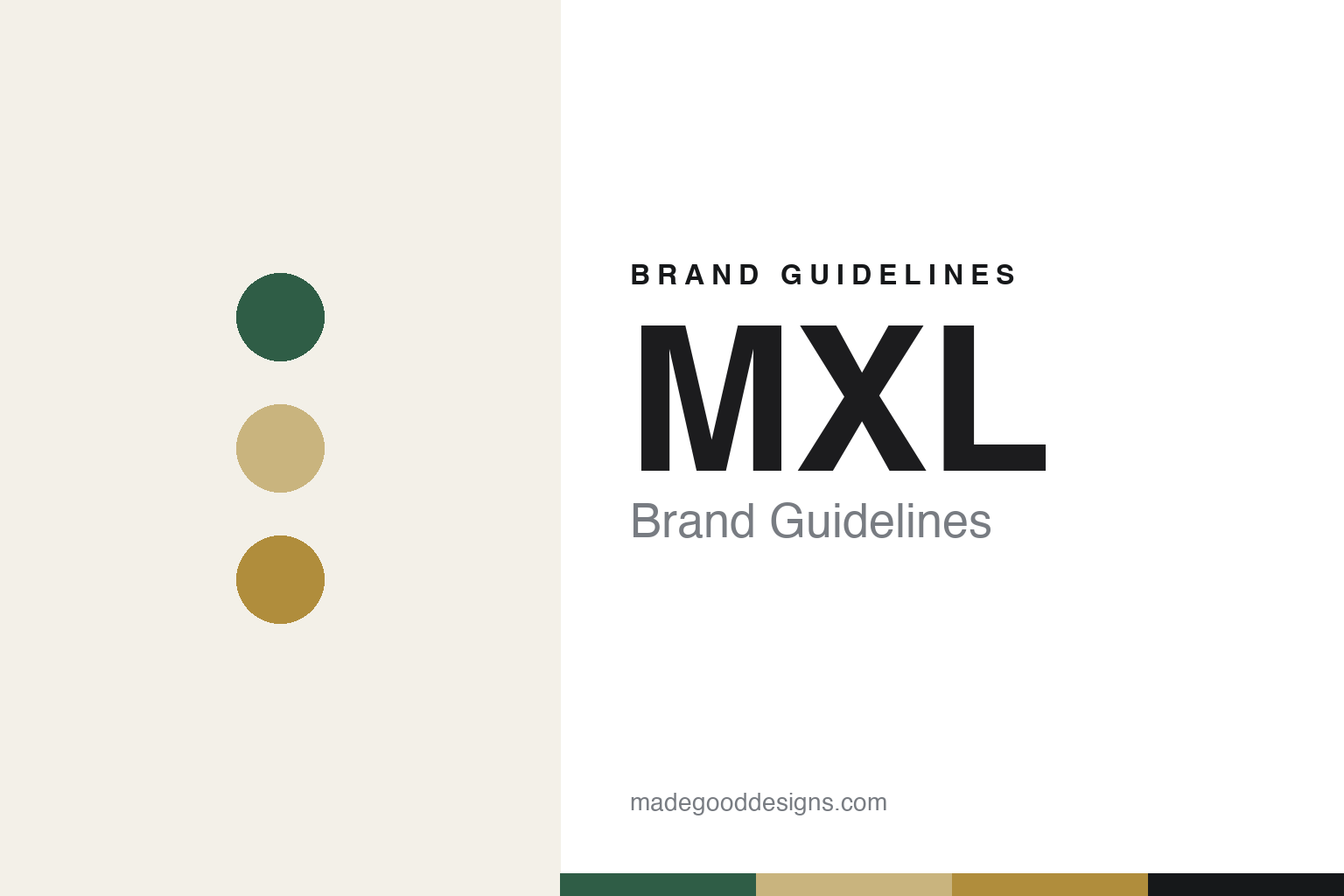
MXL Brand Guidelines
The California brand that made studio condensers affordable — and green and gold.
Aa
Two constants: an MXL green, champagne and gold palette and a Geometric sans register. Abstract homage — not an MXL product or mark; no microphone, logo or nameplate is reproduced.
Marshall Electronics
A video and optics company that took up microphones.
MXL is a brand, not a stand-alone company. It belongs to Marshall Electronics, a privately owned American firm whose website describes four operating units — Marshall Broadcast & AV, Marshall Optical Systems, MXL Microphones and Mogami Cable & Connectors — and which also sells TAJIMI connectors. Marshall says it has been in business “for over 40 years”; an archived version of the MXL website from 2009 said “almost 30 years,” which points to a start around 1980, although we found no exact founding date.
The parent’s other businesses explain much about MXL. Marshall makes LCD monitors and compact cameras for broadcast and AV, supplies miniature lenses to automotive and industrial customers, and runs Mogami Cable, the brand it calls “The Cable of the Pros,” as one of its own operating units. Sound On Sound put the link simply in 2011: MXL microphones “are produced by the same company that markets Mogami cables,” and the magazine’s reviewers have noted the Mogami leads packed with MXL’s valve microphones.
The obvious trap is the name. Marshall Electronics has no connection with the British amplifier maker Marshall, as Sound On Sound pointed out in its first MXL review, in 2000. When the 2009 website was written the company was based in El Segundo, near Los Angeles International Airport, where it said its headquarters, research centre and production operations stood; it now gives its headquarters as Torrance, in the South Bay area of Los Angeles County.
Colour
Condenser microphones at home-studio prices.
MXL’s own account starts with one microphone. A page marking the brand’s 20th anniversary in 2014 said that in 1994 “the MXL 2001 microphone was developed by Marshall Electronics CEO Leonard Marshall” and “became the first MXL Microphone”; today’s website says Leonard Marshall, “an avid enthusiast of microphones, founded MXL in the 1990s.” Sound On Sound reviewed the 2001 in October 2000 — a large-diaphragm cardioid condenser with a one-inch gold-sputtered diaphragm and a shockmount included in the price — and placed it in “the flood of budget capacitor mics from Chinese factories” that had driven studio microphone prices down.
The MXL 990 became the brand’s best-known model. In 2005 MXL’s website said the 990 “has changed the way project studio recordings are being created,” because “production breakthroughs” had brought a condenser microphone within reach of home recordists — a company claim, but one that sums up the brand’s pitch. The 990 had a 20mm gold-sputtered diaphragm and, the same page said, a champagne metal finish. The V67G made the look part of the offer: a green body with a gold-plated round grille, which MXL called a “distinctive vintage” design, quoting a studio owner who said it looked as if it cost around $2,500.
Valve microphones followed higher up the range. Sound On Sound reviewed the Genesis in July 2010 and the multi-pattern Revelation, MXL’s flagship, finished in dark violet with chrome, in September 2010; its reviewer wrote that it would be easy to dismiss MXL as “just another company building nice-looking ‘me too’ microphones in China,” but that he had been increasingly impressed by its build quality and sound. The magazine also reviewed the R144 ribbon microphone in 2011; the BCC1 and BCD1 broadcast microphones in 2013, whose styling it said paid homage to Electro-Voice’s RE20; and the Revelation II and Revelation Mini FET in 2021. For the 20th anniversary, MXL issued the Genesis, R144 and 2001 in pearl white with gold grilles.
Typography
American microphone makers.
The United States has microphone makers at every price. At one end are small workshops that build by hand or recreate classic studio designs; at the other are brands selling inexpensive microphones to home studios and podcasters. The seven makers here cover that range, spread across the country.
Two are small workshops in the West and South. Ear Trumpet Labs says it was founded in Portland, Oregon, by Philip Graham, a former software engineer, and that its microphones are handbuilt in Oregon. Wunder Audio says its showroom, the Wunderbar Room, is in Austin, Texas.
Two revive vintage designs in the East. Peluso Microphone Lab says John Peluso founded it in 2002 after decades of repairing vintage microphones, and calls FloydFest, held near Floyd, Virginia, its local festival. Telefunken Elektroakustik, founded in 2001, says it assembles its microphones in South Windsor, Connecticut, under the name of the German radio company Telefunken.
Three are larger brands. CAD Audio grew out of Astatic, the Ohio microphone maker founded in the 1930s, which formed CAD as a division in 1988, according to English Wikipedia; its website now gives an address in Berlin, Connecticut, and names JAM Industries USA in its footer. MXL is a brand of Marshall Electronics, which gives its headquarters as Torrance, California. Samson, with a mailing address in Hicksville, New York, says it began with wireless systems in 1980.
This guide sets out what can be checked about each brand — who founded it, who owns it, and what it says about where its products are made — and marks clearly what rests only on the company’s own word.
Aa
A clean geometric sans for a brand built on finishes. (Specimen set in Jost, a sans STAND-IN; NOT the MXL logo.)
MXL
Designed in California, fabricated in China.
Where MXL microphones are made is better documented than for many budget brands. MXL’s website says all its microphones “are designed, engineered, and tested” at its headquarters in Torrance; it does not say they are built there. Marshall says it “operates manufacturing facilities in the US, China, Japan, and Korea” — a list that, on the 2009 website, also included Russia. Independent reviewers have consistently described the microphones as made in China: Sound On Sound called the 2001 “orientally-produced” in 2000, found the Revelation’s internal construction “unmistakably Chinese” in 2010, and described the Revelation II in 2021 as “designed in the US and fabricated in China.”
The website also calls MXL “independently owned and operated,” which matches Marshall’s description of itself as privately owned; we found no record of the brand being sold. MXL now aims well beyond the studio — at live sound, broadcast, podcasting, video conferencing, houses of worship and court reporting, its parent says. It also reports recognition: MXL said its DX-2 microphone was nominated for a TEC Award for best recording microphone, presented at the NAMM show in January 2018, and that its Visual Podcast Station bundles won a NewBay Best of Show award at NAB 2018. Those are the company’s accounts, and we have not checked them with the award organisers.
For a design guide, MXL shows how a budget brand can make appearance part of the product — champagne, green and gold, pearl white and violet finishes in place of anonymous black. Compare Electro-Voice, whose RE20 inspired the look of MXL’s broadcast microphones, and Warm Audio, another American brand whose studio microphones take their cue from classic designs. For this guide we use a vintage green, a champagne gold and an ink with a sans, an unofficial interpretation; no product or logo is reproduced.
Explore & save
Keep MXL’s identity on hand — save it to a board in the Made Good inspiration library.
MXL identity set
Pin the MXL green, champagne and gold palette and the Geometric sans register to your own board.