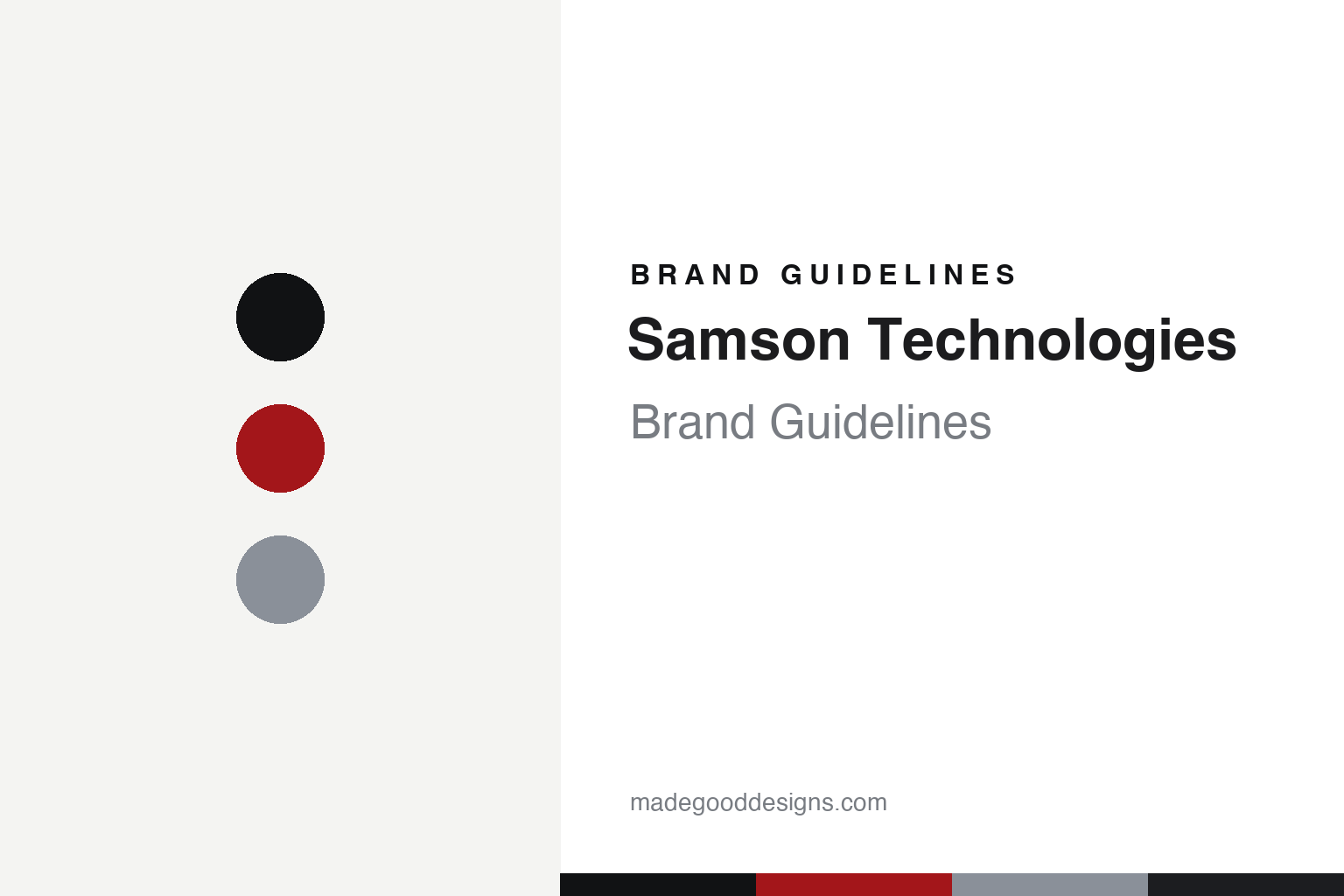
Samson Technologies Brand Guidelines
From 1980 wireless to the USB microphone.
Aa
Two constants: a Samson stage black, signal red and steel grey palette and a Utility sans register. Abstract homage — not a Samson Technologies product or mark; no microphone or logo is reproduced.
Wireless first
From a two-person start to 140 countries.
Samson Technologies is an American audio company that started with wireless microphones and became one of the best-known names in affordable recording gear. It began, it says, designing wireless systems in 1980, and has grown “from a small two-person operation” into a business whose products are sold in more than 140 countries. The company does not name its founders on its website, and we found no independent account that does, so we leave them unnamed rather than guess. Its base is on Long Island, New York: its website in 2000 gave a Syosset mailing address, and its contact page now lists Hicksville.
The first product, the company says, was the TR2 of 1980, a three-channel consumer wireless system in the 49 MHz band. The 1985 Broadcast Series added a rack-mounted receiver with ten selectable VHF channels, and the 1986 Concert TD brought true-diversity reception with two antennas, which the company says was a first. UHF systems followed in 1990, and Samson describes the 1992 UHF Synth, or Synth 5, as the first multichannel UHF wireless system. In 1993 it launched Samson Audio with the MPL2242, a 22-input mixer aimed at the new project-studio market, and spent the 1990s adding power amplifiers, mixers, wired microphones and signal processors. The 1999 AirLine system did away with the bodypack, and the 2000 Expedition range took the company into rechargeable portable PA.
Samson is now the parent name for three brands. The company lists Samson, the bass-amplifier brand Hartke and Michael Kelly Guitars, and all three websites carry the same copyright line.
Colour
The USB turn.
The product that defined Samson’s modern reputation arrived in 2005. The C01U was a large-diaphragm studio condenser microphone with a USB connection, letting it plug straight into a computer without an audio interface. Samson calls it “the world’s first studio condenser USB mic” and says it introduced “the first professional USB microphones.” Independent press was more cautious: reviewing the C01U in June 2006, Sound On Sound wrote that there were “only a couple of other USB-equipped condenser microphones,” adding that this “may well prove to be a growth area.” It did. Samson followed with the Q1U dynamic USB microphone in 2006, which it calls the first of its kind and which led to the Q2U; the Go Mic portable microphone in 2009; the G-Track Pro in 2019; and the Q9U broadcast dynamic, with USB and XLR outputs, in 2020. The company describes its USB microphones as “an industry standard for content creators.”
Wireless remained central. The company lists the Concert 288 dual-channel system of 2015, the Go Mic Mobile smartphone wireless system of 2017, the Concert XD2 in the 1.9 GHz band in 2023 and the AirLine Micro Pro in 2025, alongside MIDI controllers such as the Graphite 49 and the MXP mixers.
The two other brands have their own histories. Hartke says Larry Hartke and Ron Lorman began experimenting with aluminium-cone drivers in the late 1970s, released their first products in 1980 and, after Larry Hartke built an 8×10 cabinet for Jaco Pastorius in 1984, began mass-producing aluminium-cone bass cabinets in 1985. Hartke was already part of Samson’s range on its 2000 website. Michael Kelly, English Wikipedia says, was founded in 1999 by Tracy Hoeft in Clearwater, Florida, and imports instruments made to its specifications, mainly in South Korea; we did not find when it joined Samson.
Typography
American microphone makers.
The United States has microphone makers at every price. At one end are small workshops that build by hand or recreate classic studio designs; at the other are brands selling inexpensive microphones to home studios and podcasters. The seven makers here cover that range, spread across the country.
Two are small workshops in the West and South. Ear Trumpet Labs says it was founded in Portland, Oregon, by Philip Graham, a former software engineer, and that its microphones are handbuilt in Oregon. Wunder Audio says its showroom, the Wunderbar Room, is in Austin, Texas.
Two revive vintage designs in the East. Peluso Microphone Lab says John Peluso founded it in 2002 after decades of repairing vintage microphones, and calls FloydFest, held near Floyd, Virginia, its local festival. Telefunken Elektroakustik, founded in 2001, says it assembles its microphones in South Windsor, Connecticut, under the name of the German radio company Telefunken.
Three are larger brands. CAD Audio grew out of Astatic, the Ohio microphone maker founded in the 1930s, which formed CAD as a division in 1988, according to English Wikipedia; its website now gives an address in Berlin, Connecticut, and names JAM Industries USA in its footer. MXL is a brand of Marshall Electronics, which gives its headquarters as Torrance, California. Samson, with a mailing address in Hicksville, New York, says it began with wireless systems in 1980.
This guide sets out what can be checked about each brand — who founded it, who owns it, and what it says about where its products are made — and marks clearly what rests only on the company’s own word.
Aa
A utility sans — plain, sturdy, built for a stage rack. (Specimen set in Archivo, a sans STAND-IN; NOT the Samson logo.)
Samson Technologies
Distributor, then owner of brands.
The company’s own records show how its structure has shifted. Its website in 2000 named Samson Technologies Corp. and listed, alongside its wireless, audio and Hartke lines, the Japanese brand Zoom, which Samson then distributed in the United States. That arrangement belongs to the past: English Wikipedia says Zoom formed its own American distribution company, Zoom North America, in 2013 and made it a wholly owned subsidiary in 2020. Since about 2024 Samson’s websites have carried the name Samson Distribution LLC; we found no explanation of the change and do not speculate about it. In November 2024 the company named Branislav Zivkovic, who had joined in 2017 as vice president of global sales, as president, succeeding Jack Knight, who retired after 31 years. It called 2022 the most profitable year in its history, and in February 2026 it marked 45 years.
Samson does not say where its products are made on the pages we checked, and we found no independent source on its manufacturing, so we make no claim either way. Its three brands are kept visibly apart: each has its own website and look, and the Samson site greets bass players with a simple pointer, “Looking for Hartke? Visit hartke.com.” Only the shared copyright line reveals the single company behind them. We found no published brand guidelines and no official colours for any of the three.
For a design guide, Samson shows how a brand can be built on access — first affordable wireless, then the USB microphone — rather than on studio prestige. Compare RØDE, which rode the same creator wave, and Audio-Technica, another maker of USB and wireless microphones for a wide market. For this guide we use stage black, signal red and steel grey with a sans, an unofficial interpretation; no product or logo is reproduced.
Explore & save
Keep Samson Technologies’s identity on hand — save it to a board in the Made Good inspiration library.
Samson Technologies identity set
Pin the Samson stage black, signal red and steel grey palette and the Utility sans register to your own board.