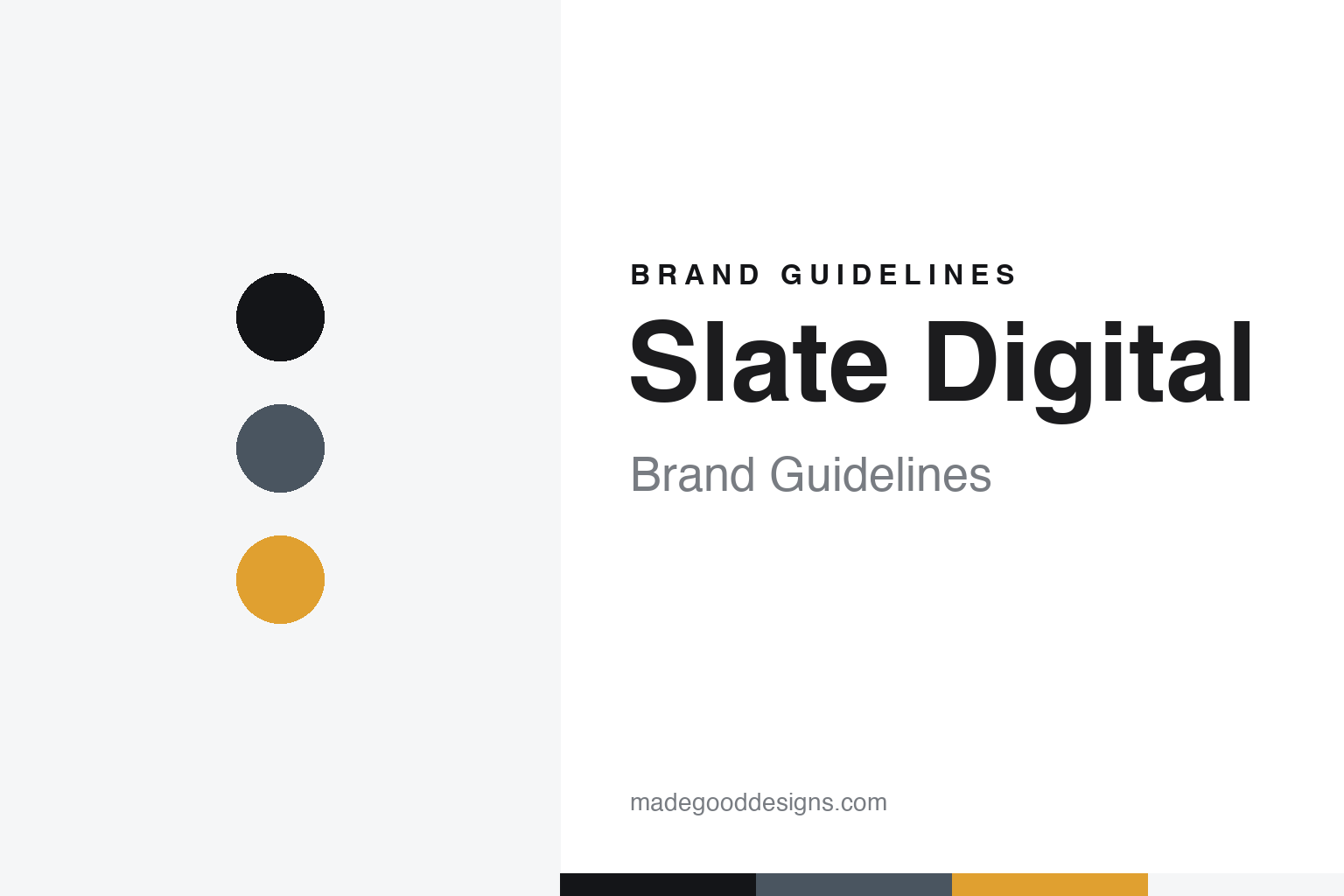
Slate Digital Brand Guidelines
The plug-in maker Steven Slate co-founded with a Grenoble DSP engineer.
Aa
Two constants: a console black, slate grey and VU amber palette and a condensed sans register. Abstract homage — not a Slate Digital product or mark; no plug-in interface, microphone, logo or nameplate is reproduced.
Steven Slate Digital
A producer’s name and a French DSP engineer.
Slate Digital is usually described as Steven Slate’s company, and his name was on it at the start: an archived copy of its website from July 2010 shows the brand as Steven Slate Digital, selling the Trigger drum-replacement plug-in, the FG-X mastering processor and the Virtual Console Collection. But the company says it was co-founded in 2008 by Steven Slate and Fabrice Gabriel, and the pro-audio group Audiotonix said the same when it bought the business in 2022. Gabriel is a French engineer who, the company says, studied digital signal processing in Grenoble; he had already founded his own plug-in maker, Eiosis, whose archived 2010 website lists the AirEQ equaliser, the EDeesser and the ELS Vocoder.
The company tells its origin as a division of labour: Gabriel’s DSP background “helped establish the technical foundation,” it says, and Steven Slate’s “creative vision” shaped an identity of “analog-inspired sound, bold product ideas, and deep DSP expertise.” Sources differ slightly on the date. Audiotonix’s 2022 announcement gives 2008 in its main text but says “founded in 2010” in its closing paragraph about Slate Digital; we follow the company and the announcement’s main text.
Through the 2010s the business was run from Los Angeles — its archived 2012 support page gave office hours in Pacific time — with a development team in Grenoble. The Slate name also appeared on separate businesses linked from the same website footer: Steven Slate Drums, Slate Pro Audio and, later, Slate Media Technology, which sold the Raven touchscreen controllers. They are distinct names, and this guide is about Slate Digital alone.
Colour
Consoles, tape and a monthly fee.
Slate Digital made its name on analogue modelling: plug-ins that recreate the sound of consoles, tape machines and outboard gear. The Virtual Console Collection was on its homepage by 2010, and an archived page from 2013 announced the Virtual Tape Machines alongside a video in which Gabriel discussed what he called “plugin mythbusting.” These and later models were gathered into the Virtual Mix Rack, a channel-strip host the company still develops and has taken to a version 3.0.
The second idea was the business model. Audiotonix says Slate Digital introduced its “All Access Pass” subscription in 2015, and Sound On Sound wrote in October 2016 that Slate was “one of the first plug-in companies to embrace an affordable pay-monthly system for their entire suite of plug-ins.” The subscription, now called Complete Access, bundles the company’s own plug-ins with other makers’. Audiotonix lists more than 80 processing and creative plug-ins, including titles from Sonic Academy, Kilohearts and Overloud, and newer tools aimed at hip-hop and electronic producers, such as MetaTune, Fresh Air, Murda Melodies and Storch Filter.
The third idea was hardware that depends on software. The Virtual Microphone System, reviewed by Sound On Sound in 2016, paired a large-diaphragm capacitor microphone and a standalone preamp, both designed to sound neutral, with software that models classic valve microphones and preamps. The review listed the first models as the FG-47, FG-251 and FG-800, which it described as pseudonyms for a Neumann U47, a Telefunken ELA M251 and a Sony C800G, plus Neve 1073 and Telefunken V76 preamp models, all for under $1,000. Today the company sells the ML-1A and a stereo pair called the ML-2A; it says the ML-1A ships with 18 microphone models, including a Radio France Signature collection. The sources we checked do not say where the microphones are made, so we do not give a country.
Typography
Software that models hardware.
The modern studio runs on software: the digital audio workstation, or DAW, in which music is recorded and arranged, and the plug-ins that load inside it to equalise, compress, tune and colour sound. The seven companies in this guide make one or both.
Waves Audio was founded in Tel Aviv in 1992, and English Wikipedia credits its Q10 equaliser as the first commercially available audio plug-in; Waves received a Technical Grammy in 2011, and Celemony, the Munich maker of Melodyne, in 2012. FabFilter, founded in 2002, is based in Amsterdam. Ableton, maker of the Live DAW, was founded in 1999, is based in Berlin and says it is still run by its founders.
Soundtoys, which began in the mid-1990s as Wave Mechanics, a company started by former Eventide designers in New Jersey, gives its address as Burlington, Vermont. Slate Digital, which Audiotonix described as based in Los Angeles and Grenoble, was bought by that company in October 2022; Audiotonix is the British group that also owns Solid State Logic.
Ownership has moved fastest at iZotope, of Cambridge, Massachusetts. It joined Native Instruments in a group backed by Francisco Partners in 2021; after Native Instruments entered preliminary insolvency and was sold to inMusic in 2026, iZotope was acquired in July 2026 by the visual-effects software company Boris FX, MusicTech reported.
Because these products are code, “where it is made” means where the developers work: English Wikipedia lists Waves development centres in India and Ukraine, and Celemony says its staff work across Germany and beyond.
This guide sets out what can be checked about each brand — who founded it, who owns it, and what it says about where its products are made — and marks clearly what rests only on the company’s own word.
Aa
A condensed sans, after the labels on studio hardware. (Specimen set in Barlow Condensed, a sans STAND-IN; NOT the Slate Digital logo.)
Slate Digital
Part of Audiotonix since 2022.
On 3 October 2022 Audiotonix, the British pro-audio group based in Chessington, announced that it had acquired Slate Digital. The group was formed in 2014 by combining the console makers Allen & Heath, Calrec and DiGiCo, and bought Solid State Logic in 2017; the investment firm Ardian took a majority stake in 2019, the Financial Times reported. In the announcement the group’s chief executive, James Gordon, said he looked forward to working with Slate Digital’s “Grenoble and US teams” and praised its “strong subscription model.” Steven Slate said the company would “have the resources to think even bigger,” and Gabriel said he would work with the wider group’s DSP teams.
Today Slate Digital says it is part of Audiotonix and continues “to develop its own creative identity, product vision, and sound.” Its press releases carry a Los Angeles dateline, and the 2022 announcement described it as based in Los Angeles and Grenoble. Its sister brands include SSL, with which it has run a time-limited joint subscription offer, and Eiosis, whose old web address now forwards to Slate Digital’s site. Sound On Sound described Steven Slate as the company’s chief executive in 2016; we have not found a dated, independent statement of his role today, so we do not give one.
For a design guide, Slate Digital shows how a software company can borrow the look and vocabulary of hardware — consoles, tape and valve microphones — while selling a subscription. Compare Universal Audio, another maker that models classic studio hardware, and Solid State Logic, its sister brand under Audiotonix. For this guide we use console black, slate grey and VU amber with a condensed sans, an unofficial interpretation; no product or logo is reproduced.
Explore & save
Keep Slate Digital’s identity on hand — save it to a board in the Made Good inspiration library.
Slate Digital identity set
Pin the Slate Digital console black, slate grey and VU amber palette and the condensed sans register to your own board.