Pioneer Pro Audio Brand Guidelines
The club speakers that followed Pioneer DJ to AlphaTheta.
Aa
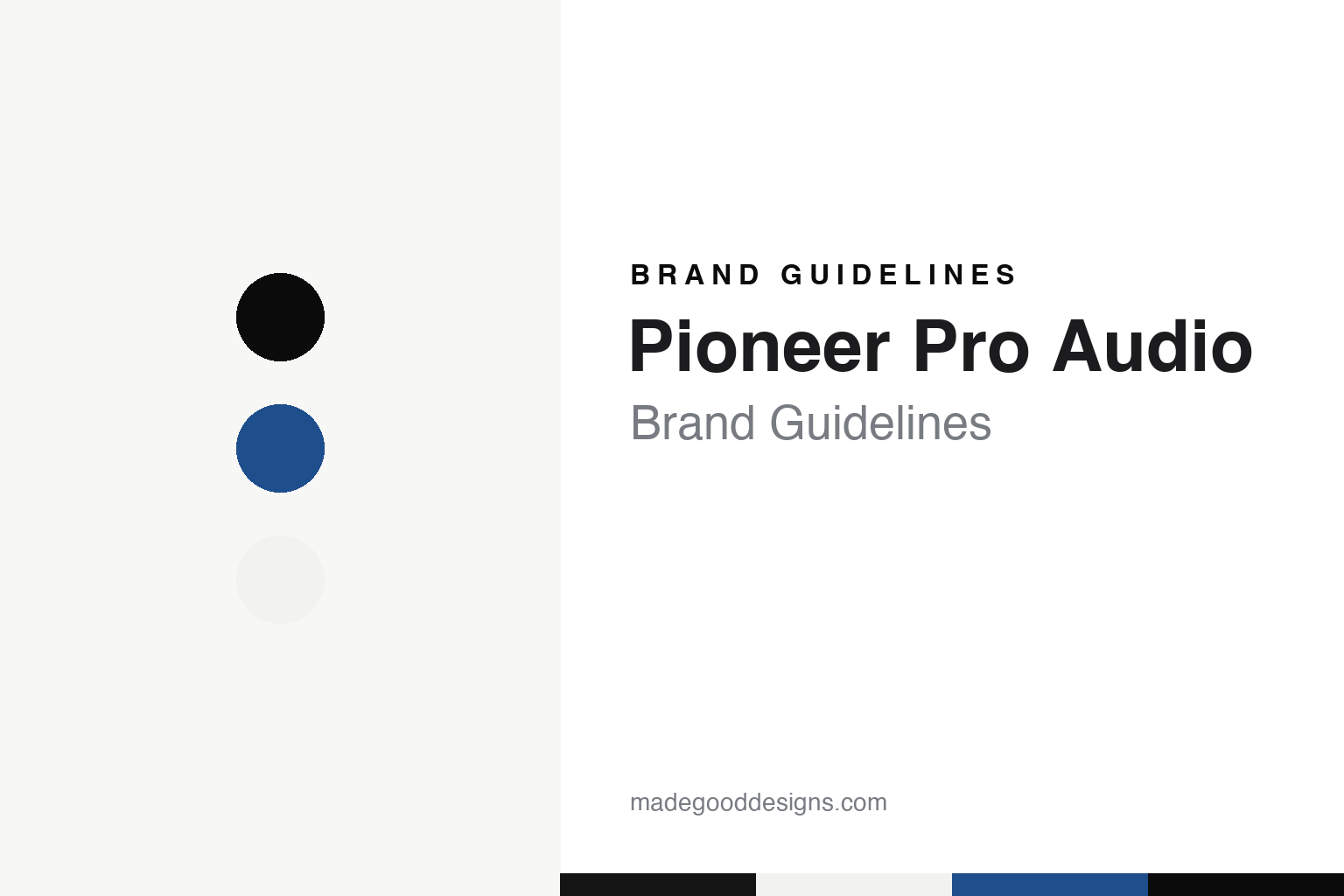
Two constants: a Pioneer Pro Audio black, white and blue palette and a club sans register. Abstract homage — not a Pioneer Pro Audio product or mark; no loudspeaker, logo or nameplate is reproduced.
Pioneer, 2013
A speaker maker’s heritage, a DJ brand’s booth.
Pioneer Pro Audio is younger than its name suggests. The name belongs to Pioneer Corporation, the Japanese electronics company that English Wikipedia says Nozomu Matsumoto founded in January 1938 as a radio and loudspeaker repair shop, a year after he built the A-8 dynamic speaker. Pioneer’s own 2013 history puts it more grandly, as a company “founded in 1938 as a speaker manufacturer”, and Wikipedia’s two articles on the company disagree on whether the shop was in Tokyo or Osaka. The professional loudspeaker line itself began in 2013.
On 2 July 2013 Pioneer issued a press release, preserved by the Internet Archive, headed “Pioneer enters the professional audio market with the launch of the ultimate club sound system.” It described a flagship club system built with Gary Stewart Audio, a club sound company whose systems, Pioneer said, had played at Singapore’s Zouk and Club Vertigo in Costa Rica, and powered by amplifiers from the Italian maker Powersoft. The work was overseen by Pioneer’s Alex Barrand, whom the release introduced as the engineer behind the Ministry of Sound London’s 2008 sound system upgrade. The system was meant to “make waves in Ibiza this season”, and a release that August said the new club BOOOM! Ibiza had opened on 15 July with a bespoke Pioneer system.
The pitch was a pairing. Pioneer said it was combining its heritage in sound reproduction — including its professional sub-brand TAD (Technical Audio Devices), whose development, the company’s history page said, began in 1975 — with Pioneer DJ’s standing in the DJ booth, where a 2014 Channel News report cited by English Wikipedia estimated Pioneer’s share of the DJ equipment market at about 60 percent. A club that already ran Pioneer decks and mixers could now buy its speakers under the same name.
Colour
GS-WAVE stacks and XY boxes.
The 2013 launch had two passive ranges. GS-WAVE was the dance-floor stack: about three metres tall, built in “close collaboration with Gary Stewart Audio”, according to a 2014 Pioneer release, with a multi-fold hyperbolic horn subwoofer, dual 15-inch upper-bass boxes, an “Acoustic Lens” with 110-degree dispersion and an omnidirectional super-tweeter pod. All five WAV models are now marked discontinued on the Pioneer Pro Audio website.
The XY Series was the smaller range, meant for DJ-booth monitoring and as in-fill for bars and smaller rooms. The 2013 release listed 12-inch and 8-inch monitors with rotatable horns, a dual 15-inch quasi-bandpass subwoofer and a reflex-loaded 18-inch subwoofer, in enclosures of “premium multi-laminate birch plywood”. In September 2014 Pioneer added four models — the XY-101 and XY-152 full-range speakers and the XY-115S and XY-218S subwoofers — and said the whole range would come in “classic black or premium white.”
The series has since grown towards larger venues. The current flagship, the XY-3B, is a dual 12-inch three-way box which the company says uses a moulded “Bi-horn” and an “X-Phase” plug, and which it calls “tour ready”, stackable two high and four wide on a wheel board. The XY-1 and XY-2E split it into separate low and mid-high cabinets for ground-stacked arrays, and the website says the XY-2 mid-high box was designed for “large-scale venues and Stadiums”. The XY range on the website now lists thirteen models.
Alongside them sit the CM Series of commercial speakers, which the company says are meant to save space and complement interior design, and to which it added surface-mount models in December 2020; and the portable XPRS range, which AlphaTheta dates to 2016, followed by XPRS2 in January 2023. Amplification has come from partners: the website still pairs the speakers with Powersoft amplifiers and preset data, and points US customers to Linea Research and LEA Professional. Its case studies run from On Air in Örebro, Sweden, to the Wonderfruit festival near Pattaya, Thailand, and two clubs in Sapporo.
Typography
Touring and club PA makers.
The makers in this guide share a market — loudspeakers for concerts, clubs and large venues — but not a pattern of ownership.
In the United States, EAW, founded in 1978 by Kenneth Berger and Kenton Forsythe, is headquartered in Franklin, Massachusetts. It was sold to Mackie Designs in 2000 and bought by Italy’s RCF group in 2018, which, EAW says, re-established it as an independently operated company. Danley Sound Labs, which says it was founded in 2005 by Tom Danley and Mike Hedden, is based in Gainesville, Georgia. Clair Global, begun by the brothers Roy and Gene Clair in 1966, is still headquartered in Lititz, Pennsylvania, and privately held, according to English Wikipedia.
In Europe, Turbosound traces its story to Tony Andrews’ festival sound systems of the early 1970s and became Turbosound Ltd in 1978, its website says; English Wikipedia reports that it was bought in 2012 by Music Group, now Music Tribe, Uli Behringer’s holding company in Makati, Metro Manila. Coda Audio is based in Hannover, Germany, and says it makes its drivers and cabinets in its own European factory.
VUE Audiotechnik, launched in San Diego in 2012 by EAW co-founder Ken Berger and Jim Sides, says it was acquired in 2024 by its long-standing Chinese distributor, C-VUE (Shanghai) Audio Technology, and closed its US office at the end of that year. Pioneer Pro Audio, launched by Pioneer in 2013, now belongs to AlphaTheta of Yokohama, a subsidiary of Japan’s Noritsu Koki.
This guide sets out what can be checked about each brand — who founded it, who owns it, and what it says about where its products are made — and marks clearly what rests only on the company’s own word.
Aa
A club sans for a booth-side brand. (Specimen set in Archivo, a sans STAND-IN; NOT the Pioneer Pro Audio or Pioneer logo.)
AlphaTheta
A Pioneer name with a different owner.
The speaker line soon changed hands with the rest of Pioneer’s DJ business. In September 2014 Pioneer agreed to sell most of its DJ equipment unit to the private equity firm KKR for about ¥59 billion, roughly $550 million, according to English Wikipedia, which cites Reuters and gives the stake as 86 percent in one article and 85.05 percent in another. AlphaTheta’s own history says the business became independent of Pioneer Corporation as Pioneer DJ Corporation in March 2015, with its first head office in Pioneer’s former Kawasaki headquarters and a later move to Yokohama. That history counts the 2013 entry into professional audio as its own, and the XY Series installation manual of 2018 carries a Pioneer DJ Corporation copyright.
On 1 January 2020 Pioneer DJ Corporation renamed itself AlphaTheta Corporation, and in March 2020 KKR and Pioneer sold their stakes to Noritsu Koki, according to English Wikipedia, which cites DJ Mag; a DealStreetAsia report it also cites put the price at ¥35 billion. Noritsu, a Tokyo-listed holding company, began in Wakayama in the 1950s making equipment for processing photographs. AlphaTheta describes itself today as a Noritsu Koki subsidiary based in Yokohama, with 620 employees at the end of 2025. Its user manuals note that “Pioneer is a registered trademark of PIONEER CORPORATION”, and the Pioneer Pro Audio website carries an AlphaTheta copyright.
Where the speakers are made is not something the company spells out. The product pages, user manuals, installation manual, brochure and specification sheet we checked give no country of manufacture. AlphaTheta lists one production site of its own, a rented factory in Dong Nai, Vietnam, but does not say what is made there, so we do not assume the XY boxes come from it.
For a design guide, Pioneer Pro Audio shows how a brand can borrow its authority from the equipment beside it: the speakers arrived carrying a name clubs already knew from their decks and mixers. Compare Funktion-One, another loudspeaker name made in clubs, and Powersoft, whose amplifiers drove the first Pioneer system. For this guide we use black, white and a deep club blue with a sans, an unofficial interpretation; no product or logo is reproduced.
Explore & save
Keep Pioneer Pro Audio’s identity on hand — save it to a board in the Made Good inspiration library.
Pioneer Pro Audio identity set
Pin the Pioneer Pro Audio black, white and blue palette and the club sans register to your own board.