EAW Brand Guidelines
The Massachusetts PA maker behind the KF850.
Aa
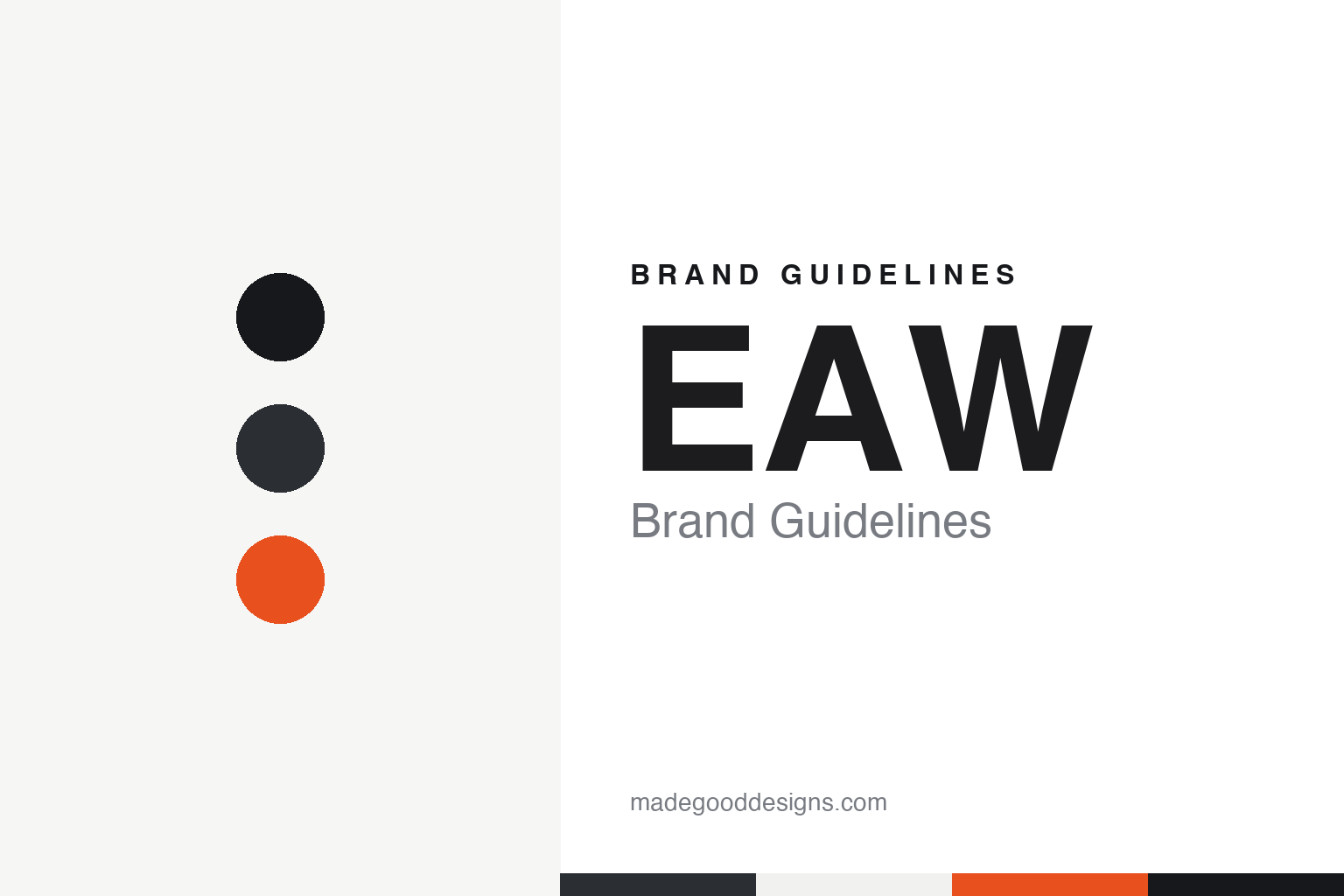
Two constants: an EAW graphite and signal orange palette and an Engineering sans register. Abstract homage — not an EAW product or mark; no loudspeaker, logo or nameplate is reproduced.
Forsythe and Berger
Two partners, a bass horn and a new name in 1978.
Eastern Acoustic Works was founded in Massachusetts in 1978. English Wikipedia, the company’s own history and a 2023 interview in Headliner all name two founders: Kenton Forsythe and Kenneth “Ken” Berger. Forsythe is often named alone, so it is worth saying that Berger was a co-founder. Mackie Designs’ annual report for 2000, filed with the US Securities and Exchange Commission, says EAW was incorporated in Massachusetts in 1978.
The two had worked together before. Forsythe, a Yale history graduate with a master’s degree in city planning from Berkeley, came to sound by building speakers for local bands, FOH magazine reported in 2023. In the early 1970s he ran a hi-fi shop, K&L Sound, which Berger joined as a young man from Emerson College; that business grew into Forsythe Audio. Its SR215 of 1975 was a double-15-inch bass horn that could fit through a 30-inch door, EAW says.
According to EAW, the first products sold under the new name in 1978 were the SR109 loudspeaker and the BH212 subwoofer. Wikipedia says the company was based in Framingham until 1988 and then moved to Whitinsville, where Mackie’s filing later described a leased complex of ten buildings covering 245,000 square feet. An early job, described by Recording Engineer/Producer in 1984, was the CS-3 system for Carlo Sound in Nashville, which Wikipedia calls the first commercially available horn-loaded single-enclosure system.
Colour
The KF850, then Anya.
The product most associated with EAW is the KF850, a large three-way touring loudspeaker. Wikipedia dates its development to 1985; EAW said in 2016 that “by the late 1980s” it had become “the number one touring loudspeaker in the world,” a company claim that FOH repeated in its 2023 obituary of Forsythe. Wikipedia names Carlo Sound and Sun Sound among the first rental companies to take it. Mackie’s 2000 filing listed EAW technologies including the Virtual Line Array and Phase PointSource, and noted that EAW had bought SIA Software, maker of the SMAART measurement program, in February 1999.
Forsythe received a Parnelli Award for audio innovation in 2011, according to EAW and FOH. He retired in 2016, rejoined the company in 2019 and died in July 2023, FOH reported.
The current flagship family is ADAPTive, built around the Anya array, with the smaller Anna and Otto. EAW’s own news archive shows Anya at work by 2013, from a Paramore show at the House of Blues in Boston to a Cho Yong-pil tour in Korea; in January 2014 the company said Anya systems had been shipped from its Whitinsville factory to Australia, Canada, China, Indonesia, Korea and Turkey. In April 2025 it launched the NT206L, the first of the Newport series of compact active line arrays, which it called the first product “conceived and designed entirely” at its new building. EAW says two Newport additions won three awards at InfoComm 2026, including a Commercial Integrator BEST Award and a rAVe Best of InfoComm award.
Typography
Touring PA and documentation.
The makers in this guide share a market — loudspeakers for concerts, clubs and large venues — but not a pattern of ownership.
In the United States, EAW, founded in 1978 by Kenneth Berger and Kenton Forsythe, is headquartered in Franklin, Massachusetts. It was sold to Mackie Designs in 2000 and bought by Italy’s RCF group in 2018, which, EAW says, re-established it as an independently operated company. Danley Sound Labs, which says it was founded in 2005 by Tom Danley and Mike Hedden, is based in Gainesville, Georgia. Clair Global, begun by the brothers Roy and Gene Clair in 1966, is still headquartered in Lititz, Pennsylvania, and privately held, according to English Wikipedia.
In Europe, Turbosound traces its story to Tony Andrews’ festival sound systems of the early 1970s and became Turbosound Ltd in 1978, its website says; English Wikipedia reports that it was bought in 2012 by Music Group, now Music Tribe, Uli Behringer’s holding company in Makati, Metro Manila. Coda Audio is based in Hannover, Germany, and says it makes its drivers and cabinets in its own European factory.
VUE Audiotechnik, launched in San Diego in 2012 by EAW co-founder Ken Berger and Jim Sides, says it was acquired in 2024 by its long-standing Chinese distributor, C-VUE (Shanghai) Audio Technology, and closed its US office at the end of that year. Pioneer Pro Audio, launched by Pioneer in 2013, now belongs to AlphaTheta of Yokohama, a subsidiary of Japan’s Noritsu Koki.
This guide sets out what can be checked about each brand — who founded it, who owns it, and what it says about where its products are made — and marks clearly what rests only on the company’s own word.
Aa
An engineering sans for a maker of large loudspeakers. (Specimen set in Archivo, a sans STAND-IN; NOT the EAW logo.)
Mackie, LOUD, RCF
Three owners in four decades, and a company that names its own bad years.
EAW stayed independent for 22 years. In April 2000 Mackie Designs, of Woodinville, Washington, bought all of its shares for about $19.6 million including costs, according to Mackie’s annual report. The same filing shows that Mackie already owned the Italian speaker maker RCF, so EAW and RCF were sister companies long before one bought the other. Mackie became LOUD Technologies; Wikipedia says it sold its Italian operations, including RCF, in December 2003, and that Transom Capital Group bought LOUD in October 2017, renamed it LOUD Audio and within a year sold Ampeg, Martin Audio and EAW.
On 4 September 2018 RCF Group, of Reggio Emilia, announced it was buying EAW from LOUD Audio, FOH reported, with president TJ Smith staying on and EAW run as an independent company. RCF’s chief executive, Arturo Vicari, said RCF had supplied drivers to EAW since its early days. EAW’s website is unusually frank about the years in between: it calls 2000–2017 the “Consolidation Era,” when combining with other companies “caused the brand to lose sight of its customer-focused mission,” and 2018 onward the “Resurgence Era.” Smith told Headliner that work outsourced to save money had been brought back in-house. From January 2021, EAW said, its sister brand dBTechnologies became its exclusive distributor in Europe.
Where EAW speakers are made is only partly documented. In May 2021 the company said it had begun assembling its MKD installation speakers at Whitinsville and was “proud to once again be assembling product in the U.S.” In January 2025 it moved into a 56,000-square-foot headquarters in Franklin, Massachusetts, with 32,000 square feet for production and warehousing, engineering labs and outdoor test areas. It does not say which products are built there, so we do not claim that every EAW speaker is American-made.
For a design guide, EAW shows how a maker can write a difficult period into its own story instead of hiding it. Compare RCF, its owner since 2018, and Martin Audio, sold by LOUD the same year. For this guide we use graphite, white and a signal orange with a sans, an unofficial interpretation; no product or logo is reproduced.
Explore & save
Keep EAW’s identity on hand — save it to a board in the Made Good inspiration library.
EAW identity set
Pin the EAW graphite and signal orange palette and the Engineering sans register to your own board.