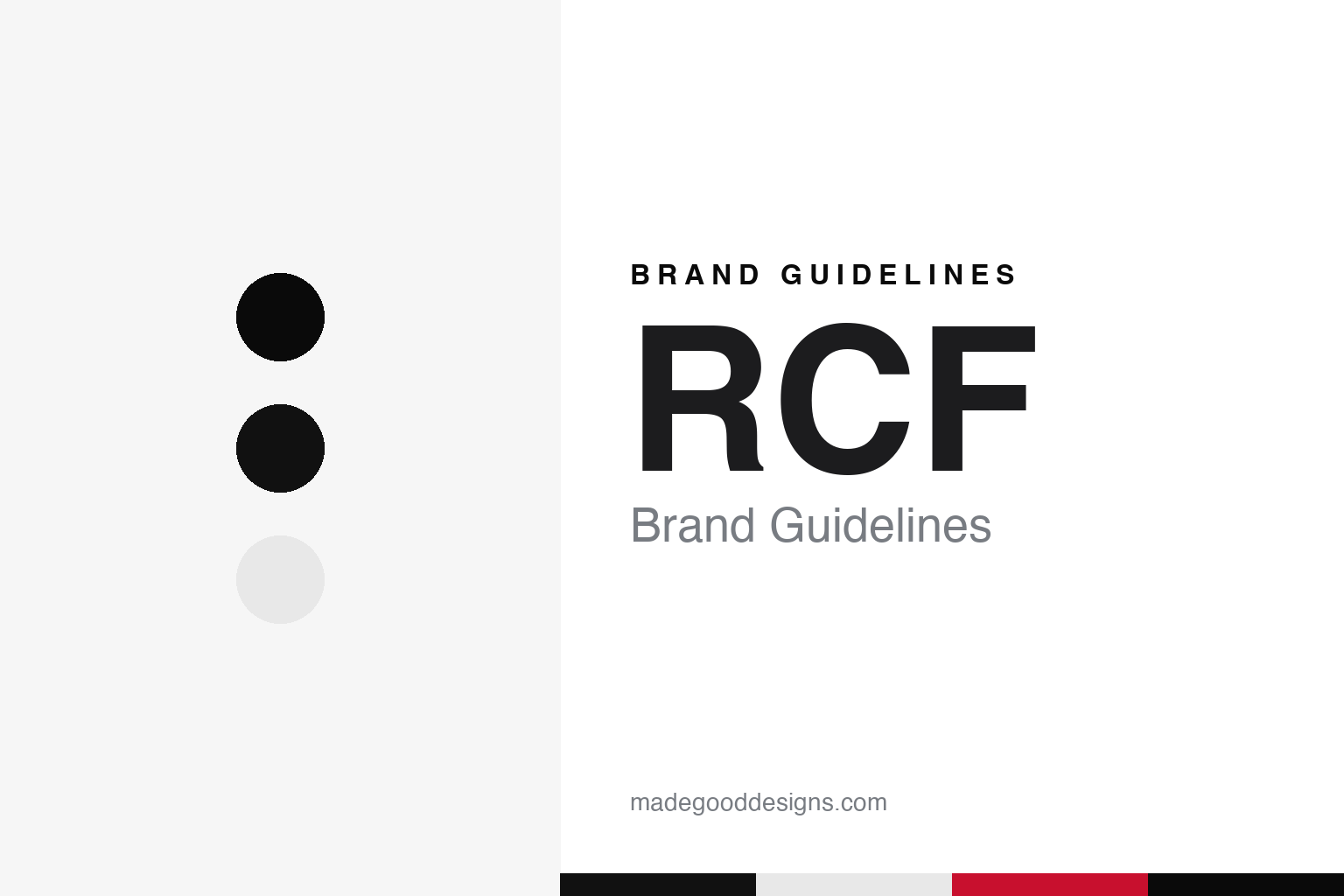
RCF Brand Guidelines
Reggio Emilia’s loudspeaker maker, from Mackie to its own arena.
Aa
Two constants: a RCF black and signal red palette and a Geometric sans register. Abstract homage — not a RCF product or mark; no instrument, logo or nameplate is reproduced.
Radio Cine Forniture
Three letters from 1949.
RCF’s name is an abbreviation of Radio Cine Forniture — radio and cinema supplies. A 2001 annual report filed with the US Securities and Exchange Commission by its then owner, Mackie Designs, which gave its office as Via G. Ferraris in the San Maurizio district of Reggio Emilia, says the company “was incorporated in Italy in 1949,” and Italian Wikipedia gives the original name as Radio Cine Forniture – R.C.F. The company says “RCF’s three founders” started it in 1949, but names none of them, and we found no source that does.
The company’s own timeline describes its path: ribbon microphones and transducers in 1949, a transducer research centre in the 1960s, home hi-fi in the 1970s, what it calls the first carbon-fibre speakers in the 1980s, and professional loudspeakers in the 1990s. Its powered ART series arrived in the mid-1990s — 1996 in Wikipedia’s account, 1997 in Mackie’s filing.
RCF is based in Reggio Emilia, in Emilia-Romagna; its headquarters today is on Via Raffaello, according to English Wikipedia. The company says it is present in more than 130 countries and uses the slogan “Sound culture.”
Colour
The Mackie years.
For five years RCF was American-owned. Mackie Designs, the American mixer maker, bought RCF in June 1998, when, its filing says, RCF had “manufacturing facilities located in northern and central Italy.” In December 2000 the Italian company was renamed Mackie Designs (Italy) S.p.A.
The arrangement ended in 2003. Mackie, by then renamed LOUD Technologies, filed the Italian company into a concordato preventivo, a court-supervised arrangement with creditors, and on 10 December 2003 its Dutch subsidiary sold all the shares of Mackie Italy to a company called Knight Italia S.p.A. “for a nominal amount,” according to LOUD’s filing with the SEC. Knight Italia offered to lease or buy the Reggio Emilia factory, the RCF name and the other Italian assets. The sale took more than $23 million of related bank debt off LOUD’s books, and LOUD moved its commercial audio business under its American EAW brand.
We could not find who controlled Knight Italia, or exactly how RCF passed to its present owners, and we do not guess. Fifteen years later the story turned: RCF Group bought EAW itself in 2018.
Typography
The groups.
Italian professional audio has been consolidating into groups. RCF Group of Reggio Emilia, which also owns dBTechnologies, bought the American loudspeaker maker EAW and the Danish microphone maker DPA in 2018–19 and the Italian PA brand Montarbo in 2019; in 2019, according to Il Sole 24 Ore, it had about 700 staff, exported 87 per cent of its sales and planned a stock-market listing it later withdrew.
A second cluster has formed around Florence. The amplifier maker Powersoft of Scandicci, listed in Milan since December 2018, bought 51 per cent of the loudspeaker maker K-array of Scarperia in 2025, on an enterprise value of €50 million, with the deal announcement stressing the two companies’ “territorial proximity.” Nearby, the listed transducer maker B&C Speakers, founded in Florence in 1946, reported revenue of €100.4 million in 2024 and has bought Eighteen Sound of Reggio Emilia and Eminence of Kentucky, according to Italian Wikipedia.
The groups reach well beyond Italy. RCF Group’s EAW is American and DPA Danish; Powersoft has a subsidiary in New Jersey and earned 44.2 per cent of its 2025 revenue in North America; and B&C Speakers, listed in Milan since 2007, bought Eminence Speaker of Kentucky in September 2023 and its operations in Dongguan, China, that December, according to Italian Wikipedia.
Ownership has moved between these firms as well as into them. Montarbo, the Bologna PA maker, was controlled by Eko Music Group of Montelupone, in the Marche, by 2012, and passed to RCF Group’s AEB Industriale in January 2020. FBT of Recanati, founded in 1963, is controlled by a holding company that bears the name of Vinicio Tanoni, and Proel of the Abruzzo was founded in 1991 by Fabrizio Sorbi, who started with cables. Each company describes where its products are designed and made in its own words, and the guides below quote them.
RCF is the largest of those groups: a 1949 radio-and-cinema supplier that now owns the American brand its former owner kept.
Aa
A geometric sans — three letters from Radio Cine Forniture. (Specimen set in Inter Tight, a sans STAND-IN; NOT the RCF logo.)
RCF
Three letters from Radio Cine Forniture.
RCF today is a group. In September 2019 Il Sole 24 Ore reported that its chief executive and shareholder Arturo Vicari, with partners Alfredo Macchiaverna and Remo Morlini, held 70 per cent, and the private-equity investors Palladio and Amundi 30 per cent; that 2018 revenue was €183 million pro forma including EAW and DPA, €145 million without them; and that the group had about 700 staff. The same report put EBITDA at €40 million. A planned listing on Borsa Italiana’s STAR segment was withdrawn on 17 October 2019. Palladio had bought its 30 per cent in 2017, the Corriere della Sera reported. Staff figures vary by source and date — more than 250 in English Wikipedia, more than 600 in Italian Wikipedia — so we use the dated 2019 newspaper figure. Announced in November 2019 and in use from September 2020, the company’s RCF Arena at Campovolo, Reggio Emilia, is an open-air venue for 10,000 to 100,000 people, which Il Sole 24 Ore put at €11.5 million — a loudspeaker maker with a stadium-scale venue under its own name.
The company says “all speakers and components are designed from the ground up and developed internally” and refers to “the modern manufacturing facility located in Italy.” It names the HDL 20 of 2013 as “RCF’s best-selling product,” and lists the TT+ touring range, the M18 digital mixer of 2015 and its FiRPHASE processing, used since 2017; sources date TT+ to 2004 or 2007.
Its logo is a black wordmark, refreshed around 2021 to judge by the file names, and its website uses the Montserrat typeface. For a design guide, RCF shows a heritage name rebuilt into a group brand. Compare dBTechnologies, founded by the same chief executive, and Montarbo, which the group bought in 2019. For this guide we use black and a signal red with a sans, an unofficial interpretation; no product or logo is reproduced.
Explore & save
Keep RCF’s identity on hand — save it to a board in the Made Good inspiration library.
RCF identity set
Pin the RCF black and signal red palette and the Geometric sans register to your own board.