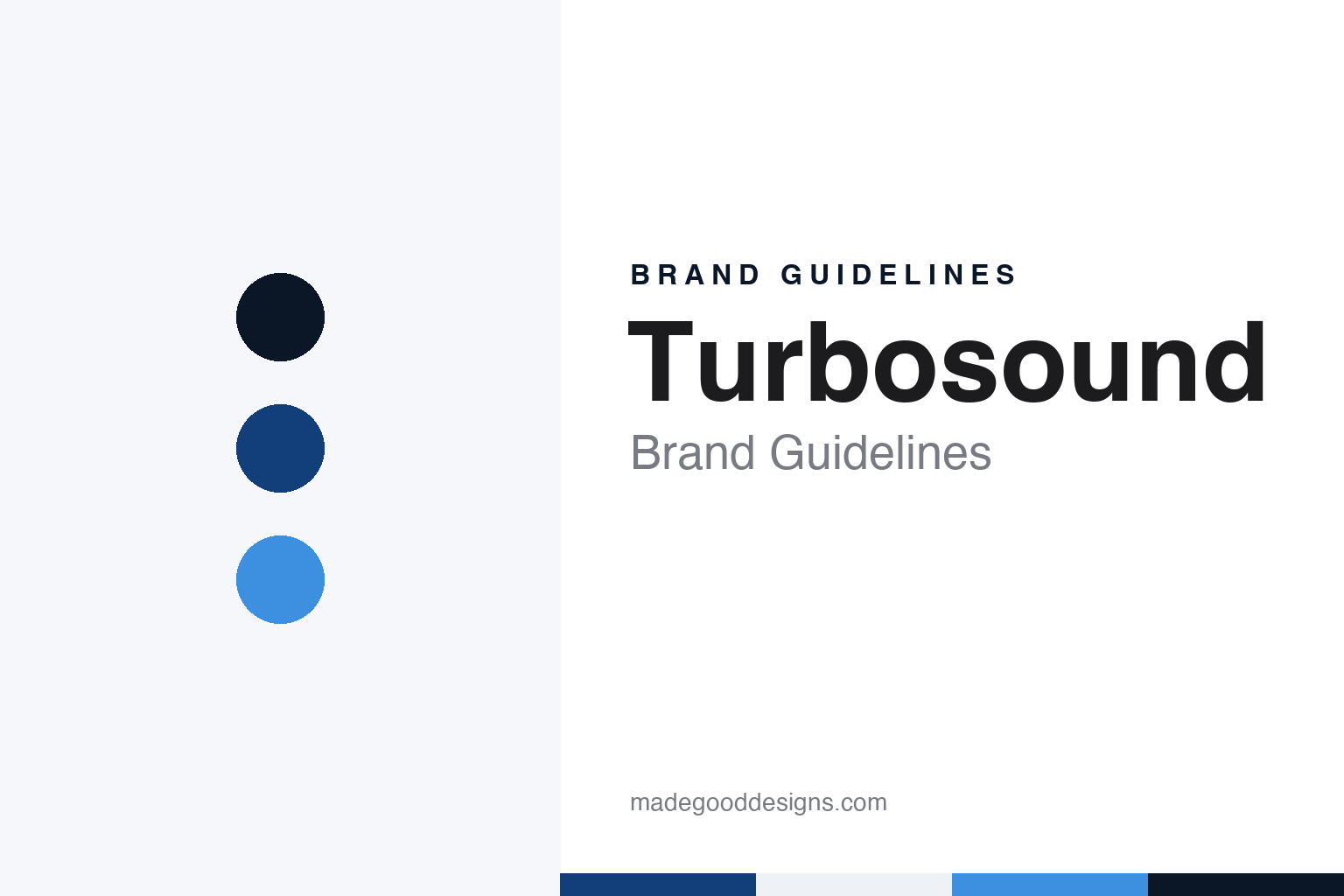
Turbosound Brand Guidelines
Tony Andrews’ festival PA, from Flashlight to Music Tribe.
Aa
Two constants: a Turbosound blue palette and a Condensed sans register. Abstract homage — not a Turbosound product or mark; no loudspeaker, logo or nameplate is reproduced.
The Festival System
Glastonbury, a nose cone and a rental company.
Turbosound grew out of festival sound in England. Its current website dates its story to 1970 and to Tony Andrews’ work at the early Glastonbury festivals, where, it says, his “Festival System” of separate bass, mid and high-frequency cabinets carried the “Turbo” phase device, first tried in 1973 — a slender nose cone mounted in front of the midrange driver. The same timeline names 1978 as the year “Turbosound Ltd is Born,” and the company’s 2019 history says that by 1978, “which is when the official story begins,” Andrews “had met Tim Isaac and joined forces with John Newsham, a respected sound engineer, to form Turbosound.” Funktion-One, the firm Andrews and Newsham later founded, says the pair established and led Turbosound “through the late-1970s, 1980s and early-1990s.”
At first they designed, built and rented out their own systems. In London, Alan Wick and Mark Hardy ran the Muscle Music rental company, which by 1980 was hiring in Turbosound equipment; in mid-1981, the company history says, the two businesses merged to form the Turbosound Group. From 1982 it sold in the United States through Turbosound Inc. For decades its base was Partridge Green in West Sussex, which the company described as “the heart of the English countryside.”
In 1986, Turbosound says, it joined BSS Audio in the Edge Technology Group, which a year later produced the driver maker Precision Devices; its 2019 history refers to “the distinctive blue Turbosound loudspeaker brand” of that period.
Colour
The TMS-3, then Flashlight.
The breakthrough was the TMS-3, launched with the TMS series in 1981: a modular three-way cabinet built around a 10-inch cone midrange and the patented TurboMid device. Turbosound says more than 3,000 were in use within a few years, and that the design was copied so closely that a court case in Canada ended with copies being cut up with a chainsaw. Rental use spread quickly: the company says Clair Brothers took 16 TMS-3s for a New York festival in 1982, Styx toured with a large system in 1983, and in 1984 a cluster went into Nashville’s Grand Ole Opry. The 1988 Monsters of Rock festival at Donington Park, headlined by Iron Maiden, used 360 Turbosound cabinets, a figure Wikipedia cites as a record PA.
Export sales of the TMS-3 brought the company the Queen’s Award for Export Achievement in 1987 and again in 1997, it says, and the technology behind its Flex Array line array earned a third Queen’s Award, for Innovation, in 2012. The second landmark was Flashlight, a narrow-beam three-way system. Turbosound says its prototype was first used at Roger Waters’ performance of The Wall in Berlin after the Wall came down, an outing it dates to 1990, and that through Britannia Row Productions it went on to Pink Floyd’s 1994 Division Bell tour and to tours by The Cure, Depeche Mode, Dire Straits and Oasis. A 1997 company page listed Live! magazine’s concert PA award for 1993, 1994 and 1995; Turbosound’s later history adds that Flashlight beat EAW’s KF850 and Martin Audio’s F2 for the 1994 award. Later systems included Floodlight, with its “axehead” waveguides; Aspect, which the company says David Gilmour used on his 2006 tour; and the Flashline line array.
Typography
Touring PA and documentation.
The makers in this guide share a market — loudspeakers for concerts, clubs and large venues — but not a pattern of ownership.
In the United States, EAW, founded in 1978 by Kenneth Berger and Kenton Forsythe, is headquartered in Franklin, Massachusetts. It was sold to Mackie Designs in 2000 and bought by Italy’s RCF group in 2018, which, EAW says, re-established it as an independently operated company. Danley Sound Labs, which says it was founded in 2005 by Tom Danley and Mike Hedden, is based in Gainesville, Georgia. Clair Global, begun by the brothers Roy and Gene Clair in 1966, is still headquartered in Lititz, Pennsylvania, and privately held, according to English Wikipedia.
In Europe, Turbosound traces its story to Tony Andrews’ festival sound systems of the early 1970s and became Turbosound Ltd in 1978, its website says; English Wikipedia reports that it was bought in 2012 by Music Group, now Music Tribe, Uli Behringer’s holding company in Makati, Metro Manila. Coda Audio is based in Hannover, Germany, and says it makes its drivers and cabinets in its own European factory.
VUE Audiotechnik, launched in San Diego in 2012 by EAW co-founder Ken Berger and Jim Sides, says it was acquired in 2024 by its long-standing Chinese distributor, C-VUE (Shanghai) Audio Technology, and closed its US office at the end of that year. Pioneer Pro Audio, launched by Pioneer in 2013, now belongs to AlphaTheta of Yokohama, a subsidiary of Japan’s Noritsu Koki.
This guide sets out what can be checked about each brand — who founded it, who owns it, and what it says about where its products are made — and marks clearly what rests only on the company’s own word.
Aa
A condensed sans for a maker of narrow-beam touring systems. (Specimen set in Barlow Condensed, a sans STAND-IN; NOT the Turbosound logo.)
AKG, Harman, Proel, Music Group
Four documented owners, and a website that leaves them out.
Turbosound has changed hands several times, and its current website’s timeline leaves the owners out. Harman International’s annual report filed in September 1996 says that brands “added to the Harman portfolio through the AKG acquisition” of September 1993 included “Turbosound professional loudspeakers,” so the Austrian microphone maker AKG owned it before Harman did; when AKG bought it we could not establish. A 1997 company page called Turbosound “a division of Harman International Industries.” By Harman’s 1998 report its name no longer appeared among the group’s brands, and we found no record of who owned it next.
The chain is often summarised as AKG, Harman and then Music Group, but that misses a step. In 2010 Turbosound’s own website said it had been “integrated as a Proel Group company since 2007,” quoting Proel’s president, Fabrizio Sorbi. In June 2012 Music Group, the company founded by Uli Behringer, announced it had bought Turbosound, which it described as based in West Sussex. Behringer said he had wanted a loudspeaker brand to sit alongside Midas and Klark Teknik, and the release said Turbosound was expected to keep its own manufacturing. Music Group renamed itself Music Tribe in December 2017, Wikipedia says. Andrews and Newsham had left long before, founding Funktion-One in 1992.
Today turbosound.com describes the brand as “part of Music Tribe” and lists 97 loudspeakers, from iP column systems and iQ powered boxes to the Berlin, Manchester and Milan ranges. In 2000 and 2010 the company said it built its products in England; its current pages do not say where they are made, and Companies House records show the company registered as Turbosound Ltd at Partridge Green was dissolved in 2015. Music Tribe runs its own factory complex in Zhongshan, China, according to Wikipedia, but we found no statement tying Turbosound’s current range to it.
For a design guide, Turbosound shows how product names — Flashlight, Floodlight, Flashline — can carry a brand through a run of owners. Compare Funktion-One, its founders’ next company, and Martin Audio, its British rival for the 1994 award. For this guide we use a deep blue, a brighter stage blue and white with a condensed sans, an unofficial interpretation; no product or logo is reproduced.
Explore & save
Keep Turbosound’s identity on hand — save it to a board in the Made Good inspiration library.
Turbosound identity set
Pin the Turbosound blue palette and the Condensed sans register to your own board.