AEA Brand Guidelines
The Pasadena ribbon-mic maker that brought back the RCA 44.
Aa
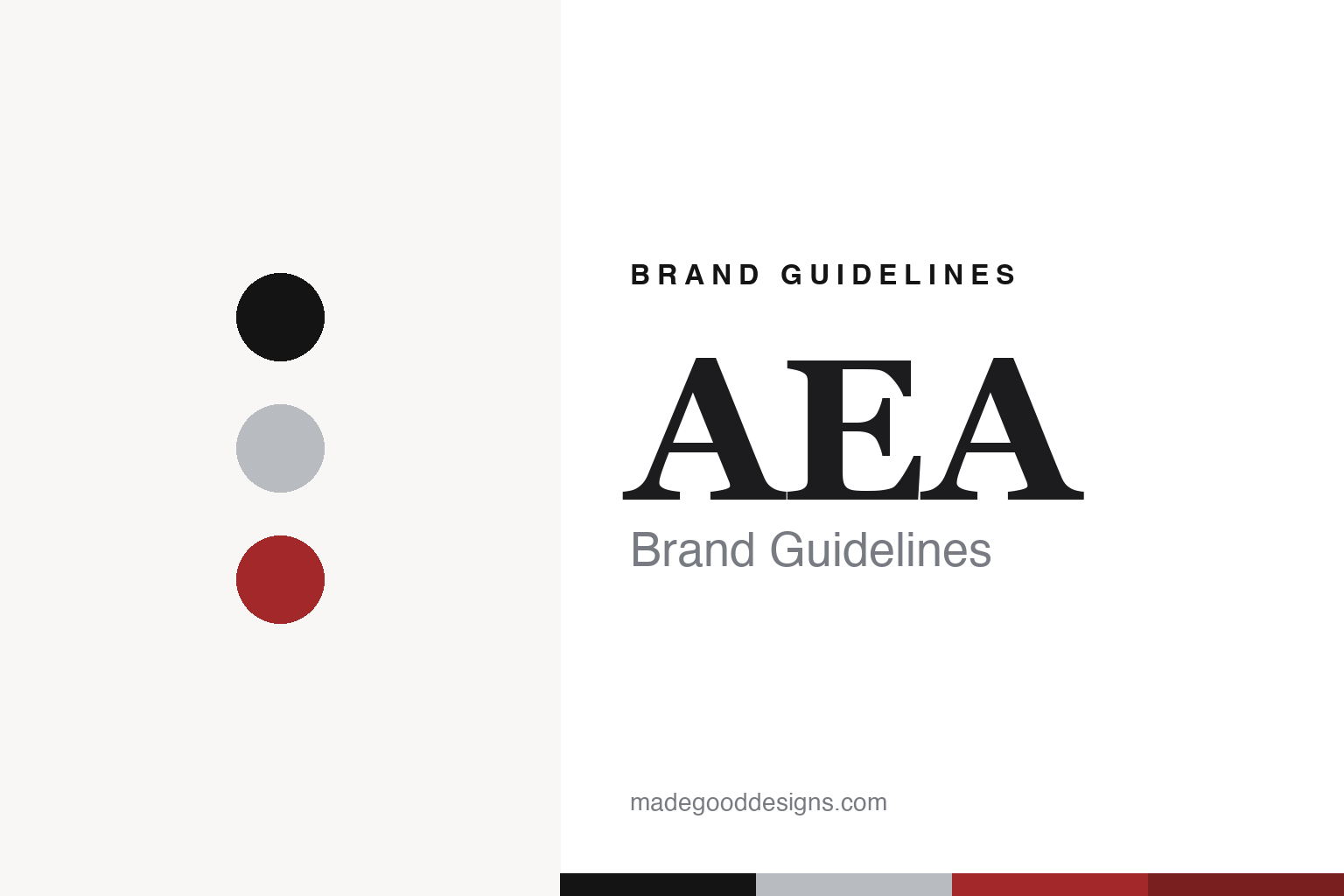
Two constants: an AEA black, nickel and red palette and a display serif register. Abstract homage — not an AEA product or mark; no microphone, logo or nameplate is reproduced.
From recordist to ribbons
A Pasadena engineer and the RCA 44.
AEA — Audio Engineering Associates — was founded by Wes Dooley and is based in Pasadena, California. The company’s own badge says 1964; English Wikipedia gives 1965 and says it began as a record label. Dooley came to it through recording. In a 2013 Tape Op interview he described building an amplifier for a high-school physics class, three years on the Pomona College station KSPC, taping the Clancy Brothers for his folk show, and a garage studio where he and a friend, Robert Gerbracht, built broadcast gear, preamps and a mastering console. His mentor was the remote-recording engineer Wally Heider, whose favourite microphone, the company says, was the RCA 44.
Ribbons came later. RCA, where Harry F. Olson developed its ribbon microphones in Camden, New Jersey, had left the business, leaving what AEA calls thousands of orphaned microphones. In 1976, the company says, its chief engineer Dick Knoppow urged AEA to take on their servicing. Dooley met RCA’s Jon Sank, who showed him how RCA installed and tensioned its ribbons and sent tooling and materials; AEA says it still uses the ribbon corrugator he gave it. In 1984, Dooley told Tape Op, AEA began importing the British Coles 4038 and 4104, and it still repairs Coles microphones. Over the years it also did forensic audio work and sold other studio equipment.
Today AEA is no longer Dooley’s company. Julie Tan, a sales and marketing executive who had worked at AMS Neve, Alesis, Line 6 and TC Group, consulted for AEA for a year and then bought it, she said in a 2025 interview on AEA’s website. The company dated the handover to “a couple of years” before mid-2025 and was introducing her as CEO by January 2024. Tan said one reason Dooley sold to her was his worry that a buyer might move the company out of Los Angeles; in September 2026 AEA promoted Paul Pegas, who joined under Dooley in 2003, to director of operations.
Colour
Rebuilding the 44 from spare parts.
AEA’s turn from repair shop to manufacturer came out of its parts bins. After years of machining replacement parts for RCA microphones, Dooley decided to see whether he could build his favourite microphone entirely from them, he told Tape Op. In 1998, the company says, it had re-created 100 percent of the interchangeable parts of the RCA 44 and assembled a new microphone, the R44C, using RCA’s methods and the tools Sank had given it. Dooley said AEA showed it at the Audio Engineering Society’s 50th-anniversary convention that year, and that former RCA engineers told him it was not an homage but “the work we did.” Mix reviewed the R44C in April 1999.
Dooley chose the earlier, undamped form of the 44 rather than the later screen-damped design patented at RCA by Mike Rettinger, because the engineers whose microphones AEA had serviced liked its sound, he said. The NAMM Foundation inducted the 1998 AEA R44-C into its TECnology Hall of Fame at the January 2017 NAMM Show, describing it as bringing the 1930s design back to market.
From there AEA designed ribbons of its own. The R84, R88 and R92 were planned with production costs in mind, Dooley said, but use the same tuning and transformers as the R44. Later came the NUVO series — the N8, N13 and N22 — the KU4 and KU5A, and preamps and direct boxes such as the RPQ3 and TRP3. English Wikipedia credits AEA’s electronics to the circuit designer Fred Forssell. In 2026 AEA won two TEC Awards, for the N28 compact stereo ribbon microphone and the TDI Duo direct box, the TEC Awards website shows.
Typography
The microphone makers.
This round turns to six more microphone makers: boutique valve and ribbon designers in California, a British maker on the Dorset coast, and a brand made in Russia.
Four are in California. AEA is in Pasadena and says its microphones are “handcrafted” there. Mojave Audio, which says it was co-founded in 2005 by the producer Dusty Wakeman and the designer David Royer, calls itself “family-owned” and based in Los Angeles. Josephson Engineering says it began in San Jose in 1988, moved to Santa Cruz in 2000, and designs and makes all its products there. Bock Audio, which David Bock says he formed in 2007 after co-founding Soundelux Microphones, designs the valve and FET microphones that Universal Audio has sold since 2022, which UA says it hand-builds at its Santa Cruz custom shop.
Sontronics is in Poole, Dorset, and its website names Omnisonic International Ltd. Soyuz is in Tula, Russia; English Wikipedia, citing Reuters, says it was founded in 2013 by the American singer David Arthur Brown and the Russian entrepreneur Pavel Bazdyrev.
This guide sets out what can be checked about each brand — who founded it, who owns it, and what it says about where its products are made — and marks clearly what rests only on the company’s own word.
Aa
A display serif for a heritage register. (Specimen set in DM Serif Display, a serif STAND-IN; NOT the AEA logo.)
AEA
Handcrafted in Pasadena.
Where AEA’s microphones are made is central to its identity. The company says all of them are “handcrafted in the United States of America,” in Pasadena, and that it uses components from America. Its website carries a “Made in the USA” badge with the line “EST. 1964,” and it still services vintage RCA and Coles microphones and sells replacement parts. Tan has described keeping the company in Los Angeles as part of the reason Dooley chose her as a buyer. The company has also partnered with folk and Americana groups, Wikipedia notes; in autumn 2025, AEA says, it recorded live sessions with more than 20 artists at AmericanaFest in Nashville with The Bluegrass Situation.
Two dates are easy to confuse. The founding year differs between the company (1964) and English Wikipedia (1965), so we give both, and 1976 is when AEA began servicing RCA ribbons, not when it was founded. The name can confuse too: AEA stands for Audio Engineering Associates, while the company trades as AEA Ribbon Mics, Inc.
For a design guide, AEA shows how a company can borrow authority from a predecessor — the RCA 44’s grille, proportions and sound — and then build a modern range on it. Compare another Los Angeles-area ribbon maker in our Royer Labs brand guidelines, and the British ribbon AEA once imported in our Coles Electroacoustics brand guidelines. For this guide we use ribbon black, satin nickel and signal red with a serif, an unofficial interpretation; no product or logo is reproduced.
Explore & save
Keep AEA’s identity on hand — save it to a board in the Made Good inspiration library.
AEA identity set
Pin the AEA black, nickel and red palette and the display serif register to your own board.