Coles Electroacoustics Brand Guidelines
The Hertfordshire maker that kept a 1950s BBC ribbon microphone unchanged.
Aa
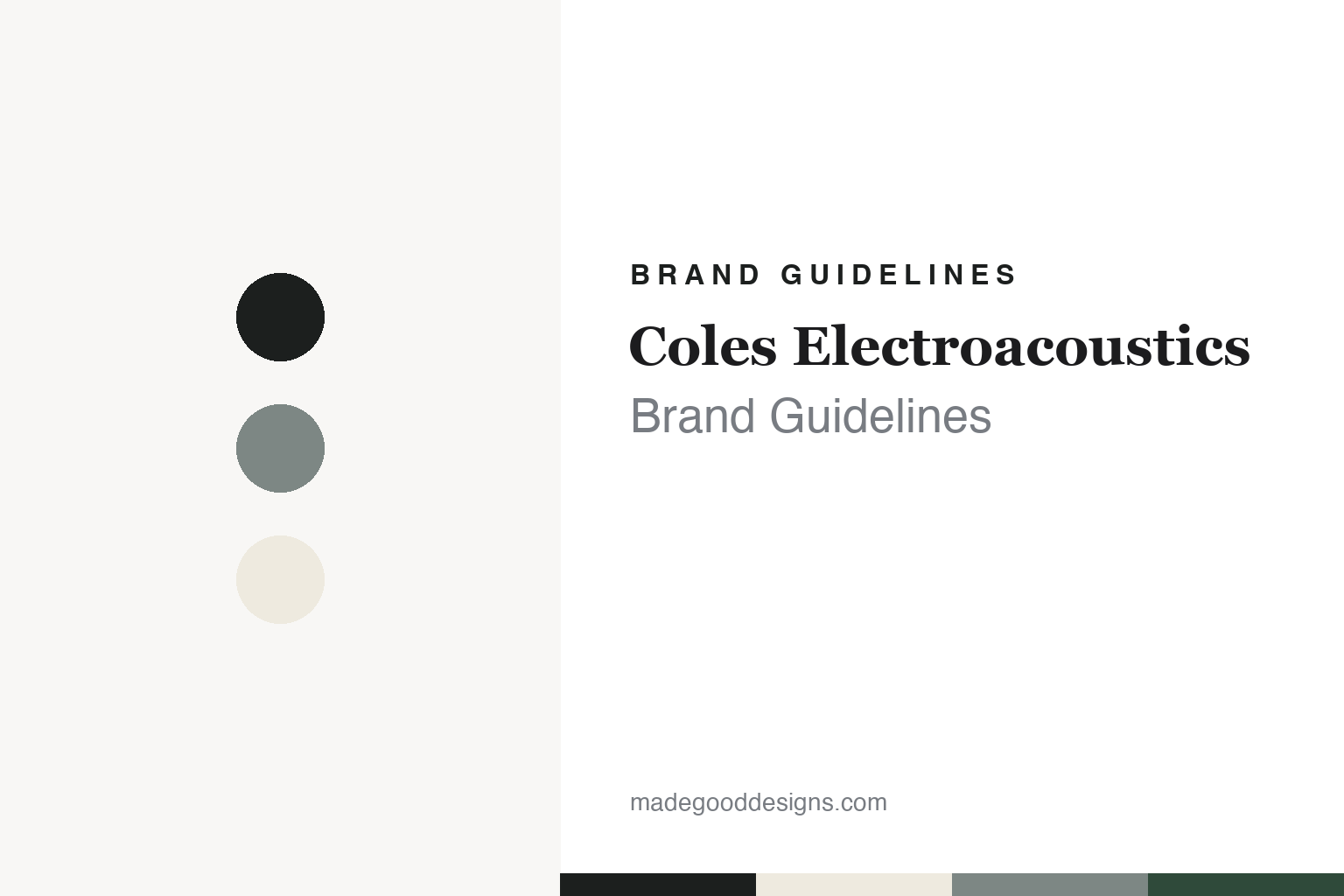
Two constants: a grille black, BBC grey and oxide green palette and a broadcast serif register. Abstract homage — not a Coles product or mark; no microphone, logo or nameplate is reproduced.
From the BBC
A 1953 BBC design and a Hertfordshire workshop.
Coles Electroacoustics is a British manufacturer in Hoddesdon, Hertfordshire, best known for making the 4038 studio ribbon microphone, a design that began at the BBC. The company says it has been “producing high quality recording equipment since 1964,” and it marked 60 years in business in 2024. Recording Hacks says Coles “was founded in 1964 by two employees of” Standard Telephones and Cables, the British telecommunications company. Neither source names them, and we did not find the founders’ names in the sources we checked, so we do not guess at who “Coles” was.
The public register adds a different date. Companies House lists the present limited company as incorporated on 1 March 1974 under the name Coles Engineering (Hoddesdon) Limited, renamed Coles Electroacoustics Limited at the end of 1976; it is recorded as an active private limited company with its registered office in Hoddesdon. The 1964 date may refer to an earlier business, but the register alone does not settle that, so we give both.
The 4038’s story starts a decade before Coles. English Wikipedia, citing a history of BBC monitoring published by the loudspeaker maker Harbeth, says the BBC designed the microphone in 1953 and gave the prototype the model number BBC PGS/1, after asking for a strong, affordable microphone smaller than its earlier Type A. The engineering was set out by D.E.L. Shorter and H.D. Harwood in “The Design of a Ribbon Type Pressure Gradient Microphone,” the BBC Engineering Division’s Monograph No. 4, dated 1955, which the BBC still hosts online. Coles adds that the design was developed into the STC 4038 with the help of Michael Gayford, a microphone engineer at STC.
Colour
The waffle iron, Bush House and the drum kit.
Standard Telephones and Cables built the 4038 and its stablemate, the 4104 commentator’s microphone, for the BBC and other broadcasters. Production then moved to Hoddesdon, on a date the sources do not agree on. Coles says “patents and production were transferred to Coles Electroacoustics Ltd in 1972.” Recording Hacks says STC outsourced its microphone line to Coles in 1974 and later sold it the rights. English Wikipedia, citing an online archive of STC brochures, says “the mid-1970s.” The microphone itself has hardly changed: Wikipedia, citing Electronic Musician in 2005, says its specifications have stayed the same since the 1950s, and Coles says it “remains faithful to the original design and specification.”
The 4038 is a figure-of-eight ribbon with a flat response from about 30 to 15,000 Hz and a 300-ohm impedance. Its slotted face has been likened to a waffle iron, in a 2008 EQ review cited by Wikipedia, and Sound On Sound in 2007 described its sound as “British,” with a “BBC politeness.” It became a favourite of British engineers in the 1950s and 1960s, mostly on drum overheads and brass, and, according to sources cited by Wikipedia, was used as a drum overhead on some Beatles and Led Zeppelin recordings; Coles places the Beatles use at Abbey Road Studios. The BBC World Service at Bush House, Hi-Fi News reported in 1997, at one time used the 4038 almost exclusively. In a 1994 interview the engineer Steve Albini said that if he owned one microphone, this would be it, and Wired quoted him in 2011 saying that “really nothing beats them as an overhead on a drum kit.”
The 4104 is the other BBC design in the catalogue: a noise-cancelling ribbon “lip” microphone for live commentary, held close to the mouth so that crowd noise falls away. Coles says it has been used by broadcasters including the BBC, IBA, CBS and ABC, and names the commentators John Motson, Peter Alliss and Clive Tyldesley among its users.
Typography
Ribbons and their makers.
Behind the best-known microphone names stands a group of smaller specialists, each built around one kind of microphone: the condenser, with a charged diaphragm; the ribbon, a thin strip of foil in a magnetic field; and the dynamic, a moving coil.
Three condenser makers here are German. Schoeps was founded in Karlsruhe in 1948 and says it makes its whole range in Durlach, the city’s old town, and remains family-owned. Microtech Gefell, in Gefell in Thuringia, traces itself to the firm Georg Neumann founded in Berlin in 1928, which moved to Gefell in 1943; its legal notice names Georg Neumann KG as sole shareholder. Brauner, a valve-microphone maker, closed its production site at Rees on the Lower Rhine in 2021 and said in July 2026 that production would restart.
DPA Microphones, founded in Denmark in 1992 by two former Brüel & Kjær employees, has its head office at Kokkedal and its factory at Asnæs; in February 2026 the British group Audiotonix announced an agreement to buy it.
The ribbon specialists are Royer Labs of Burbank, California, founded in 1998, which says every Royer is hand-made in the USA, and Coles Electroacoustics of Hoddesdon, Hertfordshire, which says it has made the BBC-designed 4038 in Britain for more than 50 years.
Electro-Voice, best known for dynamic microphones and loudspeakers, began in South Bend, Indiana, and since 2025 has belonged to Keenfinity Group, the former Bosch business owned by the investment firm Triton.
This guide sets out what can be checked about each brand — who founded it, who owns it, and what it says about where its products are made — and marks clearly what rests only on the company’s own word.
Aa
A broadcast serif — the register of a 1950s engineering monograph. (Specimen set in Libre Baskerville, a serif STAND-IN; NOT the Coles logo.)
Coles Electroacoustics
Hand-built in the UK, the company says.
Coles has added models around the BBC pair. Its catalogue lists the 4030L, an entry-level studio ribbon; the 4050, a studio ribbon with a wider response to 20,000 Hz, newer magnets and a magnetic shock mount that lets two be set up as a Blumlein stereo pair; the 4115 broadcaster’s and 4155 bus microphones; and a fist microphone. Its history page also mentions a 4040 studio model. Microphones are only part of the business: the website opens on “complete metal and plastic production facilities for sound equipment and precision components,” and lists loudspeaker drive units, sound pressure units and flooring products, while the register records its activities as the manufacture of electronic components and of technical ceramic products.
Where the microphones are made is stated by the company. It says it has “manufactured the superb BBC-designed ribbon microphones in the UK for over 50 years” and that “every microphone is still hand-built.” We give that as its claim; the Hoddesdon address on its website and in the public register is consistent with it. Abroad it sells through agents; in the United States, Audio Engineering Associates of Pasadena published the 1997 4038 user guide that Wikipedia cites.
For a design guide, Coles shows how a brand can be defined by a design it did not originate but has kept unchanged for half a century. Compare Royer Labs, the American ribbon maker given a Technical GRAMMY for bringing ribbons into mainstream recording, and beyerdynamic, another long-established microphone maker. For this guide we use grille black, BBC grey and oxide green with a serif, an unofficial interpretation; no product or logo is reproduced.
Explore & save
Keep Coles Electroacoustics’s identity on hand — save it to a board in the Made Good inspiration library.
Coles Electroacoustics identity set
Pin the Coles grille black, BBC grey and oxide green palette and the broadcast serif register to your own board.