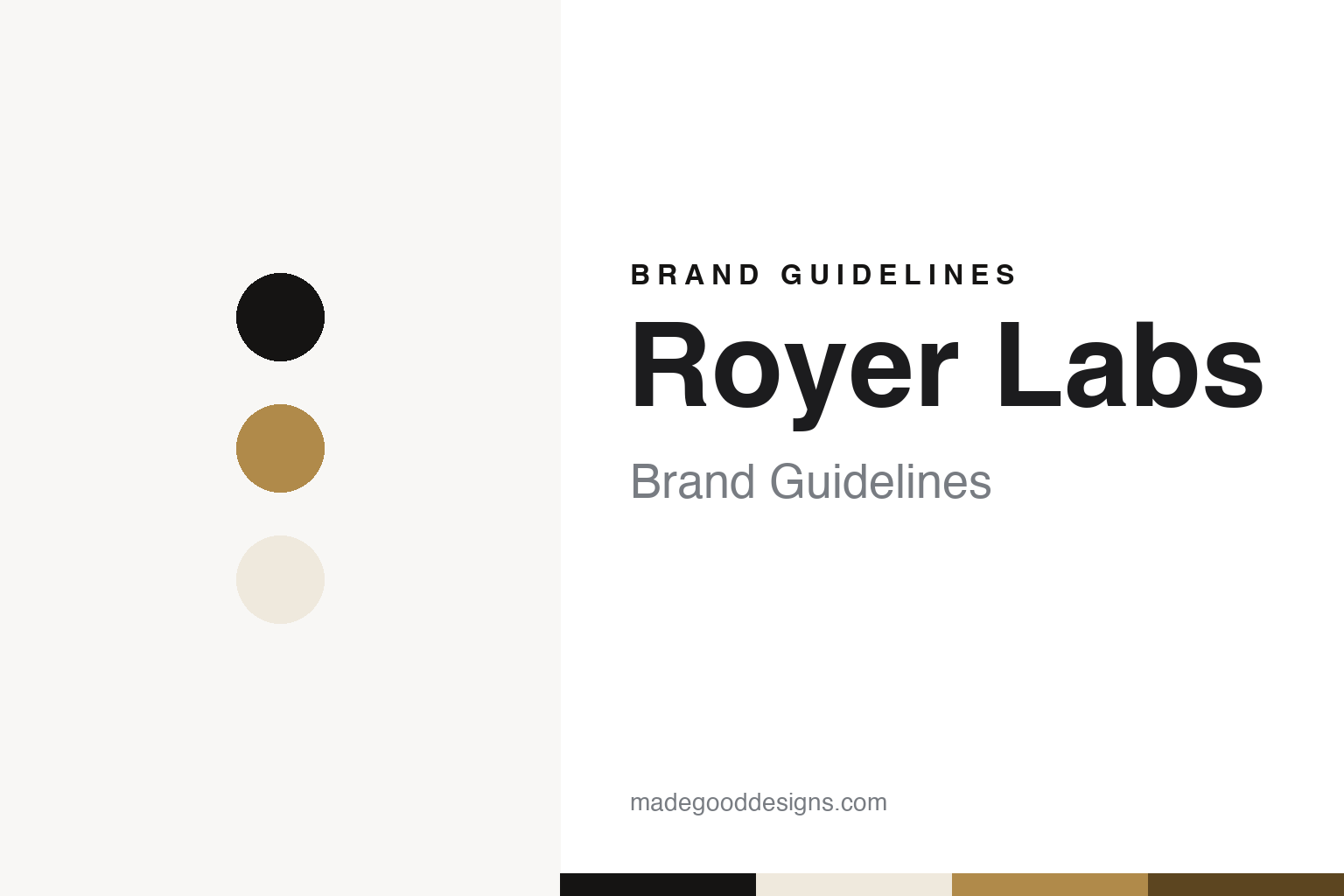
Royer Labs Brand Guidelines
The Burbank ribbon-mic maker that put an offset ribbon in the R-121.
Aa
Two constants: a ribbon black, brass and cream palette and a condensed sans register. Abstract homage — not a Royer Labs product or mark; no microphone, logo or nameplate is reproduced.
The R-121
One microphone, shown to a friend in 1997.
Royer Labs is a ribbon-microphone maker in Burbank, California, and its history begins with a single microphone. In 1997, the company says, David Royer designed his first ribbon microphone and showed it to his friend Rick Perrotta; that microphone, named the R-121, “led to the opening of Royer Labs in 1998.” English Wikipedia gives the same dates. Sound On Sound, reviewing the R-121 in April 2000, described “Royer Laboratories in Burbank, California” as founded by David Royer and Rick Perotta — the magazine’s spelling; the company writes Perrotta — “in order to bring Royer’s ribbon-microphone designs to the pro-audio marketplace.”
The founding team is described a little more widely by the company itself. In a 2024 announcement Royer Labs called both Perrotta and John Jennings, its long-serving head of sales and marketing, co-founders, and its website lists the producer and studio owner Rafael Villafane, Perrotta’s partner in a 1980s Los Angeles studio, as a founding partner. Perrotta recalled the business starting “in my backyard guesthouse.” The independent account we found, the 2000 review, names Royer and Perrotta, so we give the wider list as the company’s own description.
David Royer came to ribbons by way of condenser microphones. The company’s biography says he served four years in the US Navy as a sonar technician, then built condenser microphones, preamplifiers and compressors in his garage in Fullerton, California, under the Mojave Audio and DVA names, and that the first ribbon microphone he handled was a Reslo that needed repair. In a June 2012 interview with Recording Hacks, Royer said he had experimented with ribbons in the mid-1970s, returned to them in 1993 after re-ribboning a Reslo, and used the Mojave name when working as a “lone wolf” at times between 1983 and 1998. Sound On Sound added in 2000 that Perrotta had been production chief at Matchless Guitar Amplifiers and had earlier helped set up Baby-O Recorders in Los Angeles in the 1980s.
Colour
An offset ribbon and two claimed firsts.
The R-121’s distinguishing idea is the offset ribbon. US patent 6,434,252, titled “Ribbon microphone,” filed in September 1999 and granted in August 2002 with Royer Labs as assignee and David E. Royer and Richard T. Perrotta as inventors, describes a ribbon deliberately placed off the centre line between its magnets rather than in the middle of the gap. The company says that placement lets the ribbon take louder sources from the front, and that the back of its R-series microphones sounds slightly brighter at close range, so one microphone offers two voicings. English Wikipedia also credits neodymium magnets, stronger than the AlNiCo magnets of vintage designs, and a high-grade output transformer.
The range grew from there. The company lists the SF-12 stereo microphone soon after the R-121, then the R-122, which it says it introduced in 2002 as “the world’s first phantom powered, active ribbon™ microphone,” and the R-122V, which adds vacuum-tube electronics; English Wikipedia repeats both firsts, and we give them as the company’s claims. The current catalogue includes the R-10 and R-12, the R-121, R-122 MKII and R-122V, the SF-2, SF-12, SF-24 and SF-24V, and the dBooster inline preamplifiers; the Live Series versions of the R-121 and R-122 MKII are marked discontinued. The company says the R-122V and the Live Series won TEC Awards, and lists an Electronic Musician Editors’ Choice award for the R-121 in January 2000.
The clearest recognition is documented elsewhere. In 2013 Royer Labs received a Technical GRAMMY Award from the Recording Academy, alongside Ikutaro Kakehashi and Dave Smith, according to English Wikipedia’s list of recipients; the company says the award was for “bringing ribbon microphones into mainstream recording around the world.” Wikipedia names Carlos Santana, Herb Alpert, Steve Albini, Ross Hogarth and Ed Cherney among users. In Britain, Sound On Sound’s April 2000 review priced the R-121 at £817 including VAT.
Typography
Ribbons and their makers.
Behind the best-known microphone names stands a group of smaller specialists, each built around one kind of microphone: the condenser, with a charged diaphragm; the ribbon, a thin strip of foil in a magnetic field; and the dynamic, a moving coil.
Three condenser makers here are German. Schoeps was founded in Karlsruhe in 1948 and says it makes its whole range in Durlach, the city’s old town, and remains family-owned. Microtech Gefell, in Gefell in Thuringia, traces itself to the firm Georg Neumann founded in Berlin in 1928, which moved to Gefell in 1943; its legal notice names Georg Neumann KG as sole shareholder. Brauner, a valve-microphone maker, closed its production site at Rees on the Lower Rhine in 2021 and said in July 2026 that production would restart.
DPA Microphones, founded in Denmark in 1992 by two former Brüel & Kjær employees, has its head office at Kokkedal and its factory at Asnæs; in February 2026 the British group Audiotonix announced an agreement to buy it.
The ribbon specialists are Royer Labs of Burbank, California, founded in 1998, which says every Royer is hand-made in the USA, and Coles Electroacoustics of Hoddesdon, Hertfordshire, which says it has made the BBC-designed 4038 in Britain for more than 50 years.
Electro-Voice, best known for dynamic microphones and loudspeakers, began in South Bend, Indiana, and since 2025 has belonged to Keenfinity Group, the former Bosch business owned by the investment firm Triton.
This guide sets out what can be checked about each brand — who founded it, who owns it, and what it says about where its products are made — and marks clearly what rests only on the company’s own word.
Aa
A condensed sans — the narrow, technical register of a studio spec sheet. (Specimen set in Archivo Narrow, a sans STAND-IN; NOT the Royer Labs logo.)
Royer Labs
Made in Burbank, the company says.
Royer has kept manufacturing close to home. The company says “every Royer is hand-made in the USA,” that every R-121 “leaves our Burbank factory,” and that the R-122 MKII’s electronics are hand-wired there; it credits Perrotta with creating its “hand-built-in-the-USA production methodologies.” We give those as the company’s claims; we did not find an independent account of the factory. The R-121 carries a lifetime warranty, the company says, with the first re-ribbon free.
Leadership changed in 2024. Royer announced that Perrotta, its president, retired on 1 June 2024, and that John Jennings — “Royer’s co-founder and 26-year VP of Sales & Marketing” — became president, with Dave Bryce taking over sales and marketing. Perrotta, it said, would stay involved in technical and design work; Jennings has worked from Nashville since 2013, at an office the company calls Royer East, and David Royer is described as chief engineer. The announcement presents this as a handover among the founders rather than a sale, and the sources we checked record no acquisition of the company.
For a design guide, Royer Labs shows how one patented idea and a single model number can carry a brand for more than 25 years. Compare Coles Electroacoustics, the British maker of a BBC-designed ribbon microphone, and Aston, a British microphone maker. For this guide we use ribbon black, satin brass and studio cream with a condensed sans, an unofficial interpretation; no product or logo is reproduced.
Explore & save
Keep Royer Labs’s identity on hand — save it to a board in the Made Good inspiration library.
Royer Labs identity set
Pin the Royer Labs ribbon black, brass and cream palette and the condensed sans register to your own board.