Schoeps Brand Guidelines
The family microphone maker of Karlsruhe-Durlach.
Aa
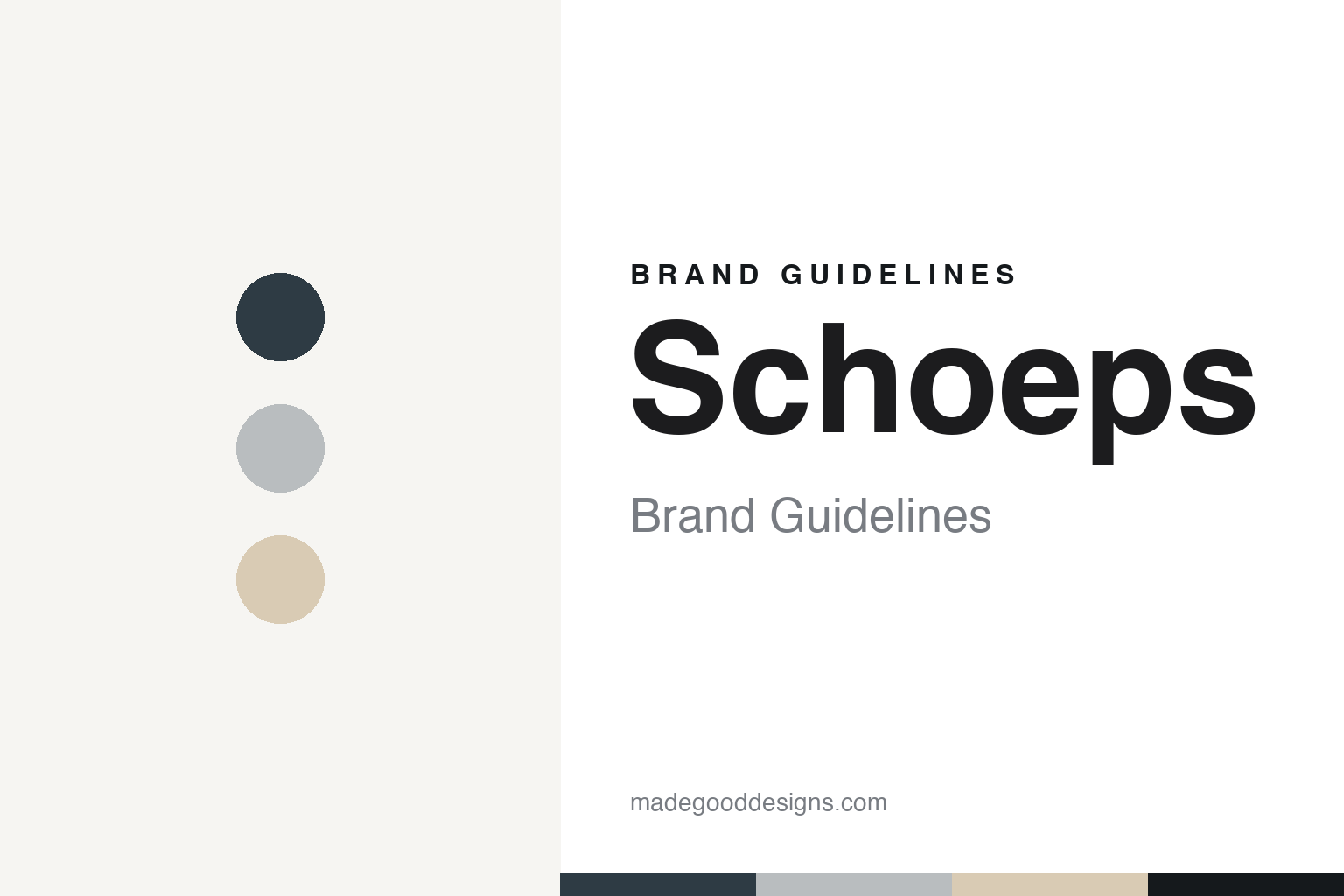
Two constants: a Schoeps slate, nickel and sandstone palette and an engineered sans register. Abstract homage — not a Schoeps product or mark; no microphone, logo or nameplate is reproduced.
Schalltechnik
Cinema sound, tape recorders, then microphones.
Schoeps was founded in 1948 in Durlach, the oldest district of Karlsruhe in south-west Germany, by the engineer Karl Schoeps, and it is still there. Its legal name, Schalltechnik Dr.-Ing. Schoeps GmbH, explains its beginnings: “Schalltechnik” means sound technology, and the company says it started with sound recording and public-address work in general, doing calculations for cinema sound systems and building tape recorders in small numbers, before microphones took over in the 1950s.
The exact founding date is less settled than the year. The company’s current website gives 1 March 1948; its own history page in 2017–18 said June 1948, adding that “the precise date is not recorded,” and the German magazine Professional audio also gave June in a 60th-anniversary report in January 2008. The company names its first employee as Wilhelm Küsters, like Schoeps a graduate in communications engineering from the technical university in Karlsruhe; Professional audio called him a co-founder. Küsters ran technology and production while Schoeps ran the business, the company says. The firm was entered in the commercial register only in 1956 and became a GmbH in 1978.
Its first big market was abroad. According to the company, Karl Schoeps’s friendship with a French sales agent with good contacts in broadcasting meant that in the 1950s “far more than half” of production went to France. Professional audio wrote that the valve CMV 51/3, nicknamed the “Muggebatscher” — Baden dialect for fly swatter — because of its shape, recorded postwar politicians including Charles de Gaulle and Konrad Adenauer.
The company has stayed in Durlach’s old town. It says it moved early on into a former brewery building whose foundation walls partly date from 1662; Professional audio described the building as listed and said Schoeps had been there since 1965, while the current company site gives 1953 for the purchase. Since 1990 a former dance hall opposite has housed series machining, the magazine reported.
Colour
Small capsules, modular bodies.
Schoeps’s reputation rests on small microphones. English Wikipedia notes that all its microphones use externally polarised, not electret, condenser capsules with a single small diaphragm, even where they offer several pickup patterns. Early valve models grew out of a relationship with Telefunken; the M 221 B, built around Telefunken’s subminiature AC 701 valve, is the company’s best-known vintage series, dated 1954 by the company and 1955 by Professional audio.
In 1964 came the CMT 20, a transistor microphone that English Wikipedia says was created for French radio. Both the company and Professional audio describe it as the first phantom-powered microphone, with a transformerless output — a principle the magazine said Schoeps has kept ever since.
The best-known design is the Colette modular system, in which a capsule screws onto an amplifier body, and “active” cables, tubes and goosenecks let the capsule sit apart from it. Its date varies: Professional audio, German Wikipedia and the company’s 2018 site give 1973; the current site and English Wikipedia give 1974. The magazine credited the engineer Jörg Wuttke, technical director for more than 35 years, as its father, and said the name came from the company’s then main French importer, after his niece Colette. It also reported that the Three Tenors sang into Colette microphones on active tubes.
Later lines shrank the idea further: the MSTC stereo microphone of 1976, which the company says was the first made for the ORTF technique; the CCM compacts of 1994, which it calls the smallest professional studio condenser microphones in the world; the CMIT 5 shotgun of 2005; and surround and 3D arrays. Users documented by German Wikipedia include the Tagesschau and heute news programmes, the Bundestag, the Bundesrat and the Berlin Philharmonie’s Digital Concert Hall.
The look is deliberately plain. The company describes products that combine transparent sound “with an elegant, simple design,” and says its V4 studio microphone of 2014 borrowed the “tennis racket” capsule head of the 1952 M 201 and the body of the CM 51/3. It also says its logo was substantially changed for the first time in early 2003, keeping its symbolism.
Typography
Design and documentation.
Behind the best-known microphone names stands a group of smaller specialists, each built around one kind of microphone: the condenser, with a charged diaphragm; the ribbon, a thin strip of foil in a magnetic field; and the dynamic, a moving coil.
Three condenser makers here are German. Schoeps was founded in Karlsruhe in 1948 and says it makes its whole range in Durlach, the city’s old town, and remains family-owned. Microtech Gefell, in Gefell in Thuringia, traces itself to the firm Georg Neumann founded in Berlin in 1928, which moved to Gefell in 1943; its legal notice names Georg Neumann KG as sole shareholder. Brauner, a valve-microphone maker, closed its production site at Rees on the Lower Rhine in 2021 and said in July 2026 that production would restart.
DPA Microphones, founded in Denmark in 1992 by two former Brüel & Kjær employees, has its head office at Kokkedal and its factory at Asnæs; in February 2026 the British group Audiotonix announced an agreement to buy it.
The ribbon specialists are Royer Labs of Burbank, California, founded in 1998, which says every Royer is hand-made in the USA, and Coles Electroacoustics of Hoddesdon, Hertfordshire, which says it has made the BBC-designed 4038 in Britain for more than 50 years.
Electro-Voice, best known for dynamic microphones and loudspeakers, began in South Bend, Indiana, and since 2025 has belonged to Keenfinity Group, the former Bosch business owned by the investment firm Triton.
This guide sets out what can be checked about each brand — who founded it, who owns it, and what it says about where its products are made — and marks clearly what rests only on the company’s own word.
Aa
An engineered sans for a maker of plain, precise objects. (Specimen set in Archivo, a sans STAND-IN; NOT the Schoeps logo.)
Schoeps
Still family-owned, still in Durlach.
Schoeps has not been sold. The company says it remains privately family-owned, with Ulrich Schoeps, the founder’s son, as majority shareholder. He joined in 1980, became managing director alongside his father in 1986 and ran the business alone from the end of 1993; Jörg Wuttke became a second shareholder in 1997, the company says. In January 2015 Ulrich Schoeps stepped back from management, and the company is now run by Karin Fléing and Helmut Wittek, the managing directors named on its website.
On manufacturing, the company says its entire range is made in Durlach’s old town — “Made in Germany” — by a team of about 50, who make all the essential parts including the capsule. The independent evidence is older: Professional audio, visiting in 2008, described an in-house operation making almost everything, with one manager putting the figure at 98 per cent, and capsules of about twenty parts assembled by hand under microscopes and each tested before leaving. German Wikipedia gives 55 employees, citing the company’s 2018 annual accounts.
For a design guide, Schoeps shows how a family company can build an identity on small, plain, modular objects rather than on ornament. Compare Neumann, the Berlin maker now part of Sennheiser, and Sennheiser itself. For this guide we use slate, nickel grey and sandstone with a sans, an unofficial interpretation; no product or logo is reproduced.
Explore & save
Keep Schoeps’s identity on hand — save it to a board in the Made Good inspiration library.
Schoeps identity set
Pin the Schoeps slate, nickel and sandstone palette and the engineered sans register to your own board.