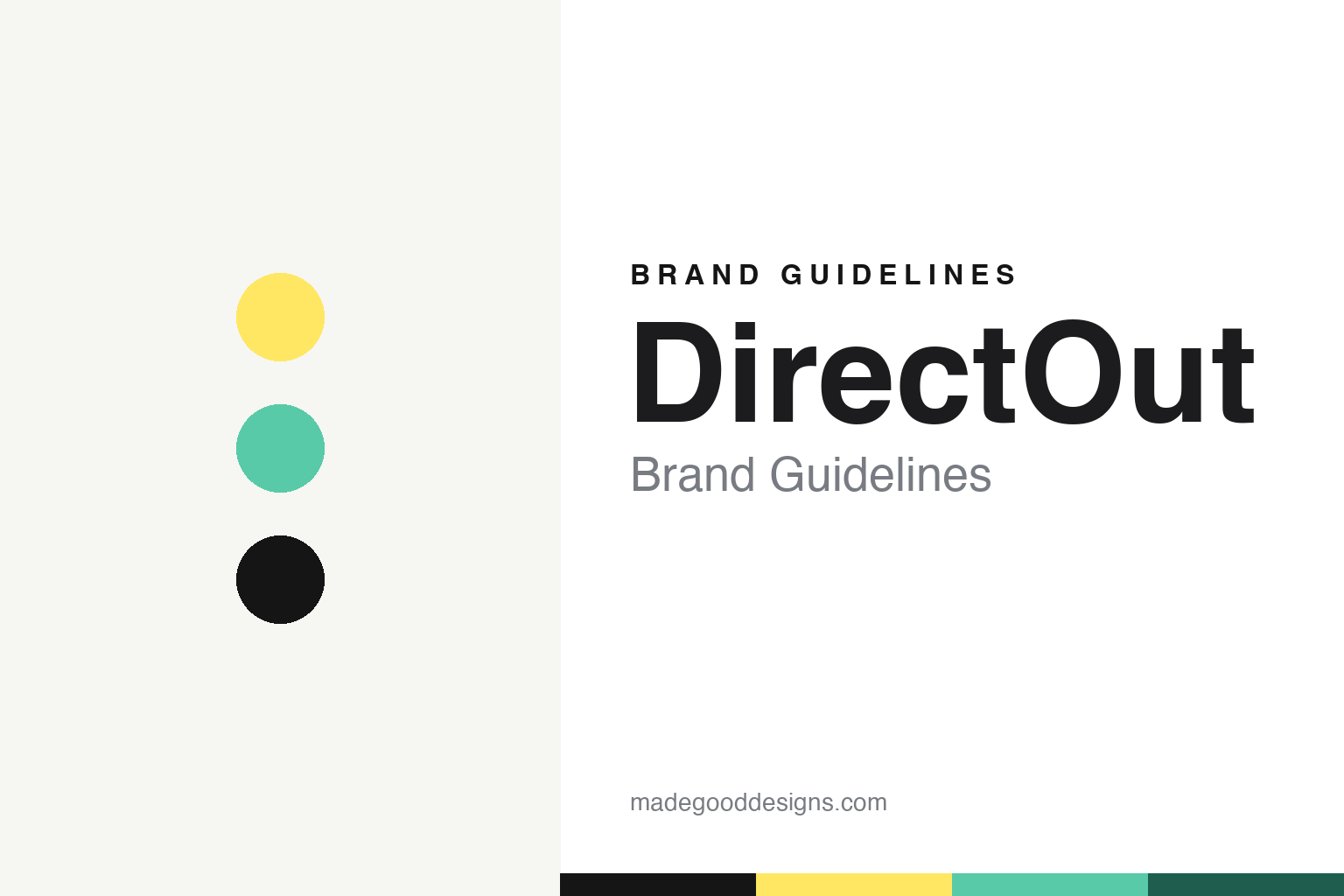
DirectOut Brand Guidelines
The Mittweida MADI specialist that bridges audio networks.
Aa
Two constants: a DirectOut signal yellow, mint and black palette and a Technical sans register. Abstract homage — not a DirectOut product or mark; no device, logo or nameplate is reproduced.
D.O.TEC
A Saxon company built around MADI.
DirectOut is a German maker of audio connectivity equipment — the converters, routers and network bridges that move large numbers of audio channels between mixing consoles, stage racks, computers and broadcast systems. The company dates itself to 2008, and its entry in the German commercial register dates from February 2009, according to register filings summarised by North Data; we give 2008 as the company’s own date.
It is based in Mittweida, a town of about 13,700 people in the Mittelsachsen district of Saxony. The town is home to a technical college, founded as the Technikum Mittweida in 1867 and now the Hochschule Mittweida, German Wikipedia says. In 2011 DirectOut’s website set out its purpose: “DirectOut GmbH was founded in 2008 with the aim of establishing effective and efficient cooperation between development, manufacturing and sales within one company” (our translation from the German).
Its products were sold under the brand DirectOut Technologies, shortened to D.O.TEC, a name that appeared on early models such as the D.O.TEC M.1k2 and that the register summary shows as a trademark from 2010.
On founders, the record is thin. In January 2019 the company called Claudio Becker-Foss a co-founder who had worked as product manager and software developer “since its beginnings in 2008.” Its 2011 imprint named two managing directors, Detlev Müller and Stephan Flock, and in 2010 its news page described Flock as chief technology officer. We found no source that names the full founding group, so we name only those the records show, and only Becker-Foss as a co-founder.
Colour
From MADI to audio over IP.
MADI, the Multichannel Audio Digital Interface, is the AES10 standard, first published in 1991 and developed by AMS Neve, Solid State Logic, Sony and Mitsubishi, English Wikipedia says; since a 2003 revision it carries up to 64 channels on one cable. DirectOut built its early range around it. In November 2010, at the Tonmeistertagung, the German sound engineers’ convention in Leipzig, it showed two new products: the ANDIAMO, a 32-channel analogue-to-digital and digital-to-analogue converter with a MADI port, in a single rack unit, and the M.1k2, a 16-port MADI router with a 1,024-by-1,024 routing matrix.
It moved early into networked audio. In September 2010 it announced that it had become a partner in RAVENNA, the audio-over-IP technology developed by ALC NetworX, a Lawo company, and introduced at IBC in Amsterdam that month; English Wikipedia still lists DirectOut among RAVENNA partners. Flock said then that MADI had long been the most important format for carrying many channels, but that network technology now played “a fundamental role.” In 2016 DirectOut announced a licensing partnership with Waves for its SoundGrid network, and it now lists Dante, AES67 and SMPTE ST 2110 among the formats its products bridge.
The range has since grown from boxes into platforms. The PRODIGY series added digital signal processing: the PRODIGY.MC modular converter in 2018, then the PRODIGY.MP multifunction processor, and the PRODIGY.MX matrix in 2023. A third-generation ANDIAMO followed in 2022, with Becker-Foss recalling that the first was launched in 2010. In May 2026 the company announced ACE, a compact platform that, it says, fits in a backpack.
DirectOut also works with RME, the German audio-interface maker. In 2022 the two presented the Digiface Ravenna, an RME interface with a RAVENNA module developed by DirectOut; the USB.IO module of 2024 and the USB.MADI of 2026 are built on RME’s USB technology.
Typography
The specialists behind the big consoles.
Big consoles get the attention, but much of a modern studio’s signal path runs through equipment from smaller specialist makers. The seven companies in this guide each built a name in one link of that chain: summing, conversion between analogue and digital, microphone preamplifiers, or moving audio between systems.
Summing is where Dangerous Music began. The company says it was officially founded in 2001 with the release of its 2-BUS analogue summing amplifier. Its website gave an address in Edmeston, in upstate New York, in 2008 and 2014.
Conversion is central to several others. Lavry Engineering, whose range includes the Quintessence digital-to-analogue converter, gives its shipping address as Kingston, Washington. Crane Song, whose products have included HEDD converters, gave its address as Superior, Wisconsin, on its website in 2005. Burl Audio, which says it was founded in 2006, makes converters and microphone preamplifiers and describes itself as “based in Santa Cruz, California.”
Grace Design, a family firm that says it was founded by the brothers Michael and Eben Grace in the early 1990s, makes microphone preamplifiers and says its shop is in Lyons, Colorado. SPL electronics, which names Hermann Gier and Wolfgang Neumann as its founders, is based in Niederkrüchten, Germany, and uses the line “Sound Performance – Made in Germany.” DirectOut, from Mittweida in Saxony, works on the networking side, with MADI and audio-over-IP converters and routers that link consoles, stage racks and computers.
This guide sets out what can be checked about each brand — who founded it, who owns it, and what it says about where its products are made — and marks clearly what rests only on the company’s own word.
Aa
A technical sans — DirectOut Technologies, once D.O.TEC. (Specimen set in Barlow, a sans STAND-IN; NOT the DirectOut logo.)
DirectOut
A Mittweida company with Mittweida shareholders.
DirectOut GmbH is privately held, and it is not one company’s subsidiary. Register filings summarised by North Data show several shareholders, among them IMM electronics GmbH, an electronics development and manufacturing firm in Mittweida founded in 1991 by Detlev Müller — the same Detlev Müller listed as a DirectOut managing director in 2011. IMM’s own company history says that in 2019 it congratulated DirectOut on its tenth anniversary “as partner for development and manufacturing,” and records that IMM began producing audio equipment for RME in 1996. In 2011 DirectOut gave the same street address as IMM gives today. The size of each holding is not shown in the sources we read, so we do not call IMM the owner.
Its leadership has changed several times. Jan Ehrlich has been chief executive and sales director since 2014, the company said in 2019, when Becker-Foss became chief executive and chief technology officer and Flock moved to research and development. In February 2026 it appointed a three-member board: Luca Giaroli as chief executive, René In der Stroth — also chief financial officer of IMM electronics, according to IMM’s website — as chief financial officer, and Ehrlich as chief operating officer, with Becker-Foss remaining chief technology officer. In January 2026 it opened DirectOut LLC, a wholly owned subsidiary in Fort Wayne, Indiana, and in June 2026 it announced a technology partnership — not a takeover — with the Italian sound-system maker RCF.
On manufacturing, its 2011 website said its self-developed products were “manufactured in Germany” (our translation); we did not find an equivalent statement on the pages of its current website we read, and give the 2011 wording as the company’s claim. No brand guidelines are published, but its website makes heavy use of a pale yellow, #FFE763, and a mint green, #58CAA8, against black and white.
For a design guide, DirectOut shows how a specialist can build a brand on interfaces rather than on a famous front panel. Compare RME, its German partner on computer interfaces, and Solid State Logic, one of the companies behind the MADI standard. For this guide we use a signal yellow, a mint green and a rack green on black with a sans, an unofficial interpretation; no product or logo is reproduced.
Explore & save
Keep DirectOut’s identity on hand — save it to a board in the Made Good inspiration library.
DirectOut identity set
Pin the DirectOut signal yellow, mint and black palette and the Technical sans register to your own board.