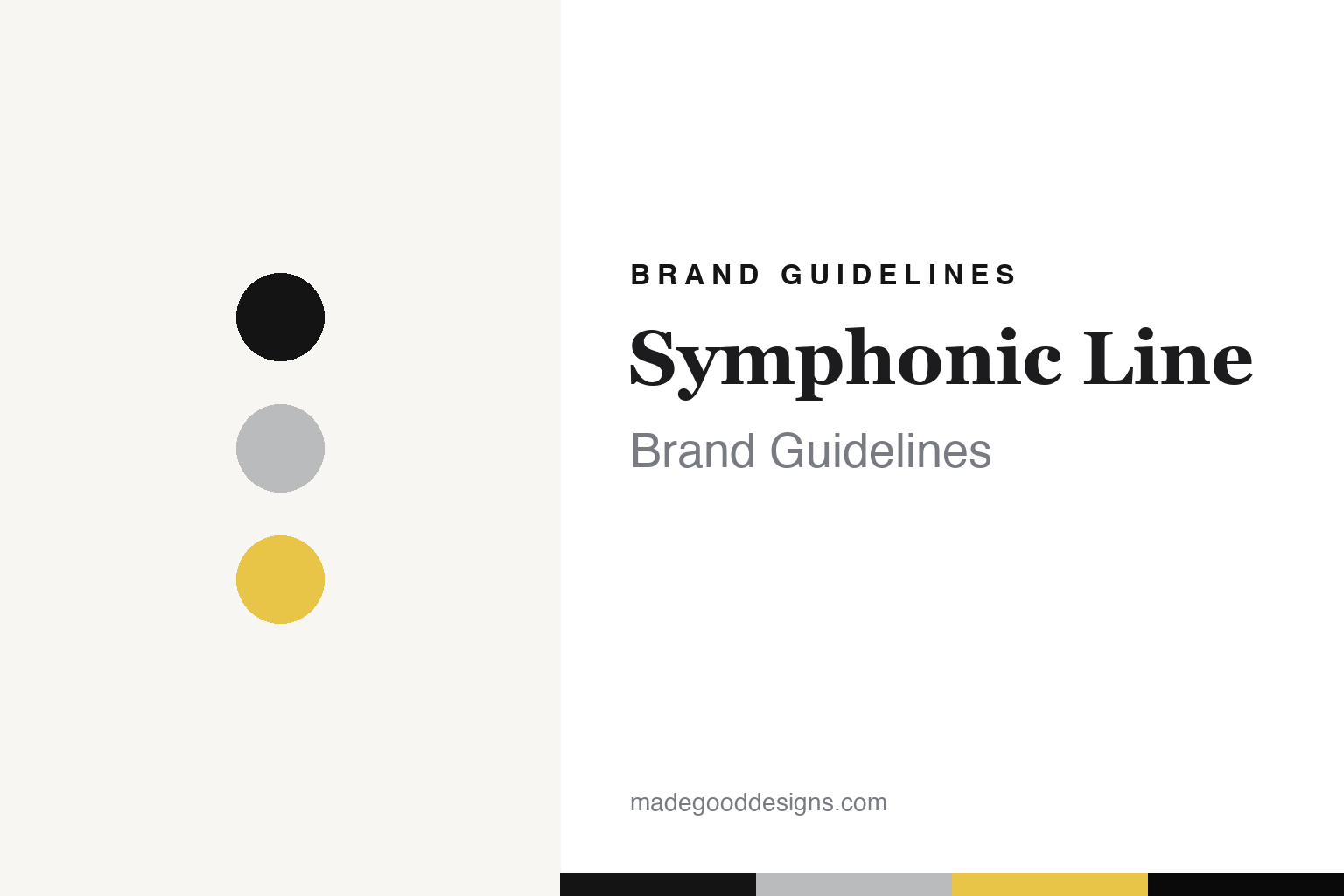
Symphonic Line Brand Guidelines
Rolf Gemein’s hand-tuned amplifiers from Duisburg.
Aa
Two constants: a black, silver and pad-yellow palette and a script serif register. Abstract homage — not a Symphonic Line product or mark; no amplifier, logo or nameplate is reproduced.
Vernissage to Duisburg
An owner, a workshop and an earlier company.
Symphonic Line is the amplifier workshop of Rolf Gemein in Duisburg, in Germany’s Ruhr region. Its legal notice names Gemein as the owner (“Inhaber”), and the trade press treats the man and the brand as one: HiFi Test called him the “founder and soul” of Symphonic Line in its 1/2026 issue, and lite magazine has described him as its “founder and mastermind.” There is no German or English Wikipedia article on the firm, so this account rests on the company’s own pages and on magazine reports.
The story begins before Symphonic Line. According to HiFi Test, Gemein and two friends decided, in a Düsseldorf ice-cream café, to build “the best amplifier in the world,” and so founded a company called Vernissage. The partnership did not last — “three individuals were in the long run two too many,” the magazine wrote — and Gemein founded Symphonic Line on the basis of what he had learned there. The company dates Gemein’s career as a high-end maker to 1979 and says that in 1980 he presented the Vernissage Kraft 100, a pure class-A power amplifier. lite, reviewing an anniversary model in July 2023, said Gemein had co-developed that amplifier at Vernissage about four decades earlier and that Symphonic Line was marking its fortieth birthday.
When Symphonic Line itself was founded is less clear. The sources we checked give no firm date: HiFi Vision wrote in 2018 that Gemein had been making his name from a workshop in central Duisburg for “around 31 years,” HiFi-Stars spoke in 2020 of “almost four decades” of Symphonic Line products, and lite and HiFi Test now say more than forty years. We therefore give no single founding year. The company also describes Gemein as a co-founder of the High End Society, the association behind the HIGH END show, and lite has called him a co-initiator of German high end; we report that as their description.
Colour
Tuned by ear, improved for decades.
Symphonic Line makes mostly amplifiers, sold as parts of a complete chain. The current range runs from the Klarheit 1 integrated amplifier, which the company calls the way in, through the RG 14 Edition and RG 10 Reference integrateds, the RG 3 preamplifier and the Kraft 300 and Kraftwerk power amplifiers, to CD players, phono stages, an analogue tuner, cables, power filters, a 50-kilogram RG 6 turntable and loudspeakers. In September 2026 it showed a new reference loudspeaker called Klangbrunnen.
The company’s idea is continuity. Models stay in the catalogue for decades and are improved in steps — the RG 14 has reached “MK 5” — and HiFi Test reported that Gemein has been updating older units for customers since the early 1980s. “Because a good product should not be bad even after years,” Gemein told HiFi-Stars. The Kraft 300 Class A Anniversary Edition MK 3, which lite tested in 2023 at €35,000, carries the Kraft idea forward with two complete mono amplifiers in one case.
The best-documented habit is tuning. lite and HiFi Test both describe how Gemein finishes each unit himself, by ear, in his Duisburg listening room, applying small damping pads — yellow pads are visible inside the cases — and dabs of a lacquer called C37, which HiFi Test says is mixed for him by the Austrian violin maker Dieter Ennemoser. Gemein calls this “resonance-pattern tuning.” The magazines report it as his method rather than testing the claim, and so do we.
Typography
Design and documentation.
The seven brands here are smaller, long-running German hi-fi makers; six still trade, most run by a founder or a founder’s family.
ASR is in Herborn, Hesse; its owner, Friedrich Schäfer, says he founded it in 1980 with Michael Rompf, who left in 1994. Restek AG of Fuldabrück, near Kassel, says Adrianus Elschot and Bernd Hugo founded it in 1975; Elschot still heads it. Gauder Akustik of Renningen, near Stuttgart, says Roland Gauder and Achim Knapp founded it in 1997.
Phonar of Tarp, in Schleswig-Holstein, says it built speakers for other brands as Scan Akustik before Klaus Henningsen founded Phonar Akustik in 1983; his son Kai took over in 1998. Abacus Electronics of Nordenham began in 1983 as Audio Pro Deutschland, part of Sweden’s Audio Pro, founder Karl-Heinz Sonder told fairaudio; the current company was registered in 2022 with Hanno Sonder as managing director. Symphonic Line of Duisburg belongs to Rolf Gemein, who founded it after an earlier firm, Vernissage, HiFi Test reported.
Isophon is the exception: German Wikipedia says the Berlin company, founded in 1929, was sold to the Bosch/Blaupunkt group in the 1980s while its name stayed with the owning family. Gauder’s firm used the name until building the last Isophon on 31 December 2012.
Five of the six active makers say they build in Germany; trade-press reports place workshops in Nordenham, Duisburg and Renningen. Phonar, a self-described manufactory, said in 2001 that many of its cabinets were made in Scandinavia.
This guide sets out what can be checked about each brand — who founded it, who owns it, and what it says about where its products are made — and marks clearly what rests only on the company’s own word.
Aa
A script serif — echoing the script lettering on the front plate. (Specimen set in Cormorant Garamond, a serif STAND-IN; NOT the Symphonic Line logo.)
Symphonic Line
Script lettering on a black front.
On where the products are made, the sources agree on Duisburg. HiFi Vision wrote in 2018 that all products were built by hand in an “almost tiny” workshop there, and lite calls it a Duisburg manufaktur. HiFi Test added detail in 2026: Gemein wants as much as possible to come from Germany, with capacitors custom-made in northern Germany, cases from Lünen, front panels from the Westerwald and engraving from Essen. The same report said certain circuits were commissioned decades ago and that a capable engineer has worked for Gemein for more than thirty years, so “tuned by Gemein” is documented, while “built by Gemein alone” is not.
Visually the brand barely changes. HiFi-Stars described the cases as plain and rectilinear, “typical of Rolf Gemein products,” apart from the script lettering on a 10-millimetre front plate of black-anodised aluminium; HiFi Vision noted solid knobs that, on the Edition model, stand out in matt silver against the black. The Kraft 300 comes in silver or black, with chrome at extra cost. “At the Duisburg manufaktur nobody turns the design wheel,” HiFi Test wrote.
The company lists its own honours — a High End prize in 1990 and 1991, a first prize for sound at a 1995 Venice hi-fi show, awards in Greece in 1997 and 1998 and HiFi Stars awards in 2011 and 2012 — and says Gemein received an honorary prize for his life’s work from the Audio Analog Association in Moers in March 2026. We give these as its claims. It remains active: in 2026 it exhibited at HIGH END in Vienna and at the Süddeutsche Hifi-Tage in Stuttgart, and it lists further shows in Düsseldorf and Hamburg.
For a design guide, Symphonic Line shows how a one-man brand can be recognised by restraint: one front, one script and decades of the same proportions. Compare Einstein, another Ruhr-region amplifier maker, and Burmester. For this guide we use anodised black, matt silver and a pad yellow with a serif, an unofficial interpretation; no product or logo is reproduced.
Explore & save
Keep Symphonic Line’s identity on hand — save it to a board in the Made Good inspiration library.
Symphonic Line identity set
Pin the Symphonic Line black, silver and pad-yellow palette and the script serif register to your own board.