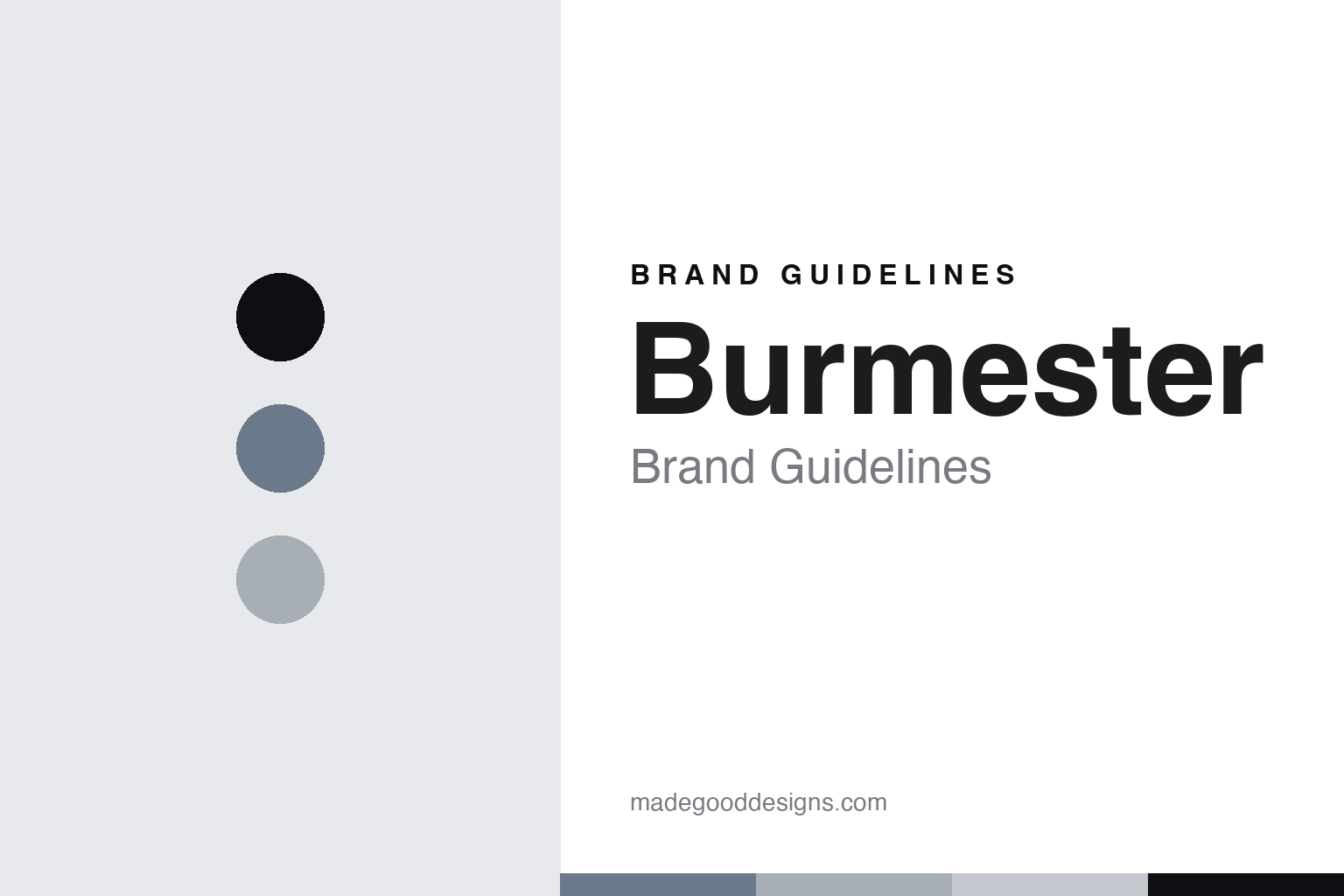
Burmester Brand Guidelines
The mirror fascia.
Aa
Two constants: a chrome-and-steel palette and a chrome sans register. Abstract homage — not a Burmester device or wordmark.
The mirror fascia
Burmester builds high-end electronics with mirror-chrome front panels in Berlin.
Burmester is a lesson in a finish as the identity. A German high-end maker in Berlin, it builds amplifiers, players and systems whose front panels are mirror-polished chrome — a bright, reflective fascia that has been its signature since the late 1970s. Electronics, made a mirror.
Its identity is the mirror fascia. Burmester’s chrome front panels and machined casework are the work it is known for. A surface, made a signature. A maker whose devices reflect the room.
(Honest notes, so the story stays precise. Burmester was founded in 1977 by Dieter Burmester, a musician and engineer who built his first preamplifier from medical-machine parts; he died in 2015, after which his widow Marianne Burmester led the company, and it is now run by two co-chief-executives while the family remains involved — so we write Dieter in the past tense. Importantly, it is independent and family-owned — it describes itself as the last independent maker in its class — and, to be clear, it has not been acquired by any Chinese group; that is a different company. Everything is developed and hand-built in small batches in Berlin, and individually tested, so it is genuinely German-made. Its separate car-audio division supplies makers such as Porsche, but we keep that distinct from its home hi-fi. Its designs and name are its IP, described but never reproduced, and there is no official brand hex — these tones are an unofficial interpretation. This is design commentary and does not promote any product.)
Colour
Burmester lives in a chrome-and-steel palette. Click a swatch to copy the hex.
Burmester’s identity is bright, reflective and luxurious — a chrome, an ink, a steel, a silver, and a chalk. The palette leans chrome and steel: the register of a mirror-polished surface and machined metal. It signals luxury and precision over warmth. The honest caveat: with no published brand hex, these values are an original, unofficial interpretation of a metallic look, not first-party colours.
The lesson is a chrome-and-steel palette signals a mirror-luxury identity. Burmester’s world is a bright, reflective, precise object. For designers, it is a reminder that a high-key metallic palette can carry a brand built on a reflective finish — the chrome of a mirror fascia and the steel of machined casework. Because these tones can fail as small text, keep type dark and let the colour live in the accents, palette and band. The takeaways: own a finish; keep it independent; make it at home; and treat any single hex as unofficial.
Typography
The register is a chrome sans — sleek, precise, luxurious.
Burmester’s identity carries a sleek, precise, luxurious spirit — a reflective object, not a matte one. A chrome sans captures the mood: crisp, contemporary and polished, the register of a mirror fascia. Set in a chrome-and-steel palette, the chrome sans feels sleek and luxurious — exactly the personality Burmester carries. It is polished rather than plain, mirroring a reflective front panel. (Burmester’s real devices and wordmark are things we describe but do not reproduce, and the exact typeface is not ours to use.) Because it is not ours to use, the honest description is “a chrome-sans spirit,” shown here in a stand-in. The type behaves like the maker: sleek, precise and luxurious.
Aa
A chrome-sans spirit — sleek and luxurious. (Specimen set in Syne, a chrome-sans STAND-IN; NOT the Burmester wordmark or any device design.)
A finish as identity
Burmester stands for the mirror fascia.
Burmester is a lesson in making a finish the identity. A chrome-and-steel palette, a chrome sans and mirror-fronted electronics make a reflective face the whole maker — bright, precise and luxurious. The chrome is the differentiator. The differentiator is a genuine, consistent signature — a mirror-polished fascia carried across decades and hand-built in Berlin, distinctive enough to be recognised at a glance.
Put to work, the identity is a finish as a face. A maker building in this spirit would hold one recognisable surface across its whole range, keep the making at home, and stay honest about its independence, so the customer buys into a look and a heritage rather than a spec. It would treat a reflective detail as a signature to protect, not a fashion to drop. The lesson Burmester teaches is that a consistent, distinctive finish can build a brand: the chrome gives it recognition, and the German making gives it credibility. The finish is the personality, and the making is the proof.
For designers and brand-builders, Burmester offers a clear takeaway: own a finish and hold it. The lessons: own a surface; keep it independent; make it at home; and be honest about the story. It is also a reminder to stay accurate: Burmester is an independent, family-owned German maker founded in 1977 by Dieter Burmester, who died in 2015, hand-building mirror-chrome electronics in Berlin — and it has not been acquired by any outside group — with the palette here an unofficial interpretation. Burmester made the mirror fascia the maker — proof that a finish can be the difference.
Explore & save
Keep Burmester’s identity on hand — save it to a board in the Made Good inspiration library.
Burmester identity set
Pin the chrome-and-steel palette and the chrome-sans register to your own board.