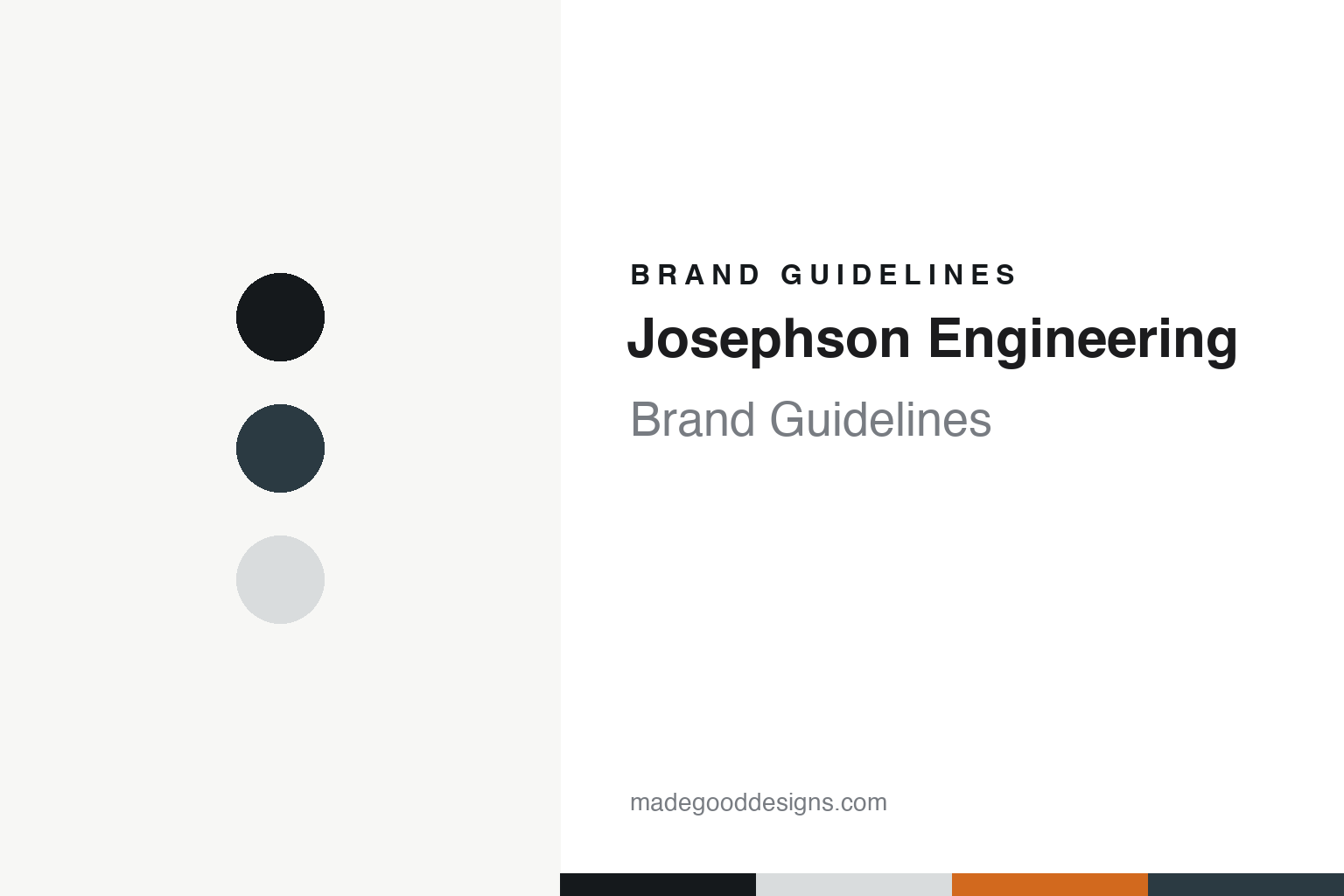
Josephson Engineering Brand Guidelines
The Santa Cruz microphone maker that builds its own capsules.
Aa
Two constants: a Josephson graphite, aluminium and orange palette and a Technical sans register. Abstract homage — not a Josephson Engineering product or mark; no microphone, logo or nameplate is reproduced.
From San Jose to Santa Cruz
An engineering firm that makes microphones.
Josephson Engineering is a condenser-microphone maker in Santa Cruz, California, named after its engineer David Josephson. Its website states its claim in one line: “Professional Condenser Microphones Since 1988 • Made in Santa Cruz, California.” The company says it “began in San Jose, California in 1988 and moved to Santa Cruz in 2000.” Sound On Sound gave the same founding year in October 2011, writing that the company “started business over 23 years ago, in 1988.” One older company page, archived in 2006, gave 1989 instead, so we note the difference.
Its website has been online for three decades: the web archive holds a copy from December 1996, when the company was still in San Jose, with its lab and workshop inside the Reid-Hillview airport there. Even then it described itself as making condenser microphones “for studio, stage and field sound pickup, and audio instrumentation,” and said it also supplied “several other mic companies around the world with diaphragms and completed microphone capsules.” The same page mentioned a talk it had given at the Audio Engineering Society’s 1995 convention in New York on the limits of how microphones are specified and measured.
David Josephson described his background to the magazine Tape Op in July 2005: he studied electrical engineering at Berkeley and was chief engineer at the campus radio station for four years. The key to a good design, he said, is “to balance between physics and music.” The company is not a one-man firm. In the same interview he named the acoustical engineer Kelly Kay as a part owner, and a company careers page dated December 2009 named three principals — David Josephson, Kelly Kay and David Gordon — working full time at the Santa Cruz shop. We found no record of a sale.
Colour
Capsules first, then microphones.
What sets Josephson apart is that it makes its own capsules — the diaphragm assembly at the heart of a condenser microphone. Sound On Sound wrote in July 2026 that David Josephson is among the few with the skill to design and build them, and that his capsules are used in “quite a few highly regarded ‘boutique’ mics from other manufacturers.” An archived company page from 2006 named two such customers: Manley Laboratories, for whose Gold Reference microphones it said it made a dual large-diaphragm capsule, and Groove Tubes, for which it said it made the Series 2 and Series 3 capsules until that company became part of Alesis. Sound On Sound wrote in 2021 that Josephson had used the Sony C-37A as the inspiration for the original Groove Tubes microphones in the 1990s.
Its own range is grouped in numbered series. Series Six, small-diaphragm microphones with interchangeable capsules, dates from 1988, the company says; it includes the C617SET, which uses a nickel-diaphragm measurement capsule from Microtech Gefell in Germany, and the e22S, a close-range drum microphone that the company says was developed with the engineer Steve Albini of Electrical Audio.
Series Seven holds the large-diaphragm models. The C700 records pressure and pressure-gradient signals separately, so that the pickup pattern can be chosen in the mix rather than at the session; the C700S adds a sideways element for stereo. The C715 uses a single large diaphragm with an adjustable rear vent for cardioid or omni, a method Sound On Sound compared in 2020 to the Sony C-37A’s, inside a basket of open-cell aluminium foam. The C716, introduced in 2010, was reviewed by the magazine in 2011 at $3,995 and praised for a “remarkably transparent sound character”; the valve C725 was reviewed in 2018 at $8,800. The C705, a cheaper cardioid version of the C715 in a steel body, was reviewed in 2020 at $2,550, and the C706 uses Josephson’s J12, a recreation of AKG’s CK12 capsule that Sound On Sound says it has made since 1990.
Typography
Design and documentation.
This round turns to six more microphone makers: boutique valve and ribbon designers in California, a British maker on the Dorset coast, and a brand made in Russia.
Four are in California. AEA is in Pasadena and says its microphones are “handcrafted” there. Mojave Audio, which says it was co-founded in 2005 by the producer Dusty Wakeman and the designer David Royer, calls itself “family-owned” and based in Los Angeles. Josephson Engineering says it began in San Jose in 1988, moved to Santa Cruz in 2000, and designs and makes all its products there. Bock Audio, which David Bock says he formed in 2007 after co-founding Soundelux Microphones, designs the valve and FET microphones that Universal Audio has sold since 2022, which UA says it hand-builds at its Santa Cruz custom shop.
Sontronics is in Poole, Dorset, and its website names Omnisonic International Ltd. Soyuz is in Tula, Russia; English Wikipedia, citing Reuters, says it was founded in 2013 by the American singer David Arthur Brown and the Russian entrepreneur Pavel Bazdyrev.
This guide sets out what can be checked about each brand — who founded it, who owns it, and what it says about where its products are made — and marks clearly what rests only on the company’s own word.
Aa
A technical sans — the register of model numbers and data sheets. (Specimen set in IBM Plex Sans, a sans STAND-IN; NOT the Josephson Engineering logo.)
Josephson Engineering
“Made in Santa Cruz.”
Josephson’s manufacturing claim is unusually complete. “All of our products are designed and manufactured in our facility in Santa Cruz,” its website says, and the 2009 careers page described the shop as the place “where all our microphones are made,” adding: “We build entire microphones, their electronics, housings and capsules.” We give those as the company’s statements; Sound On Sound’s reviewer wrote in February 2018 that the C725 is “built in the company’s own Santa Cruz factory.” In February 2011 Wired published a photo story from the workshop, in a refurbished industrial area of the town, describing an anechoic chamber, tolerances “measured in nanometers” and microphones costing “as much as $7,000.”
The firm is also a measurement business. It says it has brought Microtech Gefell’s measurement microphones to North America since 1991, sells its own C550 measurement range, and has worked since 2014 on measuring aircraft noise for the “urban air taxi” industry with government researchers — claims we give as the company’s own. Its identity is engineering-led: a plain website, still marked © 2014, with products named by series and number rather than by character. We found no published brand guidelines, and no colours or typefaces documented.
For a design guide, Josephson Engineering shows a brand built on specifications rather than nostalgia. Compare Microtech Gefell, whose measurement microphones Josephson distributes, and AKG, whose CK12 capsule Josephson recreates. For this guide we use a graphite, an aluminium grey and a signal orange with a sans, an unofficial interpretation; no product or logo is reproduced.
Explore & save
Keep Josephson Engineering’s identity on hand — save it to a board in the Made Good inspiration library.
Josephson Engineering identity set
Pin the Josephson graphite, aluminium and orange palette and the Technical sans register to your own board.