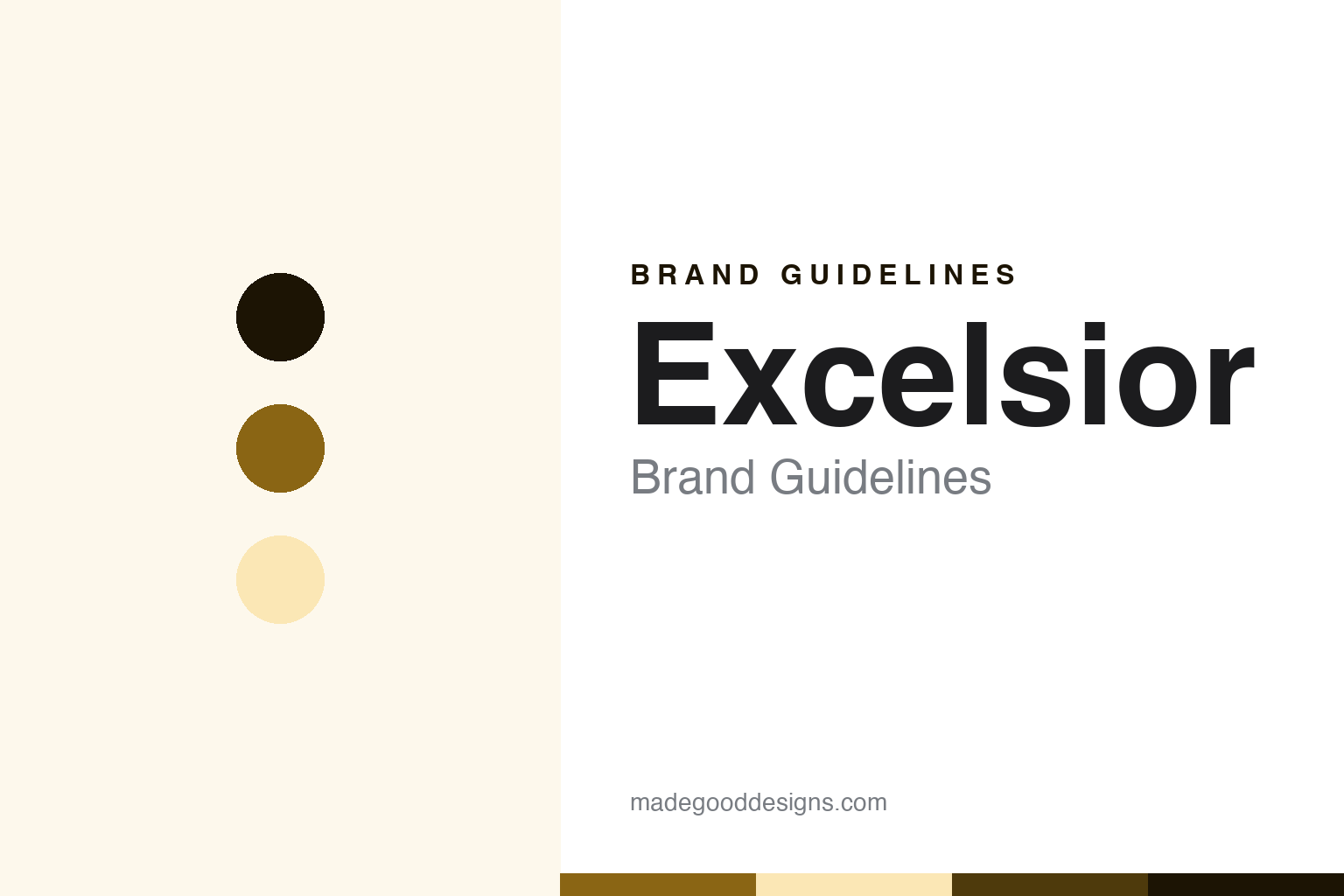
Excelsior Brand Guidelines
From New York to Castelfidardo.
Aa
Two constants: a Excelsior gold and cream palette and a New York sans register. Abstract homage — not a Excelsior product or mark; no instrument, logo or nameplate is reproduced.
From New York to Castelfidardo
An Italian-American name that came home.
Excelsior is an accordion name that crossed the Atlantic twice. Its own site tells the first crossing: “Nel 1924 … le fisarmoniche EXCELSIOR vedono la luce a NY, negli U.S.A.” — in 1924 Excelsior accordions first saw the light in New York. The instruments, it says, “conquistano i maggiori artisti americani, varcano l’oceano e approdano, nel 1948, a Castelfidardo, in Italia dove viene fondato un nuovo stabilimento” — won over the leading American players, crossed the ocean and arrived in Castelfidardo in 1948, where a new factory was founded.
Collector histories fill in the names, and we treat them with care. The ANI.PAS accordion blog and the Finnish site vapaalehdykka.net say Excelsior was founded in New York by three brothers from Castelfidardo, Archimedo, Egisto and Roberto Pancotti, and that Egisto Pancotti set up “Accordiana Melodiosa Excelsior” in Castelfidardo in 1946 — two years earlier than the brand’s own date. They also say the company became CEMEX s.r.l. in 1985 and later Excelsior s.r.l. These are hobbyist sources, and we report them as such. The same sources say American-made instruments carried a large “A,” for Archimedo, and Italian ones an “E,” for Egisto — a neat piece of lore we could not confirm.
The same sources link Excelsior to American jazz and popular accordionists of the mid-century, including Charles Magnante and Art Van Damme. We checked the English Wikipedia pages for those players and found no mention of Excelsior, so we leave the endorsements as collector lore rather than fact.
Colour
A division, not a company.
Today Excelsior is not a separate company. Every page of its website carries the same footer: “EXCELSIOR ACCORDIONS a division of Pigini srl – Via Carlo Marx, 127 – 60022 Castelfidardo (AN)”, with Pigini’s VAT number. Excelsior is a brand inside the Pigini family’s accordion company — which the collector sources say acquired it in 2003.
Pigini’s history page says Filippo Pigini registered “F.lli Pigini di Filippo” with the Ancona chamber of commerce on 6 June 1946. Its governance page lists Massimo Pigini as president, Federico Pigini as managing director and head of production, and Francesca Pigini in marketing. In 2012 Il Sole 24 Ore cited Pigini as an example of a surviving firm, with “4 milioni di ricavi con 48 dipendenti” — four million euros in revenue and 48 employees.
So the American name is now made in Italy by an Italian family, and the brand says so plainly. Il Sole 24 Ore also recalled that, fifty years earlier, accordions from the Marche had been “una delle prime voci dell’export nazionale” — one of Italy’s leading exports. Its own page calls an Excelsior a “vero tesoro MADE IN ITALY” — a true Made in Italy treasure — and says its instruments are sold in more than 26 countries — a long way from a New York workshop of the 1920s, and from the three brothers who started it.
Typography
A district that once made 240,000 a year.
Castelfidardo, a hill town near Ancona in the Marche, calls itself the home of the Italian accordion. Its municipality opened the Museo Internazionale della Fisarmonica on 9 May 1981, and its own description is plain: the town is known around the world for the instrument “grazie all’ingegno di Paolo Soprani che realizzò nel 1863 la prima industria italiana della fisarmonica” — thanks to the ingenuity of Paolo Soprani, who created the first Italian accordion industry in 1863. The chamber of commerce’s exhibition describes Paolo Soprani, “son of a Castelfidardo farmer,” as “inventing an industry from scratch.”
The scale of that industry has changed. An exhibition by the Ancona chamber of commerce says Castelfidardo, with about 9,000 inhabitants, once “provided employment for about 10,000 workers,” and that “51,000 instruments were produced in 1938 compared to just over 500 in 1944.” In 2012 Il Sole 24 Ore reported that the district had once turned out 240,000 accordions a year, and that by then Castelfidardo and Recanati made “non più di 30mila” — no more than 30,000 — with about twenty firms still passing the trade “di padre in figlio,” from father to son.
Italian law polices origin claims closely. Since 2003 it has been a “falsa indicazione” — a false indication — to stamp “made in Italy” on goods that do not originate in Italy under EU rules, and since 2009 “100% made in Italy” has required design, planning, processing and packaging all to take place in Italy. The 2009 decree also added a fine of €10,000 to €250,000 for using a trademark in a way that misleads buyers about a product’s origin. For a name born in New York, “Made in Italy” is therefore a precise claim: it is the Castelfidardo factory, not the brand’s birthplace, that the law looks at.
Aa
A New York sans — a golden oval and a star’s name. (Specimen set in Inter Tight, a sans STAND-IN; NOT the Excelsior logo.)
Excelsior
A golden oval and a star’s name.
Excelsior’s logo is a white line drawing of an accordion inside a golden-yellow oval, with a white wordmark that reads only on a dark ground; the website’s theme colour is the same warm yellow. The tagline is “Fisarmoniche con la passione per la qualità” — accordions with a passion for quality — and the collection copy reaches higher: “Shining like stars in the universe of sounds.”
The name helps. “Excelsior” is Latin for “ever higher,” the motto of New York State — a fitting word for a brand founded in New York, and one that still reads as aspiration in Castelfidardo. For a design guide, Excelsior is a name that kept its American glamour after it moved to Italy and into another family’s company. Pigini could have folded it into its own name; instead it runs Excelsior as a separate brand with its own logo, colour and voice. The instrument itself is younger than the town’s industry might suggest. Cyrill Demian and his sons Guido and Karl were granted a Viennese patent for the “Accordion” on 23 May 1829, for a small box with bellows whose five keys each sounded a chord.
For this guide we use a deep gold and a cream with a sans serif, an unofficial interpretation of the logo’s yellow. No accordion, logo or oval is reproduced.
Explore & save
Keep Excelsior’s identity on hand — save it to a board in the Made Good inspiration library.
Excelsior identity set
Pin the Excelsior gold and cream palette and the New York sans register to your own board.