Malmark Brand Guidelines
The handbell maker born from a rival.
Aa
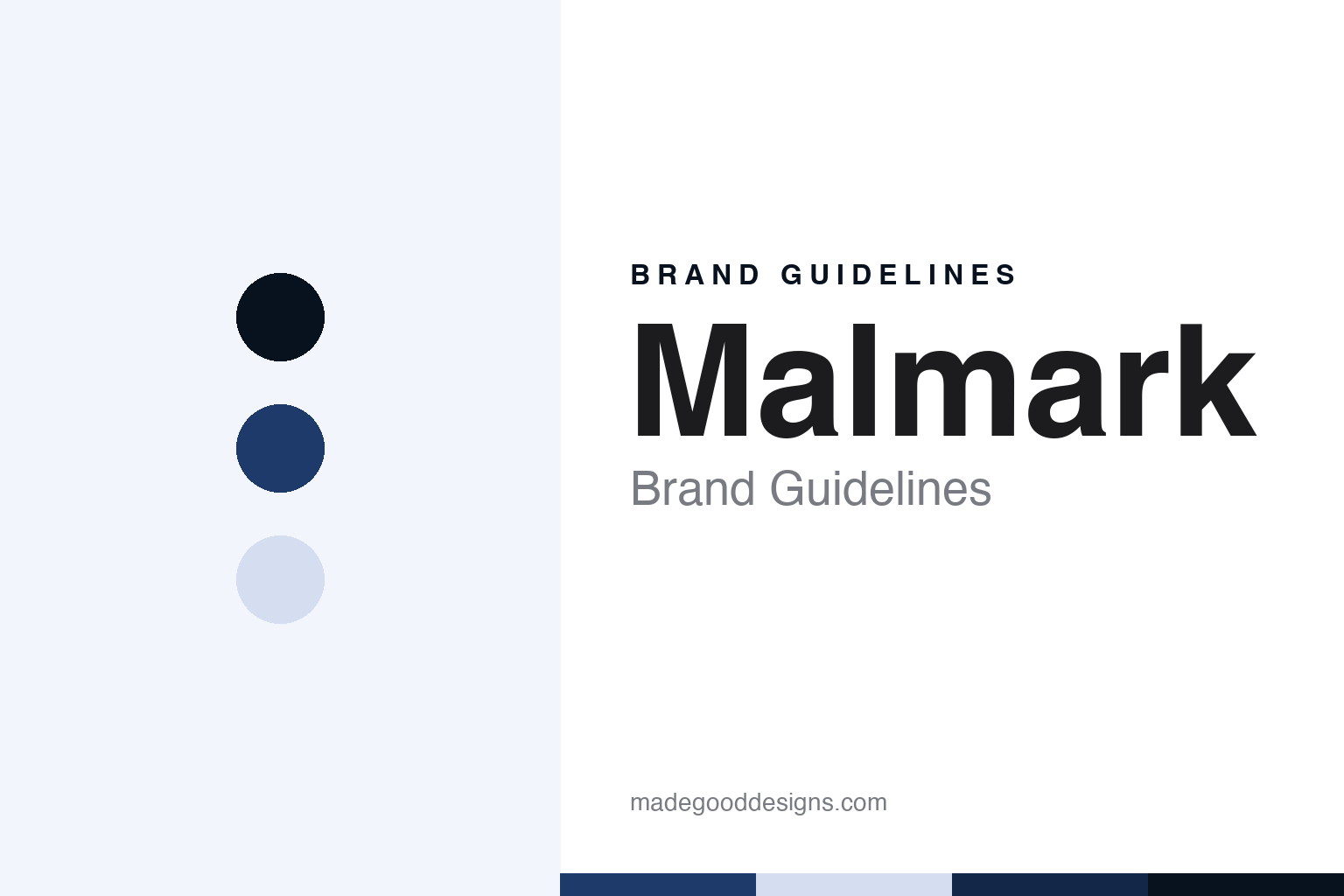
Two constants: a Malmark blue and white palette and a Keyboard sans register. Abstract homage — not a Malmark product or mark; no instrument, logo or nameplate is reproduced.
The handbell maker born from a rival
Jacob Malta left Schulmerich in 1972.
Malmark exists because its founder left a competitor, and the company says so plainly in its history. Its history page says: “Malmark was incorporated in November 1973 by Jacob H. Malta, which he formed after leaving Schulmerich Carillons where he served as Vice President and Chief Engineer.” Malta had “took over the development of the Schulmerich handbell program in 1962 and designed the first production model for that firm,” the company says, and “resigned in November 1972 to form Malmark when the ownership of the company changed hands.”
He brought a senior colleague with him from Schulmerich. Willard H. Markey, another senior figure from the old company and formerly Schulmerich’s vice-president of handbell marketing and sales, joined in April 1974 and stayed until his death in 2004. The new firm opened in Doylestown, Pennsylvania, in Bucks County, in May 1974 and shipped its first 25-bell sets that autumn, moved to New Britain in 1978, and in 1985 settled on a site of more than twelve acres in Plumsteadville, Bucks County, with about 42,000 square feet of buildings.
The family has kept it. A Suburban Life profile said Malta led the company “till his death in 2010,” and that his daughters Joann Malta and Lora Mohr succeeded him, with Tim Schuback, married to the founder’s granddaughter, as president and Derek Mohr, a grandson, in charge of research. We could not reconfirm that leadership for 2026. The website’s footer names the company as Malmark, Inc.
Colour
The Bell Wars.
The rivalry with Schulmerich became famous. NPR’s Planet Money, in a December 2013 episode called “Bell Wars,” quoted a Schulmerich advertisement: “All Schulmerich handbells have a tang… The Malmark bell, hereafter referred to as brand M, touts the tangless bell…” NPR said “The bell wars arguably began in 1976,” and that “Malmark sued Schulmerich over it. The two bell makers eventually settled this lawsuit. Each of them agreed not to compare their bells to the other’s bells.” It added that there was another lawsuit, over a patent, whose outcome we did not establish.
Malmark built its own product line. It introduced Choirchime instruments — tuned handchimes, a lighter companion to handbells — in 1982, and in 1992 began casting bass handbells in aluminium, which it says are “about half” the weight of bronze and extend the range down to G1. It describes its range as “the widest musical range (7 1/2 octaves) of handbells,” and sells Cymbells as well; those are its claims.
Its design details are practical and specific. Malmark describes “Keyboard color-coded handles and handguards (white for naturals and black for sharps/flats),” a hand-adjustable clapper, and castings “polished to a jeweler’s finish inside and out.” Its footer says “Made in the USA,” and a Pennsylvania history site invites visitors to “Come see these beautiful bronze bells being made.”
Typography
A guild, a metal and a war.
Handbell ringing has its own institutions. The American Guild of English Handbell Ringers, which does business as Handbell Musicians of America, describes itself as “a non-profit organization established in 1954” to “promote the art of English Handbell Ringing”; its national mission today is “Advancing the musical art of handbell and handchime ringing.”
Bell metal is a bronze of roughly four parts copper to one of tin — “approximately 78% copper and 22% tin,” according to the Guild of Carillonneurs in North America. Tin is the costly part: the US Geological Survey says the average New York price of refined tin rose 13 per cent in 2025, to 1,600 cents a pound. Malmark’s answer for its largest bass bells was aluminium, which it says halves the weight.
Bells have also been treated as raw metal in wartime. A 1947 photograph in Germany’s federal archives shows the “Glockenfriedhof” — bell cemetery — in Hamburg’s free port, captioned: “Diese Glocken wurden von den Nazis während des II. Weltkrieges beschlagnahmt um sie einzuschmelzen” — these bells were confiscated by the Nazis during the Second World War to be melted down. German sources estimate that about 45,000 bells were destroyed in Germany and some 35,000 more from occupied territories; the figures vary, so we attribute them. The same German sources say some 65,000 bells were melted down in the First World War, and that after 1945 more than 13,000 surviving bells were identified and returned from Hamburg.
Bells are recognised as culture too. In 2014 UNESCO selected Belgium’s programme for “Safeguarding the carillon culture” for its Register of Good Safeguarding Practices, and in 2022 it inscribed manual bell ringing in Spain — extended to Italy in 2024 — on its Representative List, calling it “a form of communication that is tied to the classification, acoustics and shapes of bells, bell towers and belfries.”
Aa
A keyboard sans — white for naturals, black for sharps. (Specimen set in Inter Tight, a sans STAND-IN; NOT the Malmark logo.)
Malmark
White for naturals, black for sharps.
Malmark’s brand borrows the piano keyboard, the instrument most musicians already know, so a set of bells laid out on a table can be read at a glance. Its colour-coded handles — white for naturals, black for sharps and flats — make a handbell table read like a keyboard, and its toll-free phone number, 800-HANDBEL, spells out the product it sells. The name joins the founder’s surname to a second syllable; we found no source that explains it, so we do not guess.
Its former employer has since changed shape: Schulmerich, which made North America’s first English handbells in 1962, was bought by a private investor in 2012 and sold its carillon business to Verdin in 2014, leaving Schulmerich Bells and Malmark as two Pennsylvania handbell makers. For a design guide, Malmark shows how a breakaway brand defines itself against its parent: tangless bells against tanged ones, a family firm against a changing owner. Compare Schulmerich, its old employer and rival, and McShane, an older American bell name.
The founder’s story is, in the end, the brand’s story: an engineer who designed a rival’s first handbells, left when the ownership changed, and built a family company that has outlived him.
For this guide we use a blue and a pale blue with a sans serif, an unofficial interpretation. No handbell, handle or logo is reproduced.
Explore & save
Keep Malmark’s identity on hand — save it to a board in the Made Good inspiration library.
Malmark identity set
Pin the Malmark blue and white palette and the Keyboard sans register to your own board.