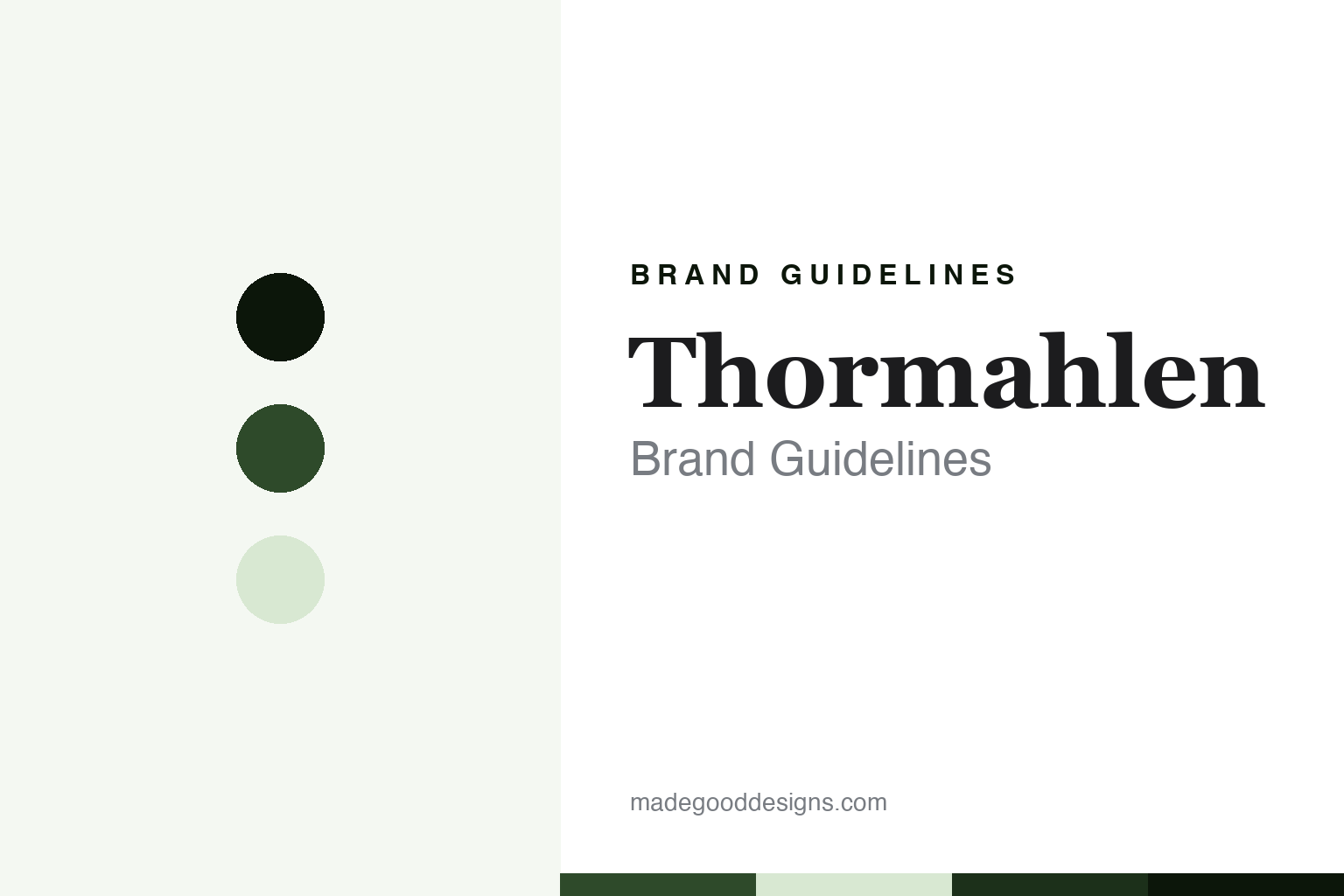
Thormahlen Harps Brand Guidelines
Lever harps from a Corvallis home workshop.
Aa
Two constants: a Thormahlen fir green and moss palette and a Oregon serif register. Abstract homage — not a Thormahlen product or mark; no instrument, logo or nameplate is reproduced.
Lever harps from a home workshop
Dave Thormahlen made his first harp in 1984.
Thormahlen Harps is a family workshop in Corvallis, Oregon. Dave Thormahlen builds the harps; Sharon Thormahlen strings and tunes them; an assistant, Tommy Nunn, works with them. Sharon writes that she watched “Dave make his first harp in 1984,” which is the earliest date the firm gives. Its site says the harps are made “In our home workshop in Corvallis, Oregon.”
The firm is still working: its models page was “Updated July 15, 2026.” We did not check the Oregon company register, so we describe it simply as a family business.
Its claims are confident. The homepage says “We make the finest and most elegant lever harps available,” that “our emphasis is on quality and personal service,” and, with a flourish, “With a Thormahlen Harp, winning happens!” We report all three as the company’s words.
Colour
Five models, 34 to 36 strings.
Thormahlen deliberately keeps a tight range. It makes five models — the Swan, Cygnet and Serenade, with 36 strings each, and the Clare and Ceili (“pronounced Kay-lee”), with 34. It explains the choice: “All of our harps have 34-36 strings because that’s what we think is the optimum range of a lever harp.” The harps are, it says, “designed for even string tension and concert spacing (the same string spacing found on most pedal harps).”
Its hardware comes from France. “They are all fully levered with Camac levers,” the company says — the same French maker whose levers the Californian builder Triplett also uses. Camac, a harp maker in Mouzeil near Nantes, thus sits inside two American brands in this vein.
The company points to a competition result: it says the Oregon harpist Annalee Foster won the 2010 All-Ireland Harp Championship playing a Thormahlen Clare made of koa. We did not check the competition’s own records, so we give it as the company’s account.
Typography
Levers, clarsachs and a national harp.
The lever harp has deep roots in Britain and Ireland. Wales’s official tourism site says “The Welsh harp (also known as the triple harp) is widely considered to be the national instrument of Wales.” In Scotland, the Clarsach Society says it was “Established in 1931 at the close of the National Mòd in Dingwall,” with a founding principle “to advance the clarsach and its music,” and describes itself as “Promoting the playing of the Scottish lever harp.”
The lever is the defining part. The Clarsach Society explains that early harps used “semitone blades… screwed into the neck of the harp, one beside each string,” later replaced by “excellent, accurate levers” — hence “The lever harp, as it is commonly called.” Each lever raises one string by a semitone; a concert pedal harp instead uses pedals that change every string of a given note at once.
The lever harp’s other ancestor is the Irish harp. Ireland’s government says it has “the distinction of being the only nation to have a musical instrument as a national emblem,” a gold harp with silver strings on blue, modelled on a fourteenth-century harp at Trinity College Dublin. Guinness says it registered its own harp as a trademark in 1876, and that this is why the two harps face opposite ways.
The pedal harp’s mechanism goes back to one patent. Sébastien Erard applied for an English patent, number 3332, in 1810, for a double-action harp in which each string has two forks worked by a pedal, so it can sound flat, natural or sharp; a Royal College of Music thesis by Fanny Guillaume-Castel says the design “remains the standard pedal harp mechanism today,” and that Erard sold about a hundred in 1812, the first full year of sale.
At the top of the market sit the pedal-harp makers. Chicago’s Lyon & Healy, harpmakers since 1889, has belonged since 1987 to the group founded by Victor Salvi, whose Italian factory is in Piasco, Piedmont; the New York Times described the result as “a genial global monopoly.”
Timber law touches every harp maker. In 2017 the CITES convention brought the whole rosewood genus, Dalbergia, under its Appendix II controls; since 26 November 2019 it has exempted “finished musical instruments, finished musical instrument parts and finished musical instrument accessories,” though Brazilian rosewood stays in Appendix I. We found no source linking any maker in this round to those timbers.
Erard’s own 1811 advertisement promised that the strings produced “three distinct tones instead of two,” so that the player “can now play in every known key.” Guinness’s archive says the harp “has been synonymous with Guinness since 1862 when it was used as a symbol on the first bottle label,” and Ireland’s patent office says the state harp is excluded “from registration or use as trade marks.”
Other American lever-harp families have taken different paths: Rees Harps moved from California to an 1881 building in Rising Sun, Indiana, in 2000 and registered the Harpsicle trademark, and Chicago’s Venus stopped building new production harps in 2018.
Thormahlen’s small scale — a couple and one assistant — is the context for all of this: the brand is the workshop, and the workshop is a home.
Aa
An Oregon serif — a family name over a home workshop. (Specimen set in Fraunces, a serif STAND-IN; NOT the Thormahlen logo.)
Thormahlen
A family name over a home workshop.
Thormahlen’s brand is a family name, a town and a small set of models with bird and Irish names — Swan, Cygnet, Clare, Ceili. Its website is direct about what it believes: the right number of strings, the right spacing, the right levers. That clarity is itself a brand position — a small maker telling buyers exactly what it will and will not build, and why, rather than offering everything to everyone. The competition result it cites, and the Irish names of two of its models, Clare and Ceili, point toward Irish traditional music. Its five models fit on one page, and so does its philosophy.
For a design guide, Thormahlen shows a small maker turning a design opinion into a brand promise — every harp 34 to 36 strings, every lever from Camac. Compare Heartland, which built its name on a new material, and Stoney End, a Minnesota maker under new owners.
For this guide we use a fir green and a moss with a serif, an unofficial interpretation. No harp or mark is reproduced.
Explore & save
Keep Thormahlen Harps’s identity on hand — save it to a board in the Made Good inspiration library.
Thormahlen identity set
Pin the Thormahlen fir green and moss palette and the Oregon serif register to your own board.