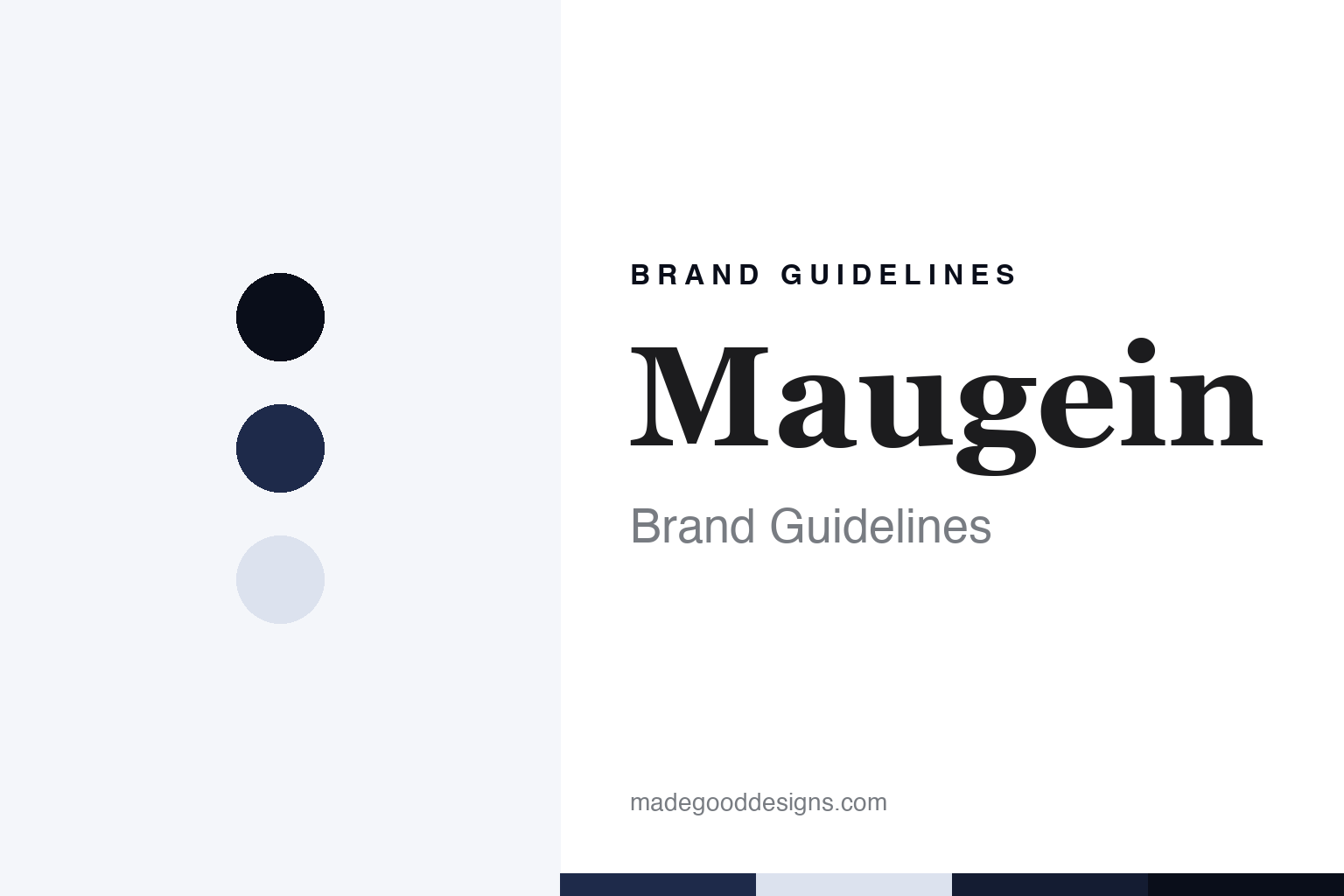
Maugein Brand Guidelines
France’s oldest accordion maker, liquidated and revived.
Aa
Two constants: a Maugein navy and nacre palette and a French serif register. Abstract homage — not a Maugein product or mark; no instrument, logo or nameplate is reproduced.
A Tulle family firm
A piano tuner who started his own workshop.
Maugein is the accordion maker of Tulle, in Corrèze. Jean Maugein, a piano tuner who had worked at a rival accordion factory in Brive, founded the business in 1919; his brothers Antoine and Robert joined him, and it became Maugein Frères. The company says the firm was formally incorporated in 1922.
It grew into a real factory. A new plant on rue d’Arsonval opened at the end of the 1930s, and the French audiovisual archive INA puts the workforce at about 290 in the 1950s. After the war Antoine’s son Georges led the firm until his death in 1977; René Lachèze revived it from 1981, and a new plant opened near Tulle in 1984.
Since 2009 Maugein has held France’s Entreprise du Patrimoine Vivant label, given to firms with rare craft skills. The AFP news agency has called it France’s oldest accordion maker. The company says it once ran its own orchestra, from 1930 until June 1944, when several of its members were deported.
Colour
Two collapses in a decade.
Maugein’s recent history is a run of rescues. The commercial court in Brive placed it in receivership on 6 December 2013; on 14 February 2014 a new team took it over, keeping 11 of 17 jobs, with backers who included the Tulle-born footballer Laurent Koscielny.
Its instruments have been played, franceinfo reported in 2024, by Indochine, Renaud and Bourvil. Ten years later it failed again. INA’s figures show the slide: 40 employees in 1989, 21 in 2012 and 10 in 2024. The court opened liquidation on 27 September 2024, and the last accordion was due for delivery three days later, and the AFP headline that day read “Le plus vieux fabricant français d’accordéons disparaît, face à un marché dominé par la Chine” — France’s oldest accordion maker disappears, facing a market dominated by China.
It did not stay gone. On 6 January 2025 the court approved the only bid, from Christophe Sirgues, a former technical-sales manager and accordionist; a new company was registered in February and production restarted in March 2025. Sirgues has been frank about the scale: “On ne peut plus tout fabriquer en interne, ce n’est plus possible” — we can no longer make everything in-house — so some components are now bought in. The regional chamber of trades reports that the restart was financed with €220,000 of private money and no subsidy.
Typography
Accordions, by the numbers.
The accordion is younger than most instruments. In Vienna, Cyrill Demian received a patent on 23 May 1829 for an instrument he called the Accordion: a box of free reeds sounded by a bellows.
Accordions still have their own line in the European customs code. Under CN code 9205 90 10, “Accordions and similar instruments,” Eurostat records that Italy exported €22.37 million of them in 2024 — 9,998 instruments, an average of about €2,240 each. In 2007 Italy exported 16,905, worth €14.47 million: fewer instruments now, but more money for each one.
The United States is Italy’s largest market for them, at €5.46 million in 2024, followed by Germany at €2.82 million and China at €2.56 million. Germany’s own exports that year were €3.91 million, about a sixth of Italy’s.
The same figures show the price gap at the bottom of the market. In 2024 the European Union imported 69,520 accordions and similar instruments from China for €2.56 million, about €37 each — against Italy’s average export price of more than €2,000.
The accordion has also lost ground in the tariff tables. Until 2007 the Harmonized System gave it its own heading, 9204, “Accordions and similar instruments; mouth organs”; since then it has been folded into heading 9205, among the wind instruments. In March 2022 the European Union banned exports to Russia of musical instruments worth more than €1,500 as luxury goods, accordions among them (Regulation 2022/428).
Many accordion makers cluster in and around Castelfidardo, in the Marche, but it was never the only accordion town. In Stradella, in Lombardy, Mariano Dallapè began series production in 1876, and the town says 44 accordion factories have existed there since. In 2026 Stradella is marking the 150th anniversary with a project called “Formazione armonica,” which includes a new accordion museum in the town’s former court building.
Outside Italy the trade has been fragile. France’s oldest maker, Maugein of Tulle, was placed in liquidation in September 2024 and revived by a former employee in 2025; in Germany, the Weltmeister manufactory in Klingenthal, a town that has made accordions since the nineteenth century, filed for insolvency in autumn 2023.
The instrument sits inside protected traditions, too. UNESCO’s 2015 inscription of the traditional vallenato music of Colombia’s Greater Magdalena region, on its list of heritage in need of urgent safeguarding (decision 10.COM 10.A.2), names the accordion alongside the caja drum and the guacharaca.
Tulle has tied its identity to the instrument. The town opened a museum covering the accordion, its arms factory and its lace in April 2024, and its long-running accordion festival, Les Nuits de Nacre, was replaced in 2025 by a city-run festival after the organising association ran out of money.
Aa
A French serif — a family name over a Corrèze workshop. (Specimen set in Fraunces, a serif STAND-IN; NOT the Maugein logo.)
Maugein
A family name over a Corrèze workshop.
Maugein’s brand is a town and a date. The company says its 2021 rebrand adopted the line “French Sound Makers depuis 1919,” refreshing a logo first drawn in 1981, and its newer products lean on place: the Maujo harmonica, launched in 2022, uses Corrèze walnut. Its range runs from diatonic to chromatic accordions, with a cajón added in 2023, and INA reported in 2012 that each accordion took 100 to 110 hours of work, at about 600 a year. For a maker that has nearly disappeared twice, “since 1919” is less a boast than a statement of survival.
For a design guide, Maugein shows a heritage brand defined as much by its rescues as by its history — and the honesty needed when a firm can no longer make everything itself. Compare Cavagnolo, another surviving French maker, and Weltmeister, Germany’s, which filed for insolvency in 2023.
For this guide we use a navy and a mother-of-pearl tone with a serif, an unofficial interpretation. No instrument or logo is reproduced.
Explore & save
Keep Maugein’s identity on hand — save it to a board in the Made Good inspiration library.
Maugein identity set
Pin the Maugein navy and nacre palette and the French serif register to your own board.