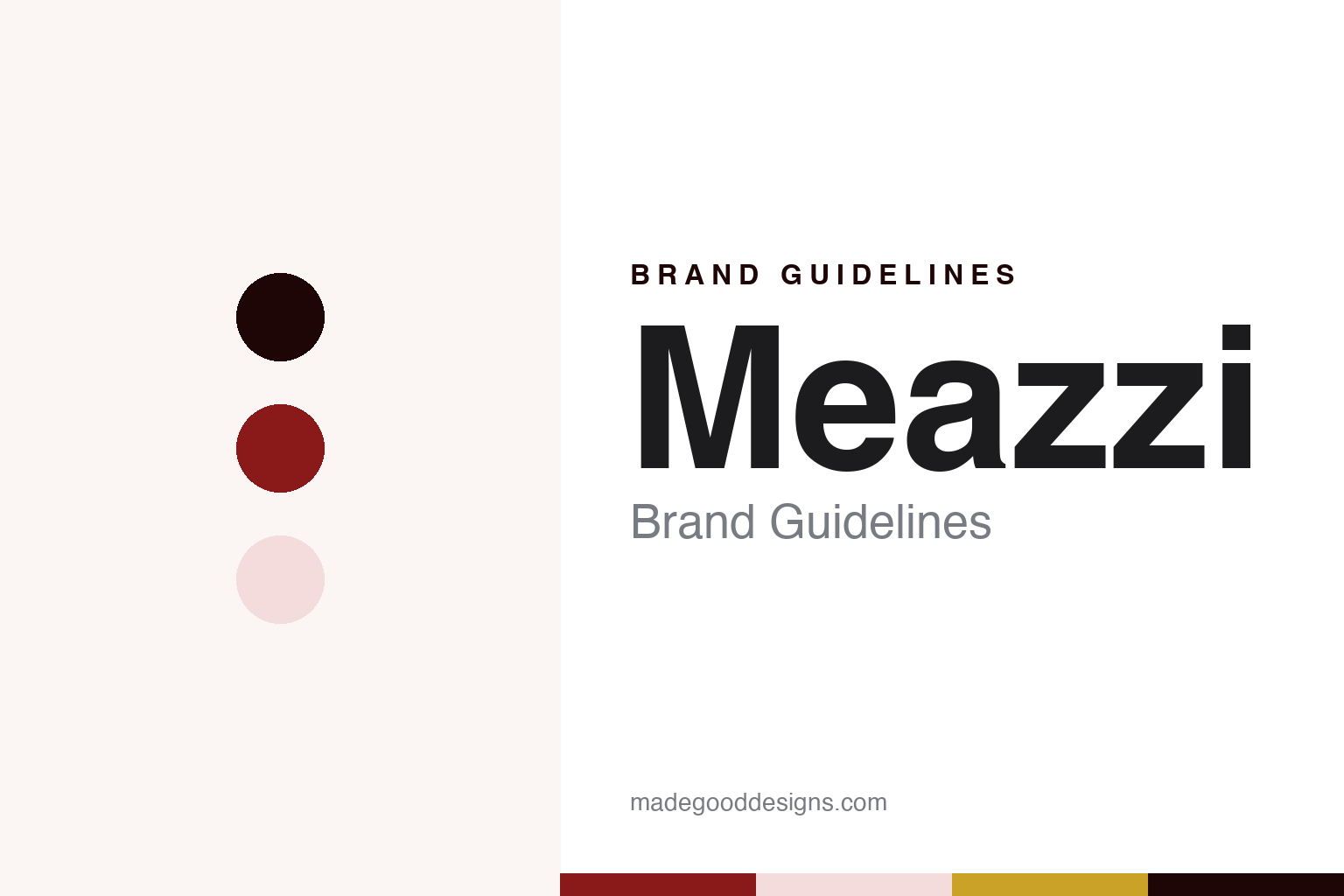
Meazzi Brand Guidelines
The Milan brothers behind Hollywood guitars and the Echomatic.
Aa
Two constants: a Meazzi stage red and gold palette and a Showbiz sans register. Abstract homage — not a Meazzi product or mark; no instrument, logo or nameplate is reproduced.
Clock parts and gramophones
Enrico Meazzi’s one-man firm.
Meazzi began far from the stage. On 24 July 1946, Enrico Meazzi, born in 1926, registered a one-man firm in Milan selling spare parts for clocks and gramophones, run from the family home in via Montepiana, according to Italian Wikipedia and Fetishguitars, a site devoted to Italian guitars of the 1960s. The family came from Mairago, near Lodi. In 1947, after a short stay in Bologna, he opened his first Milan office, at via Bligny 27.
The business became a family one. In 1953 his brothers Remo and Marino joined, together with Luigi Scarpini, later their brother-in-law, whom Fetishguitars credits with driving the firm’s growth. The company moved several times as it grew — to via Beatrice d’Este, then via Piatti, where it had 60 staff, then via Bellerio, and in the 1970s to Paderno Dugnano, outside Milan.
Fetishguitars adds some colour that we give as its account only: that none of the brothers could play an instrument, that drums arrived already sold, 200 a week, and that the singer Adriano Celentano bought watches from them.
The brothers’ birth years — Enrico in 1926, Remo in 1929, Marino in 1934 — show how young the firm’s founders were when it began to grow, Remo and Marino joining in their early twenties and late teens.
Colour
Framez, Hollywood and the Echomatic.
Meazzi sold under several names. Framez — from “FRAtelli MEaZzi,” Meazzi Brothers, and meant to echo the German brand Framus — was used for 1950s guitars made in Sicily, Germany and Stradella. Hollywood was the brand Meazzi registered for professional instruments; Dynelectron was a Sicilian line imitating the American Danelectro. Its Jolly drum series of 1958 and 1959 were made in Brianza from pressed cardboard, with cymbals from Zanchi, the maker of UFIP cymbals, and heads from Remo Belli, the American drumhead maker. Fetishguitars calls Meazzi above all a drum brand.
Others built its guitars. From 1963 to 1969 Hollywood guitars were made by the Polverini brothers in Castelfidardo; Panati of Stradella made the acoustics and, from 1962, electrics; and Wandré supplied some Framez models until about 1960. Guitar production ended in 1969, and the 1968 catalogue already listed guitars by EKO, Brandoni, Moreschi and Beccacece for distribution. Italian Wikipedia dates the start of solid-body electric production to 1962; Fetishguitars gives a more detailed sequence of makers. The guitar historian Jack Marchal adds that Welson, the Castelfidardo maker, supplied Meazzi with modified versions of its guitars.
Its best-known product was an echo unit. English Wikipedia’s article on the Binson Echorec says that Hank Marvin, the Shadows’ lead guitarist, used Meazzi Echomatic machines before moving to Binson units, and Italian Wikipedia’s article on Marvin mentions “the famous Meazzi Echomatic echoes.” English Wikipedia also says the British Watkins Copicat came before it. We found no launch date for the Echomatic and give none.
Meazzi also worked with Antonio Pioli, the guitar designer known as Wandrè. A history of Wandrè by Marco Ballestri, published in 2014 and followed by Fetishguitars, dates a “collaboration with Meazzi and Davoli” to 1957–1960 — linking Meazzi with Davoli, the Parma amplifier maker, through the same designer.
Typography
The other badge.
Italian electronic instruments of the 1960s to the 1980s often reached the world under other names. English Wikipedia records that Siel’s 1979 Orchestra was sold in the United States by ARP as the Quartet, and that its OR400 of 1982 was sold by Sequential Circuits as the Prelude; that the Logan String Melody, designed by the engineer Giuliano Costantin, was also sold under the Hohner name; and, according to the guitar historian Jack Marchal, that Welson’s guitars were sold in Germany under the Dynacord name.
Some Italian names did become famous in their own right. Farfisa, formed in 1946 from the accordion makers Settimio Soprani, Scandalli and Frontalini, made Compact organs that English Wikipedia says were used by Pink Floyd, Sly Stone, Blondie and Philip Glass. Elka’s Synthex, designed by Mario Maggi, was made in about 1,850 units between 1981 and 1985, according to the same source.
Many of these firms did not survive the 1980s. Siel’s life, by English Wikipedia’s account, ran from 1976 to 1986; Crumar stopped trading in 1986 or 1987; Generalmusic, owner of LEM and Elka, was declared bankrupt in 2011. Their names have since been revived, sold or left dormant — and the guides below say which.
Meazzi worked both sides of that trade: it sold instruments made by others under its own names, and distributed other makers’ guitars and keyboards under theirs.
Aa
A showbiz sans — a capital M under the family name. (Specimen set in Inter Tight, a sans STAND-IN; NOT the Meazzi logo.)
Meazzi
A capital M under the family name.
Meazzi was more than an instrument brand. Italian Wikipedia records that it ran record labels under its EDM imprint — Hollywood, Panoramic Record and Astraphon — sold PA systems that it described as the first with tape echo, and distributed keyboards from the Marche. Its amplifiers included the Paramount of 1960, the Meazzi 777 and the Ultrasonic Vibrato. The same article says it sponsored famous names such as Cliff Richard; it does not explain how, so we give it as Wikipedia’s statement.
Its identity, as Italian Wikipedia describes it, was a capital M with the name Meazzi above it. In 1998 the company was still Meazzi S.p.A.; its website then read “Meazzi – 50 anni per la musica,” fifty years for music. Italian Wikipedia says activity wound down gradually through the 1990s and gives 1999 as the end. The meazzi.it address had become a spam portal by 2008, was parked and priced at €299 in 2016, and is now offered for sale, and there is no official site today. English Wikipedia’s “Meazzi” page is about a footballer, not the firm; there is no English article on the company.
For a design guide, Meazzi shows a trading house that built brands around imported glamour — Hollywood, Framez, Paramount. Compare Davoli, which shared a designer with it, Brandoni, whose accordions Meazzi distributed, and EKO, whose guitars it later sold. We say plainly that the firm no longer trades. For this guide we use a stage red and a gold with a sans, an unofficial interpretation; no instrument or logo is reproduced.
Explore & save
Keep Meazzi’s identity on hand — save it to a board in the Made Good inspiration library.
Meazzi identity set
Pin the Meazzi stage red and gold palette and the Showbiz sans register to your own board.