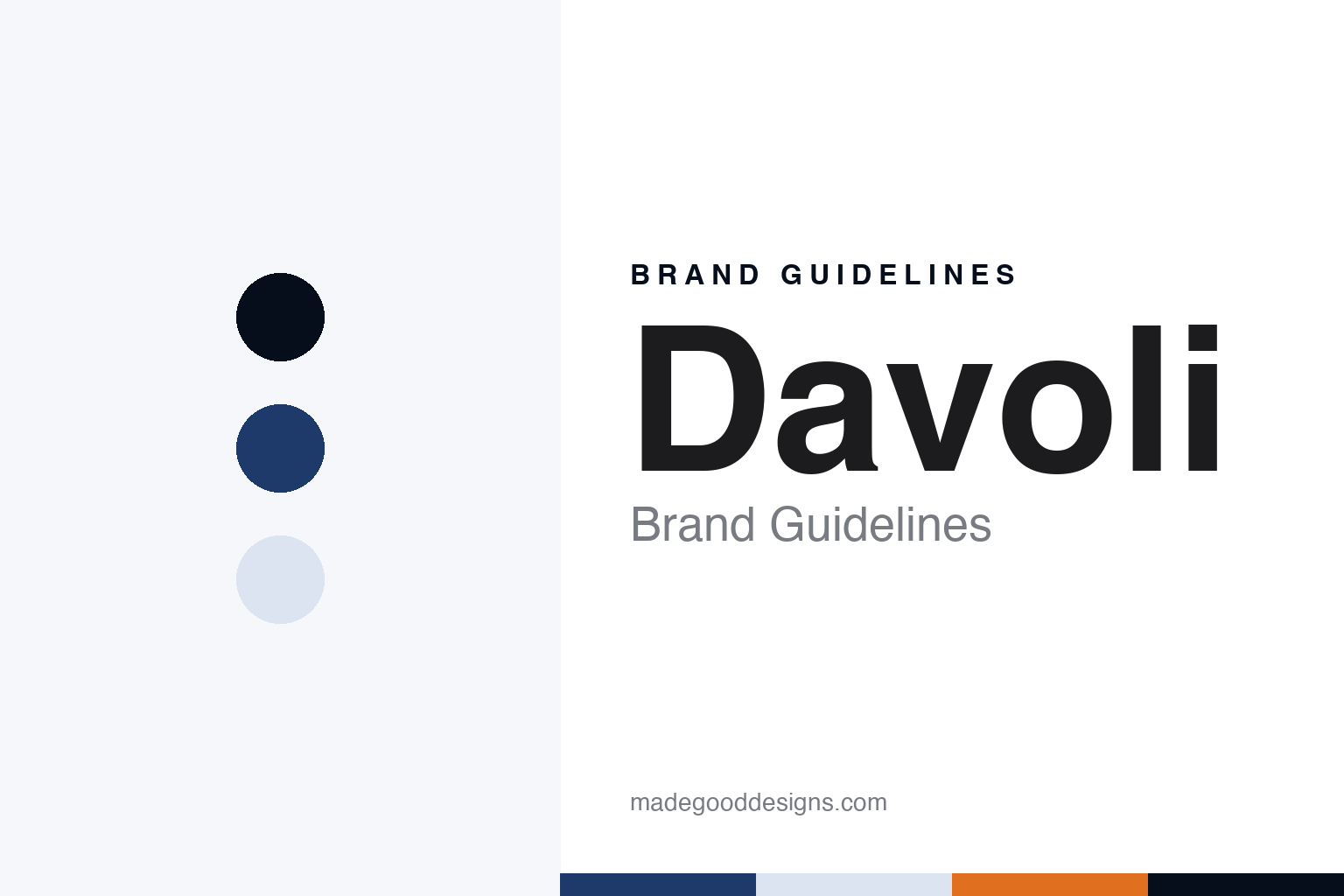
Davoli Brand Guidelines
Davoli Krundaal, the Parma amplifier maker and its Davolisint.
Aa
Two constants: a Davoli amp blue and orange palette and a Beat-era sans register. Abstract homage — not a Davoli product or mark; no instrument, logo or nameplate is reproduced.
Athos Davoli
From aircraft radios to amplifiers.
Most of Davoli’s story comes from the Davoli family’s own history, published by the family firm Wilder and quoted in full by Fetishguitars, a site devoted to Italian guitars of the 1960s; we give it as the family’s account. It says Athos Davoli, born in Correggio, near Reggio Emilia, was apprenticed at 17, in 1943, on radio systems for aircraft built by the Italian maker Savoia-Marchetti, at the Officine Reggiane works, and that in 1957 he founded “Krundaal Davoli” in Parma.
In the 1960s, the family history says, the firm made instrument and vocal amplifiers and PA systems that it says were used by most Italian bands and by foreign bands on tour; we give that as its claim. It says the company reached its peak between 1969 and 1972, with 220 employees — years that overlapped the song contest it sponsored. Athos’s wife, Elide, ran the administration, the family history says; their son Eolo, known as Willy, opened Davoli UK Ltd in London in 1973 and later founded Wilder, an equipment-rental company in Parma.
The firm used two names, and we found no explanation of the second. Parma is in Emilia-Romagna, not the Marche: Davoli worked outside the Marche accordion district, like Meazzi in Milan and LEM in Romagna, which are also in this guide. “Krundaal” ran alongside “Davoli” as a co-brand, and Fetishguitars titles its history “Davoli – Krundaal.”
Colour
Wandrè, guitars and a song contest.
Davoli worked with the guitar designer Antonio Pioli, known as Wandrè (1926–2004). English Wikipedia says Pioli’s guitars appeared under the Davoli brand, among others. The dates differ: the family history places the collaboration in the 1960s, while Marco Ballestri’s 2014 history of Wandrè, followed by Fetishguitars, dates a “collaboration with Meazzi and Davoli” to 1957–1960, before Wandrè’s best-known “Bikini” period of 1960 to 1963, when he worked from his “Fabbrica Rotonda,” the round factory. In the same years Wandrè supplied some guitars to Meazzi for its Framez brand, until about 1960, Fetishguitars says.
The firm’s product list was long. Fetishguitars lists models including the Miura, Matra, Athena, D250, Bioctav, Echo 2k, Davolino, J6, Lied, Phonodoppler, Storm, TX15, Tuono and a Drum Synth, as well as the Informatore Krundaal. The names mixed cars, myth and weather — Miura and Matra, Athena, Storm and Tuono, Italian for thunder. The family history describes the Davolisint as a patented two-oscillator mini synthesizer sold in the United States and Australia, and says Davoli sold a 32-channel mixer to a Nigerian studio in 1980. Because the family history is the main source, several of its claims — the bands using its PA systems, the 220 staff, the Davolisint patent — remain the family’s own; we found no independent confirmation. We omit an honorary degree it mentions, because the university is not named.
Davoli also put its name on popular music. Italian Wikipedia records that it sponsored a song contest, the Torneo nazionale Rapallo Davoli, from 1966 to 1973, compèred by Daniele Piombi and devised by Franco Norma; it was also called Torneo Italia Beat and, after moving from Rapallo, on the Ligurian coast, to Tirrenia, in Tuscany, EuroDavoli, with a European edition in Lugano in 1968 and a second in 1970. Italian Wikipedia’s source is Castaldo’s Dizionario della canzone italiana, published in 1990. Winners included Mat 65 in 1966 and Gens in 1968.
Typography
The other badge.
Italian electronic instruments of the 1960s to the 1980s often reached the world under other names. English Wikipedia records that Siel’s 1979 Orchestra was sold in the United States by ARP as the Quartet, and that its OR400 of 1982 was sold by Sequential Circuits as the Prelude; that the Logan String Melody, designed by the engineer Giuliano Costantin, was also sold under the Hohner name; and, according to the guitar historian Jack Marchal, that Welson’s guitars were sold in Germany under the Dynacord name.
Some Italian names did become famous in their own right. Farfisa, formed in 1946 from the accordion makers Settimio Soprani, Scandalli and Frontalini, made Compact organs that English Wikipedia says were used by Pink Floyd, Sly Stone, Blondie and Philip Glass. Elka’s Synthex, designed by Mario Maggi, was made in about 1,850 units between 1981 and 1985, according to the same source.
Many of these firms did not survive the 1980s. Siel’s life, by English Wikipedia’s account, ran from 1976 to 1986; Crumar stopped trading in 1986 or 1987; Generalmusic, owner of LEM and Elka, was declared bankrupt in 2011. Their names have since been revived, sold or left dormant — and the guides below say which.
Davoli worked the other way round: an Italian amplifier name that put its own badge on guitars, a synthesizer and a song contest.
Aa
A beat-era sans — two names, Davoli and Krundaal. (Specimen set in Inter Tight, a sans STAND-IN; NOT the Davoli logo.)
Davoli
Two names, Davoli and Krundaal.
The Davolisint reached British progressive rock. English Wikipedia’s credits for the Canterbury band Caravan’s 1973 album For Girls Who Grow Plump in the Night list Dave Sinclair on “Davoli synthesizer,” and its article on Sinclair lists the Davolisint among his keyboards; the 1978 album British Lions credits the keyboard player Morgan Fisher on “davolisint.”
Readers should be careful online. The wilderdavoli.it site was a genuine family business site until early 2023, but by mid-2024 it had been turned into a page of casino and poker spam; we do not link it. davoli.it belongs to the Calabrian town of Davoli, and the name is shared with the actor Ninetto Davoli, the singer Gianni Davoli and the Black Box producer Daniele Davoli, among others. The krundaal.com and krundaal.it addresses sat behind security checks and could not be read. We found no closure date for the company and no documented logo or colours, and we omit an unverified claim about a guitar with a built-in amplifier.
For a design guide, Davoli shows a family electronics firm that used sponsorship and a second name to reach musicians. Compare Meazzi, the Milan firm that worked with the same designer, and Welson, another 1960s guitar maker. For this guide we use an amp blue and a valve orange with a sans, an unofficial interpretation; no instrument or logo is reproduced.
Explore & save
Keep Davoli’s identity on hand — save it to a board in the Made Good inspiration library.
Davoli identity set
Pin the Davoli amp blue and orange palette and the Beat-era sans register to your own board.