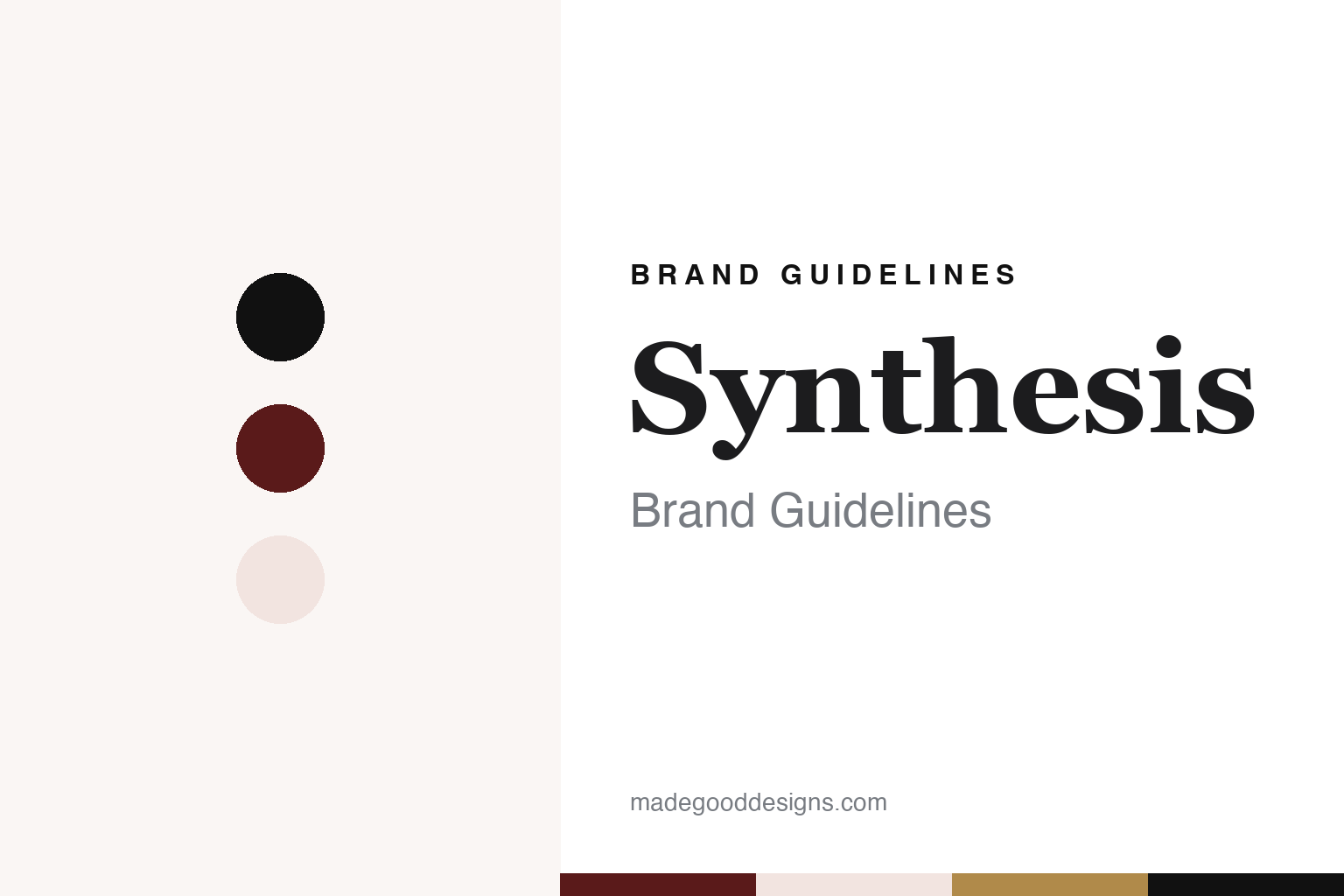
Synthesis Brand Guidelines
Luigi Lorenzon’s lacquered-wood valve amplifiers from the Marche.
Aa
Two constants: a Synthesis lacquer red and brass palette and a Classic serif register. Abstract homage — not a Synthesis product or mark; no instrument, logo or nameplate is reproduced.
Art in Music
Luigi Lorenzon’s company.
Synthesis calls itself “Art in Music,” the name it has used on its website since at least 2003. The company says it was “founded by Luigi Lorenzon in 1992,” and its website footer runs from 1992 to the present; we found no independent dated source, so we give 1992 as the company’s own date.
It is a Marche firm. Its website gives its “head office and production site” as Via Vanvitelli in Morrovalle, in the province of Macerata — the same province as Recanati, home of the loudspeaker maker FBT. The business is registered in Macerata as EgoSonoro di L. Lorenzon, a sole trader’s firm, which suggests it is run by its owner; we found no parent company.
The Marche has a long history in musical electronics. Its accordion towns turned to electronic organs, synthesizers and guitars from the 1960s, and firms such as Farfisa, Elka and Crumar were based there; Synthesis belongs to a later, much smaller generation of makers in the same region, alongside firms such as FBT of Recanati and Elettromedia, the owner of the Lavoce brand, at Potenza Picena.
Colour
A family of transformers.
Synthesis tells a family story about transformers. Lorenzon’s father, it says, founded FASEL, a transformer maker, in 1961, and FASEL made the output transformer used in the Vox AC30, the British guitar amplifier, and the “red Fasel inductor” used in the Dunlop Cry Baby, the wah pedal now sold by the American company Dunlop. The company claims “65 years of experience,” counting from FASEL’s founding in 1961. We could not verify those claims independently and give them as Synthesis’s own account.
The Cry Baby has its own Italian history. English Wikipedia records that early Thomas Organ Cry Baby and Vox wah pedals were built by the Pescara firm Jen Elettronica; Synthesis’s claim about the Fasel inductor places its family firm in the same story, by its own account.
Its early landmark was the NIMIS — Latin for “too much” — a 15-watt valve amplifier, now discontinued, which the company calls “a turning point.” Its current range is organised in lines: the Roma series — the 79DC, 753AC, 510AC and Signature, 96DC, 117DC and 98DC SE amplifiers, the 14DC+ CD player and 69DC converter, and the 37DC+, a hybrid of valves and transistors; the Action power amplifiers, the A40 Virtus, A50 Taurus and A100 Titan — virtue, bull and titan; the Metropolis line, with the NYC100i, NYC175i, NYC200i and NYC500; the FCO300B; and the Embrace HDP 300B headphone amplifier, built around the 300B triode valve, a design dating from the 1930s; it also sells a PC-15EU power cable. We found no launch dates for any of them, and the “DC” and “AC” suffixes in the Roma names are not explained on the pages we read. By its own dates, the company has now made amplifiers for more than three decades.
Typography
Design and documentation.
Italy has a long record of treating audio equipment as design. The Compasso d’Oro, the industrial-design award associated with Italy’s ADI design association, went to Brionvega’s Doney television in 1962 and to the company as a whole in 1970, according to Italian Wikipedia; Brionvega’s radios and record players are now held by museums including London’s Victoria and Albert Museum.
The country’s hi-fi makers range from that design-led tradition to small engineering workshops. Sonus faber, the loudspeaker maker founded near Vicenza in 1983, has passed through several investors and in November 2024 was included in Bose’s announced purchase of McIntosh Group, according to What Hi-Fi?. Many smaller makers remain private, and some are hard to document beyond their own websites.
Italy’s hi-fi trade has its own shows and press. Milan’s Top Audio show is where Norma says it launched its range in 1997, and where Audia Flight says its Strumento amplifiers won an award in 2012; Italian magazines such as Audio Review and Fedeltà del Suono review the country’s equipment and appear in the makers’ own lists of press coverage.
The makers in this guide are spread across northern and central Italy rather than gathered in one district: Brionvega in Milan, Diapason in Brescia, Lector near Pavia, Norma near Cremona, Mastersound at Arcugnano outside Vicenza, Viva Audio’s research workshop at Camisano in the same province — with a legal address in Latvia — and Synthesis at Morrovalle in the Marche, according to their own websites.
This guide sets out what can be checked about each brand — who founded it, who owns it, and what it says about where its products are made — and marks clearly what rests only on the company’s own word.
Synthesis is one of the makers whose story rests almost entirely on its own website: a family firm documented mainly by its own pages.
Aa
A classic serif — “Art in Music.” (Specimen set in Fraunces, a serif STAND-IN; NOT the Synthesis logo.)
Synthesis
“Art in Music.”
Its manufacturing claim is strong: “Each piece is entirely made in Italy, in one of the few Italian companies in which everything is carefully handmade within the company, with particular care and attention to the transformers.” We give that as the company’s statement. Like Unison Research and Pathos Acoustics, Synthesis presents handwork in Italy as central to its brand; like Unison, it singles out transformers.
Its visual signature, by its own description, is lacquered wood: “The use of lacquered wood, adopted from the earliest projects, have made Synthesis amplifiers immediately recognizable.” Its website uses a dark, near-black background, #111111, and carries a “Made in Italy” mark in the footer. We found no published brand guidelines, no staff or revenue figures, and no reviews of its products in the press sources we could reach. Its line names — Roma, Metropolis, NYC, Virtus, Taurus, Titan — lean on cities and Latin.
For a design guide, Synthesis shows how a small maker can build an identity from one material and one family trade. Compare Jen Elettronica, the Italian maker linked to the Cry Baby, and Unison Research, another Italian valve maker that stresses wood and in-house transformers. For this guide we use a lacquer red and a brass with a serif, an unofficial interpretation; no product or logo is reproduced.
Explore & save
Keep Synthesis’s identity on hand — save it to a board in the Made Good inspiration library.
Synthesis identity set
Pin the Synthesis lacquer red and brass palette and the Classic serif register to your own board.