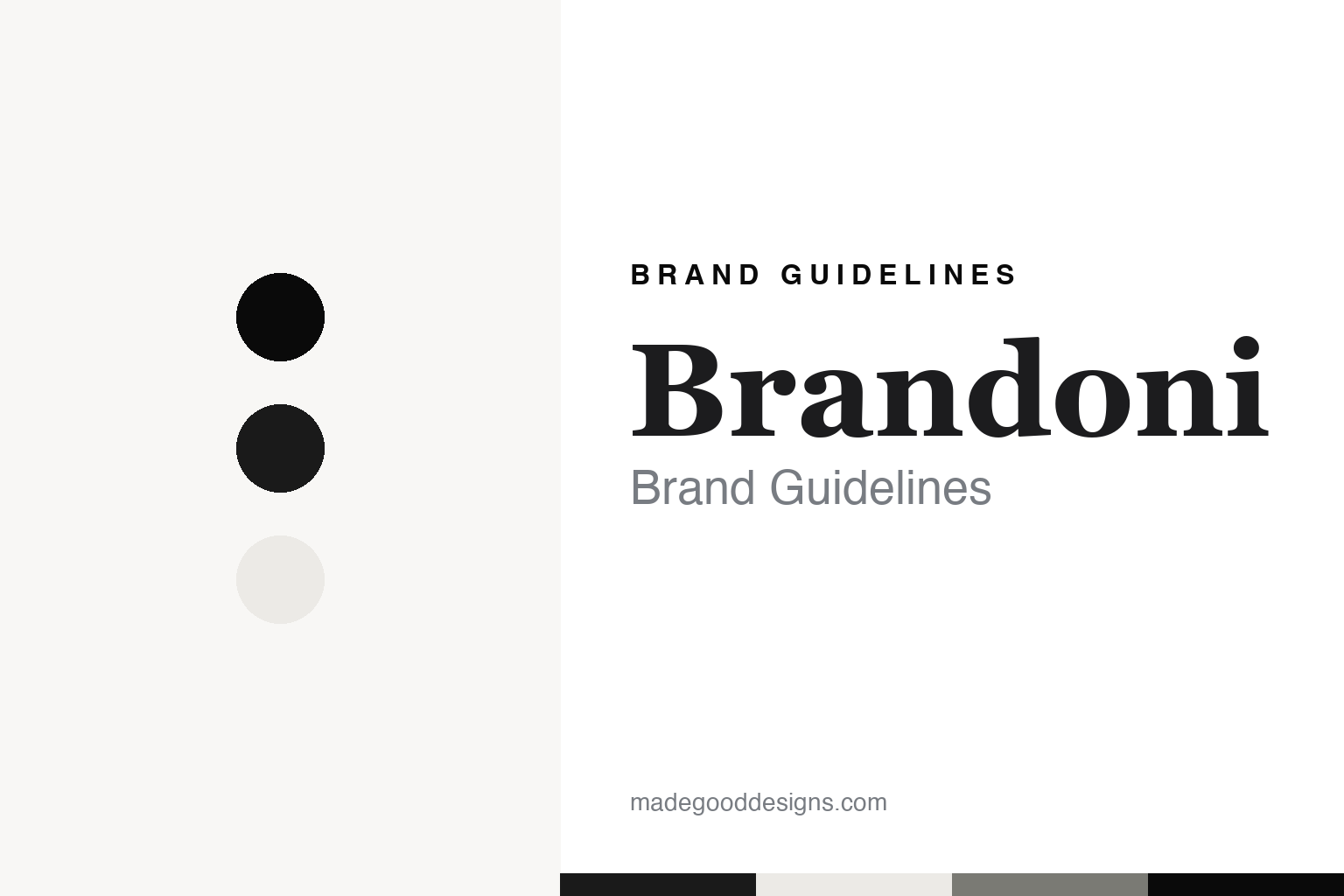
Brandoni Brand Guidelines
Brandoni & Sons, Castelfidardo accordions since 1949.
Aa
Two constants: a Brandoni black and grey palette and a Slab serif register. Abstract homage — not a Brandoni product or mark; no instrument, logo or nameplate is reproduced.
Giovanni, Paolo and Ubaldo
A father, two sons and an American market.
Brandoni dates itself to 1949. “Everything begins in 1949, in Castelfidardo,” its website says, on a page about the company’s history, when Giovanni Brandoni founded the firm with his sons Paolo and Ubaldo. It says the company “quickly won the American market.” We found no independent source for the founding date or the founders, so we give them as the company’s account. The founders’ later roles are not described in the sources we checked.
The company’s earlier website, archived in 2010, adds detail. It repeated that Brandoni was “founded in Castelfidardo in 1949,” said that “in 1996 the next generation took over,” and showed a 1950 catalogue made for America and a photograph of an American orchestra in the 1950s whose accordions, it said, carried the firm’s “first brand, ‘General.’”
One independent trace survives. Italian Wikipedia’s entry on Meazzi, an Italian distributor, says Meazzi sold Brandoni accordions under the maker’s own name.
The company’s web history is also a record. An archived page from 2004 shows an earlier site, brandoniaccordions.com, giving the firm as “Brandoni & Sons – Castelfidardo” on Via Martiri della Libertà; that address now returns an empty page, while the company’s email still uses a third domain, brandoni-accordions.com. Between its founding and today, the 1996 handover to a new generation is the only date the company’s histories give.
Colour
Brandoni & Sons today.
The company is Brandoni & Sons Accordions S.R.L., registered in Castelfidardo, with a showroom on Via XVIII Settembre in the town’s historic centre. Its website, brandoniaccordions.it, is current. It says each accordion has “over 4,000 components” and takes “over 300 hours” to assemble, and that its instruments are “strictly handcrafted”; we give those as the company’s claims.
Its range has changed over time. The 2010 site listed the Piccolo, a Super series, a “King Line Cassotto” group — a cassotto is a tone chamber inside the accordion — button and converter series, and diatonic models named after flowers: Daisy, Iris, Lily and Rose. The 2010 model numbers ran from the Super 67 and 68 to button models numbered 183 to 260 and converters from 158 to 278. Today it offers an Infinity Line, a Compact Circle, a Liberty & Classic Collection and a Wood Piano, with models such as the 147C, 149C, 184W, 255C, 260C, Heather and Jasmine.
The firm is still active, and it is still introducing new products. In February 2025 it announced KeyBra, a keyboard it describes as patented, and from 22 to 25 October 2025 it exhibited at Music China in Shanghai. We give the patent as the company’s claim.
Typography
The keyboard district.
In the 1960s and 1970s the accordion towns of the Marche became a centre for electronic keyboards. Farfisa, formed in 1946 from three accordion firms, made its Compact organs from 1964; Elka was founded in 1965 by members of the Crucianelli accordion family, and Orla the same year by Nazzareno Orlandoni; Crumar followed around 1970–71. Several older accordion houses, such as Welson, also turned to organs.
Orla’s own history shows the link: it says it began in 1965 by making parts for accordions and reed organs, and moved into electronic organs after Alfio Monaci joined. The district’s products ranged from home organs and portable combo organs to string machines, synthesizers and, later, arranger keyboards.
Some of the district’s instruments reached a wide audience. Farfisa launched its FAST organs at the 1968 NAMM show in the United States, English Wikipedia records; Elka’s Synthex was used by Jean-Michel Jarre on Rendez-Vous, according to Sound On Sound; and Crumar’s DS-2 of 1978 was, English Wikipedia says, one of the earliest synthesizers with digitally controlled oscillators.
The boom did not last. The industrial district of Recanati, Osimo and Castelfidardo went into crisis at the end of the 1970s, Italian Wikipedia says, under Asian competition. Crumar stopped trading in 1986 or 1987, and Welson ceased activity in 1981, according to the guitar historian Jack Marchal. Some names survive as revived brands or distributors’ labels; and Ketron, founded in Ancona in 1981, says it still designs and makes electronic instruments there.
Brandoni stayed with the acoustic accordion through that whole period, as its website and catalogues show.
Aa
A slab serif — “Italian Accordions since 1949.” (Specimen set in Fraunces, a serif STAND-IN; NOT the Brandoni logo.)
Brandoni
“Italian Accordions since 1949.”
Brandoni’s identity is restrained. Its logo is the name BRANDONI in black serif capitals over a thin rule, with the line “ITALIAN ACCORDIONS SINCE 1949” in small sans-serif capitals beneath; its website uses black, white and greys, with the Roboto Slab and Exo typefaces. The founding date and the family name do the work.
Readers searching online should take care. The obvious web addresses belong to other firms: brandoni.com is Brandoni Solutions, a maker of design radiators that is also in Castelfidardo and says it was founded in 1989 by Luciano Brandoni, and brandoni.it belongs to Brandoni S.p.A., an industrial-valve maker. Neither is the accordion maker, whose site is brandoniaccordions.it.
Brandoni works in a district that has shrunk. In 2012 the business paper Il Sole 24 Ore put the peak output of Castelfidardo and Recanati at 240,000 accordions a year, and current output at no more than 30,000. A March 2000 trade report, quoted by the accordion writer Mario Bruneau, counted 29 accordion firms in the area and found that only two could make an entire accordion themselves. Brandoni’s count of 4,000 components per instrument should be read as its own description of the work.
We found no documented famous players of Brandoni instruments in the sources we checked, and we do not name any; nor did we find independent figures for its output, staff or exports. The company also says it began “collaborating with Bompezzo,” a name we could not identify, so we leave it out.
For a design guide, Brandoni shows how a family name and a date can carry a brand. Compare Borsini, another Castelfidardo house that dates itself to the day, and Excelsior, another name that sold to America. For this guide we use black and grey with a slab serif, close to the company’s own site but an unofficial interpretation; no instrument or logo is reproduced.
Explore & save
Keep Brandoni’s identity on hand — save it to a board in the Made Good inspiration library.
Brandoni identity set
Pin the Brandoni black and grey palette and the Slab serif register to your own board.