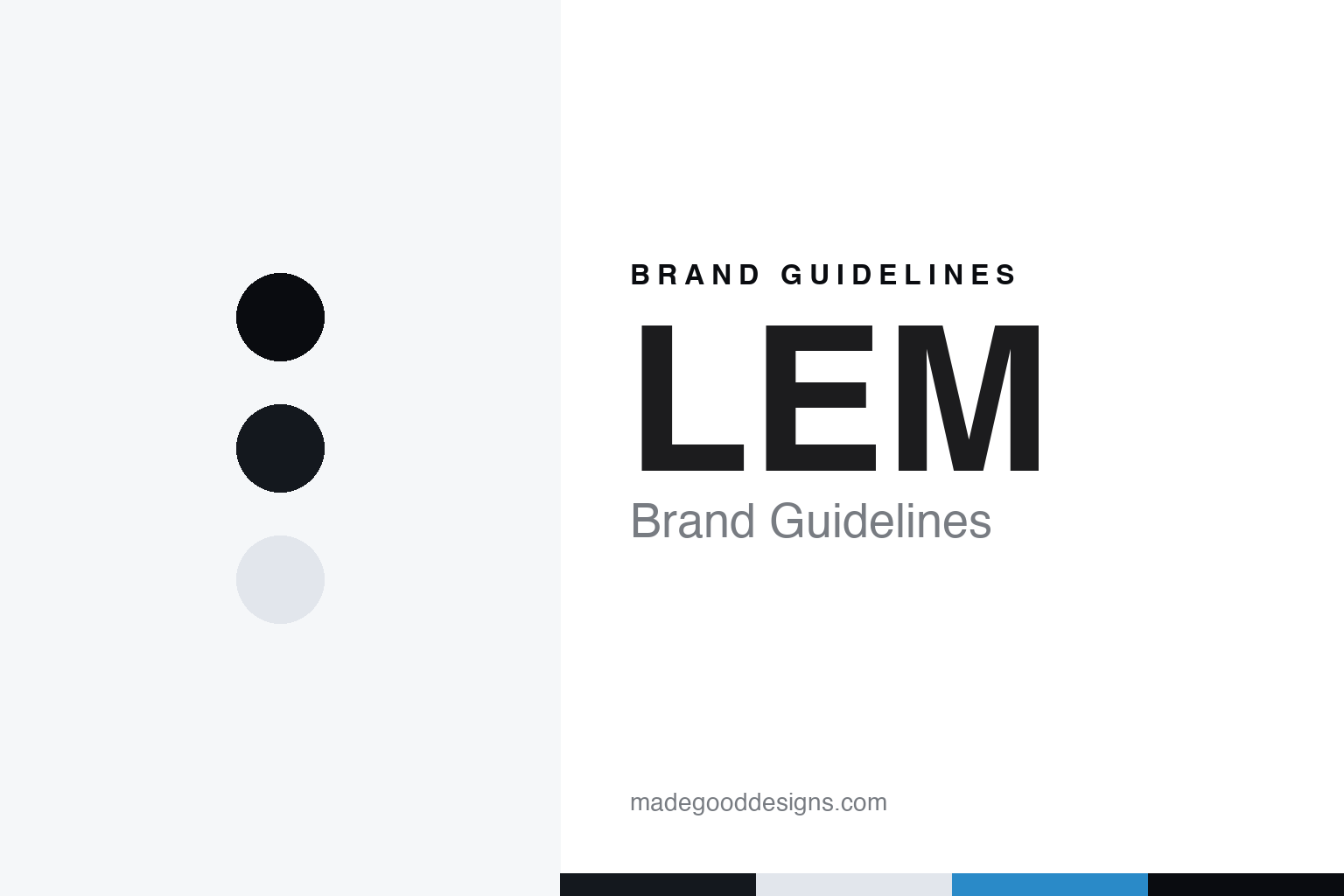
LEM Brand Guidelines
Generalmusic’s sound-system brand, revived in 2026.
Aa
Two constants: a LEM install black and signal blue palette and a Geometric sans register. Abstract homage — not a LEM product or mark; no instrument, logo or nameplate is reproduced.
Sound systems from Romagna
A sound-system brand inside an organ company.
LEM was the sound-system side of the Galanti family’s electronics business. Generalmusic’s own 1997 company profile says “the renowned LEM was founded in 1969 for the production of sound diffusion systems,” alongside GEM, which it says was founded in 1959 as “the first company in Italy to start manufacturing electronic organs.” We found no named founder for LEM.
The name is an abbreviation, though sources expand it differently: Italian Wikipedia gives “Laboratorio Elettro Musicale,” and the current owners’ site “Laboratori Elettro-Musicali” — electro-musical laboratory or laboratories. The group was based at Via delle Rose in San Giovanni in Marignano, in the province of Rimini, according to Italian Wikipedia. GEM’s own name came from “Galanti Egidio Mondaino,” after a family member and his home town; LEM’s carried no family name.
The 1997 profile also described the group as a whole: more than 400 staff, about 200 products and exports to 80 countries, figures we give as the company’s own. Italian Wikipedia records the group’s growth — the Schulze Pollmann piano brand in 1972, a research laboratory in the United States in 1974, a joint venture with the German organ maker Ahlborn in 1980, and Elka of Castelfidardo in 1989.
Colour
Bankruptcy, Finland and a return.
LEM fell with its parent. Generalmusic dismissed its staff in February 2009, English Wikipedia says, and the court in Rimini declared it bankrupt on 23 June 2011, in case number 25/2011, according to Italian Wikipedia. In December 2014 a Finnish company, Soundion, led by Jukka Kulmala, said it had acquired the GEM, LEM and Elka brands, with production planned in Salo, Finland; its plans for Elka included a failed 2015 crowdfunding campaign, it showed a GEM Promega 2+ piano in 2016, and an Italian trade writer later reported that Soundion apparently failed during the Covid period, a claim he based on information found online.
In January 2026, at the NAMM show in California, two Italian entrepreneurs announced that they had brought GEM and LEM back to Italy. The trade site SMstrumentimusicali, in a report by Riccardo Gerbi dated 23 January 2026, named them as Fabio De Fazio, a co-founder and long-time general manager of StrumentiMusicali.net, and Marco Medica, chief executive of Audio Effetti, a distributor of entertainment technology, and said that “LEM will soon return with audio systems.” Italian Wikipedia gives February 2026; we use the NAMM date. Elka is not mentioned in the 2026 deal.
The owners then took the brands to trade shows: ISE in Barcelona in February 2026, where De Fazio said, “We are back to stay,” and MIR Tech in Rimini, where LEM Commercial had its world premiere, according to posts on the owners’ Generalmusic site. That site’s domain was registered in June 2025, and it also announced the death of Matteo Galanti, a founder of GEM, on 14 February 2026, aged 92.
Typography
The other badge.
Italian electronic instruments of the 1960s to the 1980s often reached the world under other names. English Wikipedia records that Siel’s 1979 Orchestra was sold in the United States by ARP as the Quartet, and that its OR400 of 1982 was sold by Sequential Circuits as the Prelude; that the Logan String Melody, designed by the engineer Giuliano Costantin, was also sold under the Hohner name; and, according to the guitar historian Jack Marchal, that Welson’s guitars were sold in Germany under the Dynacord name.
Some Italian names did become famous in their own right. Farfisa, formed in 1946 from the accordion makers Settimio Soprani, Scandalli and Frontalini, made Compact organs that English Wikipedia says were used by Pink Floyd, Sly Stone, Blondie and Philip Glass. Elka’s Synthex, designed by Mario Maggi, was made in about 1,850 units between 1981 and 1985, according to the same source.
Many of these firms did not survive the 1980s. Siel’s life, by English Wikipedia’s account, ran from 1976 to 1986; Crumar stopped trading in 1986 or 1987; Generalmusic, owner of LEM and Elka, was declared bankrupt in 2011. Their names have since been revived, sold or left dormant — and the guides below say which.
LEM is the other side of that story: an Italian brand that kept its own name, lost it in a bankruptcy, and got it back.
Aa
A geometric sans — an M drawn as an arch with three stems. (Specimen set in Inter Tight, a sans STAND-IN; NOT the LEM logo.)
LEM
An M drawn as an arch with three stems.
On 16 July 2026 the owners announced LEM Commercial, launched on the Italian market only and distributed by Audio Effetti. It has three lines: BORA outdoor fixed-installation speakers, named after the north-easterly wind, with five point-source models, two column lines and a subwoofer line, stainless-steel parts and colour-matched enclosures, brackets and grilles; D-DRIVE compact amplifiers with signal processing, in AES67 and Dante network versions; and AV-CORE audio-visual processing matrices in four versions, with 4K HDMI switching, USB-C capture, echo cancellation, automatic mixing and camera auto-tracking. The D-DRIVE amplifiers come with presets for the BORA speakers. Datasheets were described as coming soon.
The owners’ blog makes claims about LEM’s past that we could not check: that it amplified Mina, Gino Paoli and Nino Ferrer, was used across Europe, the United States and China, and equipped Riviera clubs such as Bandiera Gialla, Aquafan and Baia Imperiale. It also claims the Beatles, mentions a PMA, or “Portable Mixing Amplifier,” series, and tells a story of amplifiers that kept working after being soaked in a storm — a story the blog itself introduces with “it is told.” We give none of these as fact. The site calls itself a blog run by enthusiasts, though Italian Wikipedia treats it as official.
LEM’s current logo is a custom geometric wordmark: an L and E built from thick strokes with rounded outer corners, and an M drawn as an arch with three stems, shown in white on dark backgrounds, with a registered-trademark sign. lem.it shows a blank page, and other LEM domains did not resolve. For a design guide, LEM shows a revived brand choosing installation work over nostalgia. Compare Generalmusic, its parent, and Elka, a sister brand left out of the 2026 deal. For this guide we use an install black and a signal blue with a sans, an unofficial interpretation; no instrument or logo is reproduced.
Explore & save
Keep LEM’s identity on hand — save it to a board in the Made Good inspiration library.
LEM identity set
Pin the LEM install black and signal blue palette and the Geometric sans register to your own board.