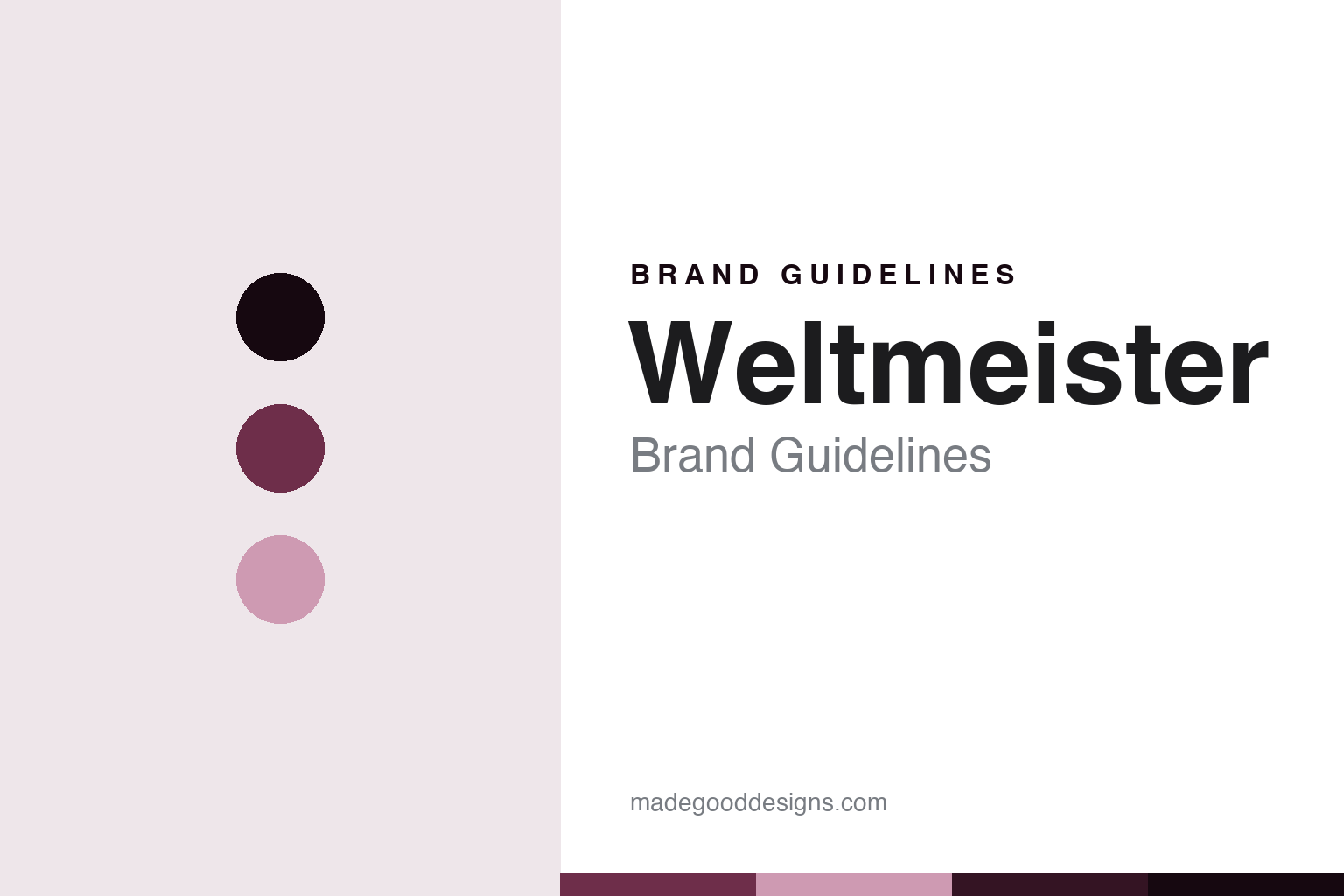
Weltmeister Brand Guidelines
The Klingenthal accordion.
Aa
Two constants: an accordion-plum palette and a heritage-sans register. Abstract homage — not a Weltmeister accordion, grille or mark.
The Klingenthal accordion
Weltmeister is the historic German accordion brand from Klingenthal, once made by the East German state, now a heritage name working through repeated insolvency.
Weltmeister is the round’s most turbulent survivor — a historic accordion name from the German town where the craft is rooted. From Klingenthal, in Saxony, the Weltmeister brand carries accordions with roots claimed to the middle of the nineteenth century. Its answer to how a maker becomes a name is heritage and endurance under strain: carry a famous accordion name from a famous accordion town, through state ownership and repeated financial trouble. A German accordion, from the accordion town, holding on.
Its identity is the Klingenthal accordion. Weltmeister’s Klingenthal heritage, its German making and its turbulent recent history are the work it is known for. An accordion, from Klingenthal. A heritage name working to survive.
(Honest notes, so the story stays precise. Weltmeister is an accordion brand from Klingenthal, Saxony; its live presence is at weltmeister.net (not weltmeister-akkordeon.de, which does not exist). The brand is reported to be one of the oldest accordion makers, with the local accordion tradition dated to around 1852, which we attribute as a claim rather than assert; we do not name a single founder, since a name sometimes attached to it belongs to a different, Magdeburg firm. On what it makes, it is piano and button accordions up to concert instruments, such as the Supita. On where it is made — a theme of this round — Weltmeister accordions are made in Germany, in Klingenthal, with a high degree of in-house manufacture. On ownership — the honest heart of this entry — Weltmeister was the brand of the East German state enterprise, VEB Klingenthaler Harmonikawerke; after reunification the accordion line continued as HARMONA Akkordeon GmbH, which has since been through repeated insolvencies (rescued in 2017, insolvent again since 2023, with proceedings unresolved as of the latest reporting) — so we present the brand and site as alive in 2026 but its ownership and long-term future as unconfirmed. Given the sensitive East German history, we reproduce no state or GDR imagery. Its name and marks are IP, described but never reproduced, and there is no official brand hex; these tones are an unofficial interpretation. This is design commentary and does not promote any product.)
Colour
Weltmeister lives in an accordion-plum palette. Click a swatch to copy the hex.
Weltmeister’s identity is heritage, German and embattled — an accordion plum, an ink, a pearl, a deep plum, and a paper. The palette leans accordion plum and pearl: the register of a classic accordion body and pearl-celluloid. It signals a storied name under strain. The honest caveat: with no published brand hex, these values are an original, unofficial interpretation, not first-party colours.
The lesson is an accordion-plum palette signals a heritage, Klingenthal identity. Weltmeister’s world is a heritage, celluloid-and-reed, German object. For designers, it is a reminder that a deep plum and a soft pearl can carry a name built on a craft town — the wine of an accordion body and the sheen of pearl celluloid. Because these tones can fail as small text, keep type dark and let the colour live in the accents, palette and band. The takeaways: carry the heritage; be honest about the trouble; keep the making in the craft town; and treat any single hex as unofficial.
Typography
The register is a heritage sans — storied, plain, embattled.
Weltmeister’s identity carries a storied, plain, embattled spirit — a historic accordion name, not a fashion label. A heritage sans captures the mood: even, solid and classic, the register of an old Klingenthal maker. Set in an accordion-plum palette, the heritage sans feels storied and embattled — exactly the personality Weltmeister carries. It is a heritage name under strain rather than a marketing wall, mirroring a Klingenthal accordion. (Weltmeister’s real logo and wordmark are things we describe but do not reproduce, and the exact typeface is not ours to use.) Because it is not ours to use, the honest description is “a heritage-sans spirit,” shown here in a stand-in. The type behaves like the name: storied, plain and embattled.
Aa
A heritage-sans spirit — storied and embattled. (Specimen set in Mulish, a heritage-sans STAND-IN; NOT the Weltmeister logo or any mark.)
The instrument around the world
Weltmeister stands for the Klingenthal accordion name working to survive.
Weltmeister is a lesson in how a heritage name endures under strain. An accordion-plum palette, a heritage sans and a Klingenthal accordion make one thing — the Klingenthal accordion — the whole identity: heritage, German and embattled. The Klingenthal roots are the differentiator, and the turbulent recent history is the meaning. The point is a famous accordion name from a famous accordion town that came through East German state ownership and, since reunification, a series of insolvencies — still making accordions, still fighting for its future.
Put to work, the identity is a heritage name under strain, honestly told, as design. A house in this spirit would carry the heritage, keep the making in the craft town, and be candid about the trouble — accordions made in Klingenthal, a brand from the East German state enterprise, a company through repeated insolvency. A brand learning from it would see that a heritage name can endure real trouble — but that trust depends on saying so plainly, not pretending to be thriving. Weltmeister is this round’s hard counterpart to the piano house that opened it: both are Eastern-bloc heritage makers that came through state ownership, but where the Estonian grand was rescued and rebuilt by a pianist, the Klingenthal accordion is still in insolvency limbo — two survival stories, two very different endings so far. The discipline is in the honesty: attributing the “oldest” claim rather than asserting it, not naming a founder who belongs to a different firm, correcting the state-enterprise name, and framing the 2026 status as alive-but-unresolved rather than either dead or thriving. The lesson Weltmeister teaches is that a heritage name can hold an identity even under strain: the Klingenthal roots give it substance, and the honesty about the insolvency keeps it credible. The name is the personality, and the Klingenthal accordion is the proof.
For designers and brand-builders, Weltmeister holds the Germany pole in the instrument around the world: carry the heritage, and be honest about the trouble. The lessons: a heritage name is real equity; keep the making in the craft town; say plainly when the company is in difficulty; correct the record; and never reproduce a logo or state imagery. It is also a reminder to stay precise: Weltmeister is the historic German accordion brand from Klingenthal, once made by the East German state, now a heritage name working through repeated insolvency — with the palette here an unofficial interpretation. Weltmeister made an embattled heritage the identity — proof that a name working to survive, honestly told, can be the difference.
Explore & save
Keep Weltmeister’s identity on hand — save it to a board in the Made Good inspiration library.
Weltmeister identity set
Pin the accordion-plum palette and the heritage-sans register to your own board.