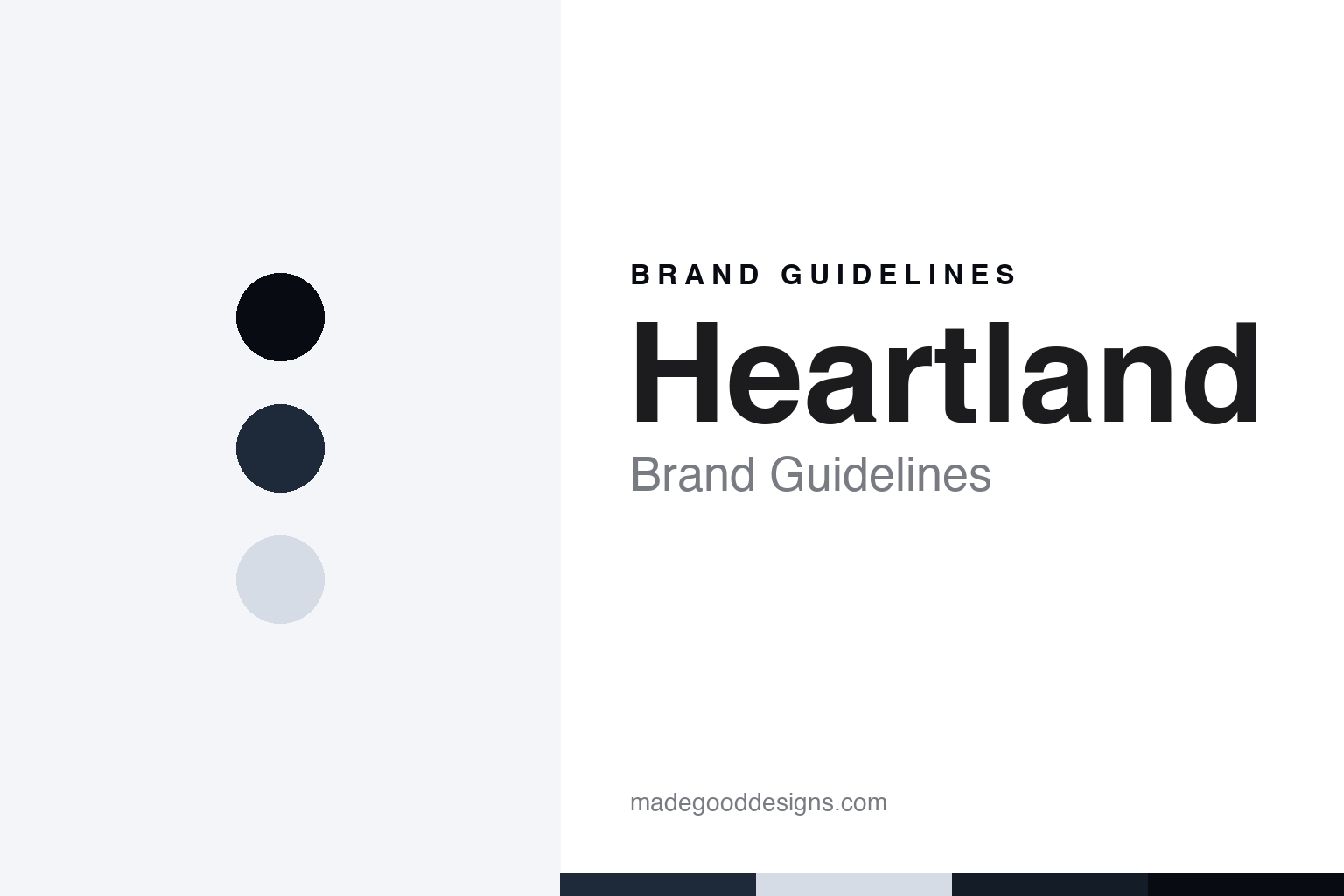
Heartland Harps Brand Guidelines
Carbon-fibre harps from the coast of Georgia.
Aa
Two constants: a Heartland carbon and silver palette and a Engineered sans register. Abstract homage — not a Heartland product or mark; no instrument, logo or nameplate is reproduced.
From wood to carbon
Dave Woodworth’s 1,700 wooden harps.
Heartland Harps is the work of Dave Woodworth, its “Founder and CEO.” He began building wooden harps in 1984, the company says, and built more than 1,700 of them over twenty-five years, under the name “Heartland Strings.” In 2001 he married the harpist Pamela Bruner.
The business has moved often. Woodworth writes: “I’ve built harps in Minnesota, Wisconsin, Oregon, North Carolina and now coastal Georgia.” A trade article placed it in Zirconia, North Carolina; the website footer now gives Darien, Georgia, with a North Carolina phone number carried over. We have no date for the move, so we give none.
It is active: its homepage was updated in May 2026 and refers to 2026 prices. Its long history in wood, before carbon, is part of how it presents itself.
Colour
A new material.
Heartland’s defining step came in 2009, when, it says, it “introduced the world’s first harp fabricated from carbon fiber.” The “first” is the company’s claim. It now says it has built more than 1,200 carbon-fibre harps; an earlier article in the trade magazine CompositesWorld gave more than 650, so the figures come from different dates.
It describes the material’s advantages plainly: its harps are “lightweight, impermeable to the elements, and virtually indestructible.” Its range includes the Infinity, the 36-string Legend and the Delight lever harps, and a pedal harp called the Starlight, whose faceplates it cuts on a new CNC mill. Its tagline is “Continuing to Redefine the Harp Experience.”
The website does not use the words “made in USA,” so we say it is based in coastal Georgia rather than describing where each part is made.
Typography
Levers, clarsachs and a national harp.
The lever harp has deep roots in Britain and Ireland. Wales’s official tourism site says “The Welsh harp (also known as the triple harp) is widely considered to be the national instrument of Wales.” In Scotland, the Clarsach Society says it was “Established in 1931 at the close of the National Mòd in Dingwall,” with a founding principle “to advance the clarsach and its music,” and describes itself as “Promoting the playing of the Scottish lever harp.”
The lever is the defining part. The Clarsach Society explains that early harps used “semitone blades… screwed into the neck of the harp, one beside each string,” later replaced by “excellent, accurate levers” — hence “The lever harp, as it is commonly called.” Each lever raises one string by a semitone; a concert pedal harp instead uses pedals that change every string of a given note at once.
The lever harp’s other ancestor is the Irish harp. Ireland’s government says it has “the distinction of being the only nation to have a musical instrument as a national emblem,” a gold harp with silver strings on blue, modelled on a fourteenth-century harp at Trinity College Dublin. Guinness says it registered its own harp as a trademark in 1876, and that this is why the two harps face opposite ways.
The pedal harp’s mechanism goes back to one patent. Sébastien Erard applied for an English patent, number 3332, in 1810, for a double-action harp in which each string has two forks worked by a pedal, so it can sound flat, natural or sharp; a Royal College of Music thesis by Fanny Guillaume-Castel says the design “remains the standard pedal harp mechanism today,” and that Erard sold about a hundred in 1812, the first full year of sale.
At the top of the market sit the pedal-harp makers. Chicago’s Lyon & Healy, harpmakers since 1889, has belonged since 1987 to the group founded by Victor Salvi, whose Italian factory is in Piasco, Piedmont; the New York Times described the result as “a genial global monopoly.”
The lever itself is often French. The Mouzeil maker Camac, founded in 1972 by the brothers Gérard and Joël Garnier, supplies levers to other builders: Oregon’s Thormahlen says its harps are “all fully levered with Camac levers,” and California’s Triplett says “Our sharpening levers are manufactured in France by Camac harps.”
Timber law touches every harp maker. In 2017 the CITES convention brought the whole rosewood genus, Dalbergia, under its Appendix II controls; since 26 November 2019 it has exempted “finished musical instruments, finished musical instrument parts and finished musical instrument accessories,” though Brazilian rosewood stays in Appendix I. We found no source linking any maker in this round to those timbers.
Erard’s own 1811 advertisement promised that the strings produced “three distinct tones instead of two,” so that the player “can now play in every known key.” Guinness’s archive says the harp “has been synonymous with Guinness since 1862 when it was used as a symbol on the first bottle label,” and Ireland’s patent office says the state harp is excluded “from registration or use as trade marks.”
Other American lever-harp families have taken different paths: Rees Harps moved from California to an 1881 building in Rising Sun, Indiana, in 2000 and registered the Harpsicle trademark, and Chicago’s Venus stopped building new production harps in 2018.
The brand name, Heartland, goes back to the wood-harp years, when the business traded as Heartland Strings; it survived the change of material and every change of state.
Aa
An engineered sans — a weave rather than a grain. (Specimen set in Inter Tight, a sans STAND-IN; NOT the Heartland logo.)
Heartland
A weave rather than a grain.
Heartland’s brand is its material. Where other harp makers lead with wood — maple, spruce, koa — Heartland leads with carbon fibre and the promise of an instrument that weather cannot hurt. Its founder’s 1,700 wooden harps give that pivot credibility: this is not a materials company that discovered harps, but a harp maker that discovered a material. The move across five states, ending on the Georgia coast, adds a personal story of a maker who has kept building wherever he lived.
For a design guide, Heartland shows how a maker can build a new identity on a change of material while keeping its founder’s story at the centre. Compare Thormahlen, which stays with wood and Camac levers, and Rees, which built a brand on colour.
For this guide we use a carbon grey and a silver with a sans serif, an unofficial interpretation. No harp or mark is reproduced.
Explore & save
Keep Heartland Harps’s identity on hand — save it to a board in the Made Good inspiration library.
Heartland identity set
Pin the Heartland carbon and silver palette and the Engineered sans register to your own board.