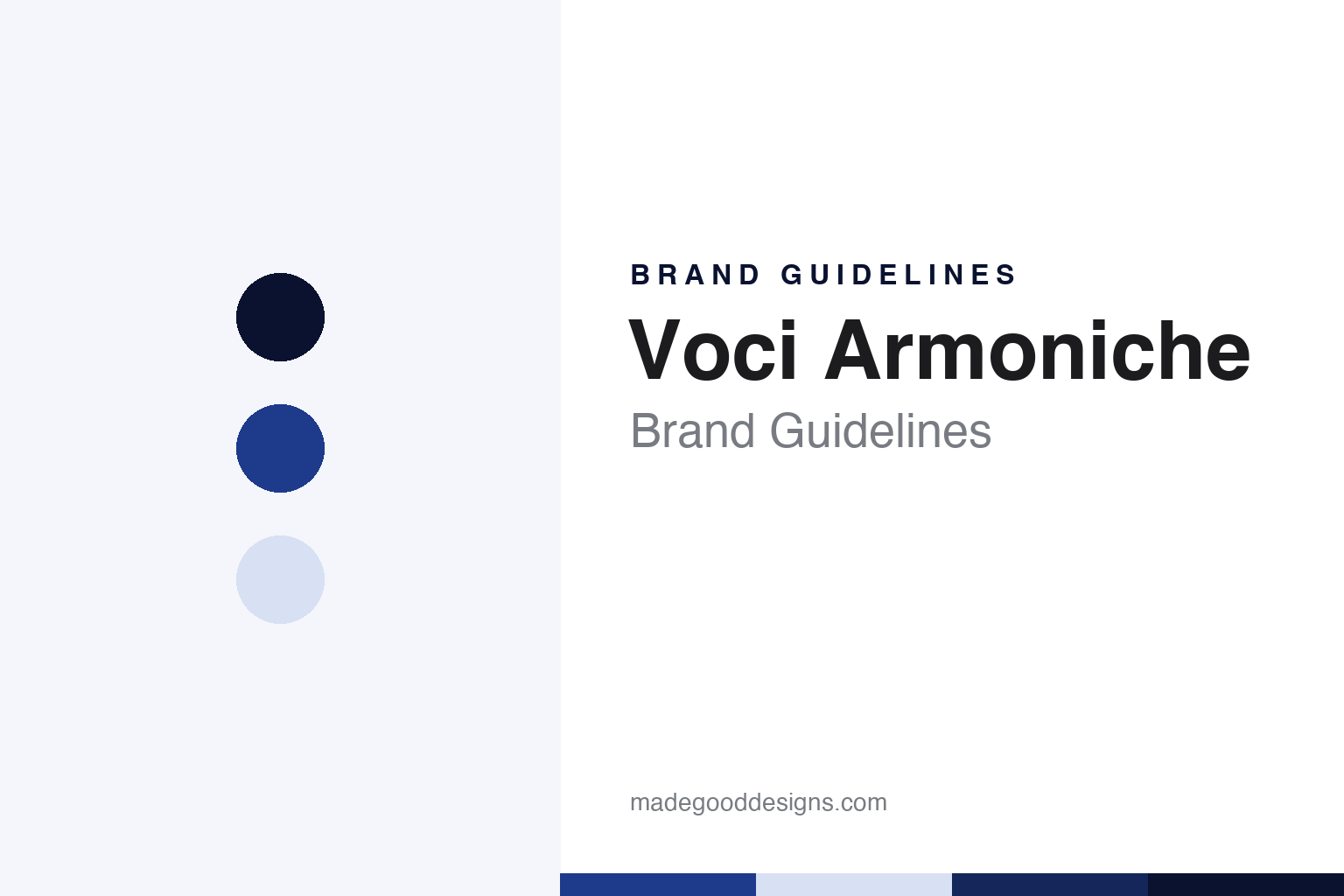
Voci Armoniche Brand Guidelines
The reed maker inside the accordion.
Aa
Two constants: a Voci Armoniche steel blue and silver palette and a Precision sans register. Abstract homage — not a Voci Armoniche product or mark; no instrument, logo or nameplate is reproduced.
Two families, one reed
Antonelli and Salpa.
Voci Armoniche makes the part of the accordion that makes the sound: the reed. Its name means “harmonic voices” — in the Marche a reed is a voce, a voice. The company describes a reed as “two high carbon steel tongues, an alloy aluminium frame called a plate and two rivets that secure the tongues to the plate.”
It was formed in 2002 by Lorenzo Antonelli and Giansandro Breccia, merging two older reed makers. In 1935 Luigi Antonelli, who had run the reed department at Settimio Soprani, founded Fratelli Antonelli in Osimo with his brothers Cesare and Filippo; in 1946 Alessandro and Remo Breccia, former technicians at the Soprani firms, founded Salpa. Both the company and an academic study, by Raffaele Pinelli in the European Journal of Musicology in 2021, record that in 1949 Fratelli Antonelli had more than a hundred workers making 100,000 reeds a day.
In 1952, the company says, Luigi Antonelli created the “tipo a mano” reed — hand-finished rather than entirely handmade. The Antonelli firm became SIVA in 1973, and the company has worked from its Osimo site since 1980. Lorenzo Antonelli, the founder’s grandson, is its chairman and chief executive, and in 2020 received the Gentile da Fabriano national award, in its Officina marchigiana section.
Colour
Grades, myths and a blue star.
Reeds come in grades, and Voci Armoniche is unusually frank about them. Its range runs from Super Durall through tipo a mano and a mano — handmade — to BlueStar. Its FAQ says the steel in a mano reeds is not metallurgically superior, only narrower, and that “since the 1990s the handmade reed has lived in an imaginary world, often cultivated for commercial reasons.” A fully 1930s-style handmade reed, it says, would cost between €15 and €20 today, “with no guarantee that it would be superior to a well-made modern reed.”
Its newest grade is BlueStar, which Lorenzo Antonelli conceived in 2013, registered as a trademark in 2014 and launched on 1 September 2021. Its tongues are blued by heat, which the company calls “a traditional technique used in high-end watchmaking,” and its star stands for five values — excellence, innovation, essentiality, inimitability and made in Italy. The company says BlueStar “exceeds the handmade reed.”
It sells only to the trade, and Pinelli counted between thirty and forty craftsmen, plus homeworkers. Its list of partners includes Castagnari, Bugari, Dino Baffetti, Scandalli, Maugein and Petosa, and Pinelli’s study records that the Antonelli family has supplied Castagnari for more than forty years. Since 2006 it has laser-marked one plate in each set with its logo and “ITALIA,” and since 2020 added a tag reading “100% made in Italy.”
Typography
The Castelfidardo supply chain.
Castelfidardo, in the Marche, has made accordions since the nineteenth century, and its own history page records the scale of the boom. Between 1947 and 1953 the town’s accordion exports rose from 57,523 to 192,058, and a town of about 9,000 people employed about 10,000 accordion workers. Seventeen firms went bankrupt between 1960 and 1963.
The post-war years were the town’s golden age. The comune records that nineteen accordion firms were founded in Castelfidardo alone between 1946 and 1948, that some took Hollywood names — Paramount, Universal, MGM, Metropolitan — to sell in America, and that one street, via Marconi, was nicknamed “via dei dollari,” the street of dollars.
Consolidation came early. In July 1946, the Treccani biographical dictionary records, three firms — Settimio Soprani of Castelfidardo, Scandalli of Camerano and Frontalini of Numana — joined to form Farfisa, the “Fabbriche Riunite Fisarmoniche,” though Frontalini soon withdrew.
The decline was long. In 2012 the business paper Il Sole 24 Ore put the peak at 240,000 accordions a year and current output at “non più di 30mila” — no more than 30,000 — between Castelfidardo and neighbouring Recanati. The town says about thirty firms still work there.
Much of the instrument comes from specialists. A March 2000 trade report, quoted by the accordion writer Mario Bruneau, counted 29 accordion firms in the area and found that “only 2 are actually able to produce an entire accordion”; the rest depended on outside companies for components such as buttons and bass mechanisms.
The reeds, which make the sound, come from a handful of makers. A 2021 study in the European Journal of Musicology by Raffaele Pinelli named four in the Marche — Voci Armoniche, Binci, Cagnoni and Artigiana Voci — and found that the Italian reed market had fallen sharply in the 2000s.
The town keeps its history in public. Its international accordion museum grew out of an appeal on the RAI television programme Portobello on 20 February 1981 and opened on 9 May 1981; a 2020 count put its collection at 450 accordions, 9,500 scores and 11,000 recordings.
Castelfidardo is now working toward UNESCO recognition for accordion making: the town says a cataloguing phase ended on 13 September 2025 with eighteen documentation sheets. As far as public sources show, the town has no protected geographical indication for its accordions, although EU rules for craft indications took effect on 1 December 2025.
The trade itself is smaller and richer. Under customs code 9205 90 10, Eurostat records that Italy exported €22.37 million of accordions and similar instruments in 2024 — 9,998 units, about €2,240 each — against 16,905 units in 2007.
Voci Armoniche is the reed end of that chain: the part every brand needs, made by a company most players never see.
Aa
A precision sans — a blued tongue and a five-point star. (Specimen set in Inter Tight, a sans STAND-IN; NOT the Voci Armoniche logo.)
Voci Armoniche
A blued tongue and a five-point star.
Voci Armoniche’s brand is a component made visible. Most accordion players never see the reeds inside their instrument, so the company has built cues that can be seen and checked: the blue of its BlueStar tongues, the laser-marked “ITALIA,” the origin tag, the grade certificates. Its candour about handmade reeds is itself a brand position — a supplier telling the trade which myths it will not sell.
For a design guide, Voci Armoniche shows how an invisible part can carry an identity. Compare Cagnoni, another Osimo reed maker, and Castagnari, a long-time customer. For this guide we use a steel blue and a silver with a sans, an unofficial interpretation; no reed or logo is reproduced.
Explore & save
Keep Voci Armoniche’s identity on hand — save it to a board in the Made Good inspiration library.
Voci Armoniche identity set
Pin the Voci Armoniche steel blue and silver palette and the Precision sans register to your own board.