Farfisa Brand Guidelines
From accordion merger to combo organ to intercom.
Aa
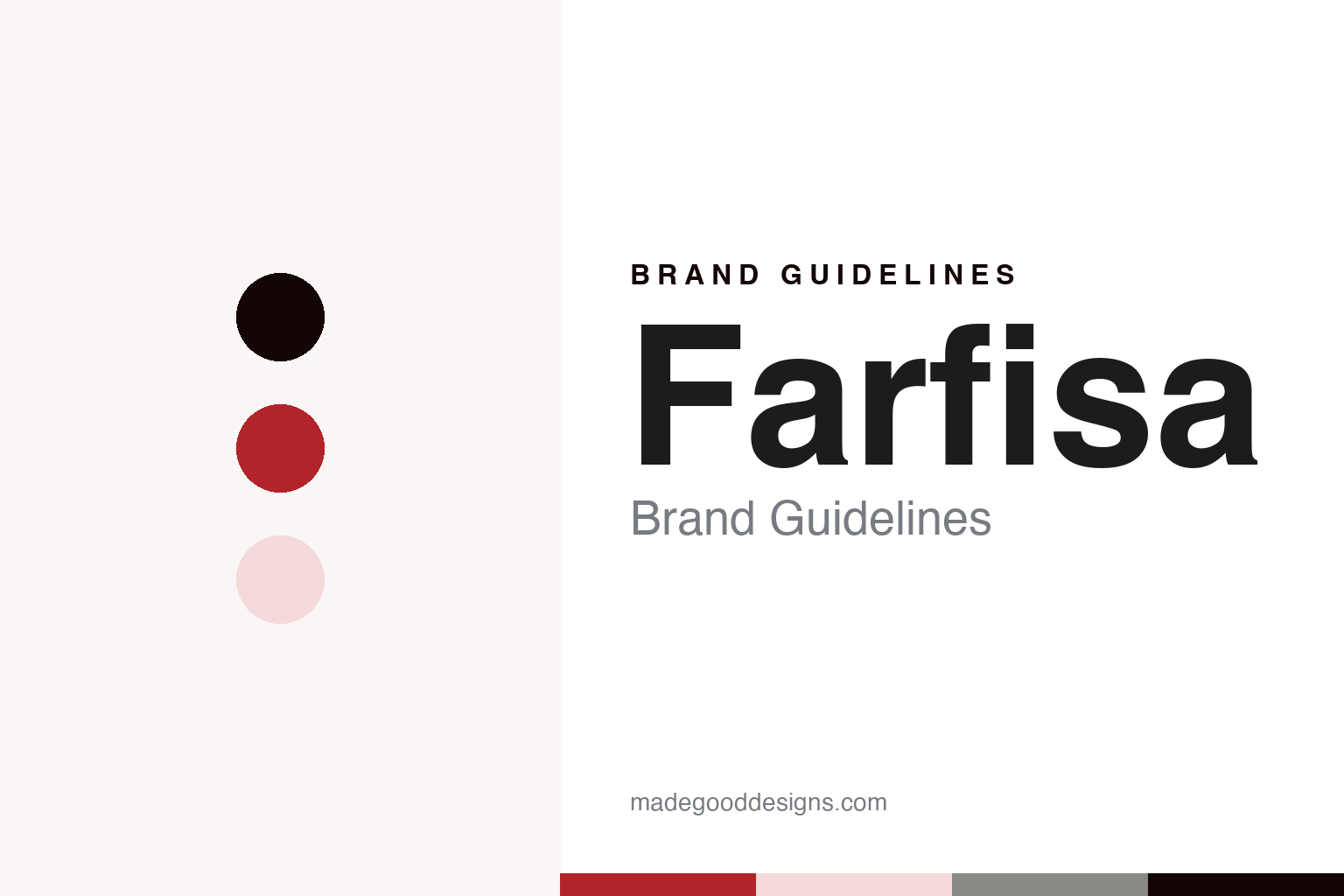
Two constants: a Farfisa compact red and grey palette and a Sixties sans register. Abstract homage — not a Farfisa product or mark; no instrument, logo or nameplate is reproduced.
A merger with an acronym
Fabbriche Riunite Fisarmoniche.
Farfisa began as an accordion merger. The Treccani biographical dictionary records that “Nel luglio del 1946 nacque così la FARFISA (FAbbriche Riunite FISArmoniche italiane)” — in July 1946 Farfisa was born, the united accordion factories of Italy. Its founders were Paolo Settimio Soprani (1913–1989), grandson of Settimio, of the Settimio Soprani firm in Castelfidardo, Silvio Scandalli of Camerano and Alfredo Frontalini of Numana; Frontalini, Treccani says, soon left, not sharing his partners’ aims.
It grew far beyond accordions. Treccani lists plants at Camerano, Castelfidardo and Origgio, in the province of Varese, a workforce that peaked at about two thousand, and products that came to include pianos, guitars, record players, organs, televisions and intercoms. English Wikipedia describes it as once the world’s largest supplier of accordions, making up to 180 instruments a day with more than 1,600 employees.
Its ownership changed hands. Treccani says the US group Lear Siegler took control, that Paolo Settimio Soprani resigned in 1970 over disagreements, and that Paolo Bontempi, of the Bontempi musical-instrument company, acquired it in October 1984.
Colour
The combo organ.
Farfisa’s fame came from electronic organs. The Powerhouse Museum in Sydney, which acquired a 1964 Farfisa Combo Compact for its collection in 2021, says the company worked with the American firm Lowrey on electronic accordions from 1960 and launched its own portable organs after the success of the Vox Continental in 1962, at about half the Continental’s price. English Wikipedia lists the line that followed: the Combo Compact of 1964, the Mini Compact and Compact Duo of 1966, the FAST series, the Professional, the VIP of 1970, the Matador of 1972 and the Syntorchestra of 1975.
The Compact became a sound of the 1960s. Pink Floyd’s Richard Wright used a Farfisa Combo-Compact on The Piper at the Gates of Dawn in 1967 and a Compact-Duo through Live at Pompeii, according to a gear list on his official website. An enthusiast archive says the basic Compacts came in red or grey, red being the most common, while the later models were a light beige.
The name then split. Farfisa’s intercom division, founded in 1967, became an independent company in 1993 — ACI Farfisa, in Osimo — which says its products are “conceived and manufactured in Osimo” and adopted a new logo for its fiftieth anniversary in 2017. The musical name stayed with Bontempi, which announced at a Sanremo event on 12 February 2025, where a musician played an original Compact Duo, that Farfisa keyboards would return to production. The intercom company, for its part, lists what it calls firsts: the Serie 280 video intercom in 1975 and Farphone, a patented two-wire system, in 1988. When it became independent in 1993, it says, it kept the brand.
Typography
The Castelfidardo supply chain.
Castelfidardo, in the Marche, has made accordions since the nineteenth century, and its own history page records the scale of the boom. Between 1947 and 1953 the town’s accordion exports rose from 57,523 to 192,058, and a town of about 9,000 people employed about 10,000 accordion workers. Seventeen firms went bankrupt between 1960 and 1963.
The post-war years were the town’s golden age. The comune records that nineteen accordion firms were founded in Castelfidardo alone between 1946 and 1948, that some took Hollywood names — Paramount, Universal, MGM, Metropolitan — to sell in America, and that one street, via Marconi, was nicknamed “via dei dollari,” the street of dollars.
The decline was long. In 2012 the business paper Il Sole 24 Ore put the peak at 240,000 accordions a year and current output at “non più di 30mila” — no more than 30,000 — between Castelfidardo and neighbouring Recanati. The town says about thirty firms still work there.
Much of the instrument comes from specialists. A March 2000 trade report, quoted by the accordion writer Mario Bruneau, counted 29 accordion firms in the area and found that “only 2 are actually able to produce an entire accordion”; the rest depended on outside companies for components such as buttons and bass mechanisms.
The reeds, which make the sound, come from a handful of makers. A 2021 study in the European Journal of Musicology by Raffaele Pinelli named four in the Marche — Voci Armoniche, Binci, Cagnoni and Artigiana Voci — and found that the Italian reed market had fallen sharply in the 2000s.
The town keeps its history in public. Its international accordion museum grew out of an appeal on the RAI television programme Portobello on 20 February 1981 and opened on 9 May 1981; a 2020 count put its collection at 450 accordions, 9,500 scores and 11,000 recordings.
Castelfidardo is now working toward UNESCO recognition for accordion making: the town says a cataloguing phase ended on 13 September 2025 with eighteen documentation sheets. As far as public sources show, the town has no protected geographical indication for its accordions, although EU rules for craft indications took effect on 1 December 2025.
The trade itself is smaller and richer. Under customs code 9205 90 10, Eurostat records that Italy exported €22.37 million of accordions and similar instruments in 2024 — 9,998 units, about €2,240 each — against 16,905 units in 2007.
Farfisa is the clearest example of that consolidation — and of how a Marche accordion name could end up on organs, televisions and door-entry panels.
Aa
A sixties sans — a merger’s acronym on a red organ. (Specimen set in Inter Tight, a sans STAND-IN; NOT the Farfisa logo.)
Farfisa
A merger’s acronym on a red organ.
Farfisa’s brand is an acronym that outgrew its meaning. Built from the words for united accordion factories, it became best known for organs, and is now carried by two separate businesses — an intercom company in Osimo, with a yellow-and-black identity, and a keyboard revival under Bontempi.
For a design guide, Farfisa shows a brand name surviving the businesses that made it — and splitting between two. Compare Settimio Soprani, one of its founding firms, and Scandalli, another. We note that some famous songs often credited to Farfisa organs were in fact played on a Vox Continental, so we name only documented uses. For this guide we use a compact red and a grey with a sans, an unofficial interpretation; no instrument or logo is reproduced.
Explore & save
Keep Farfisa’s identity on hand — save it to a board in the Made Good inspiration library.
Farfisa identity set
Pin the Farfisa compact red and grey palette and the Sixties sans register to your own board.