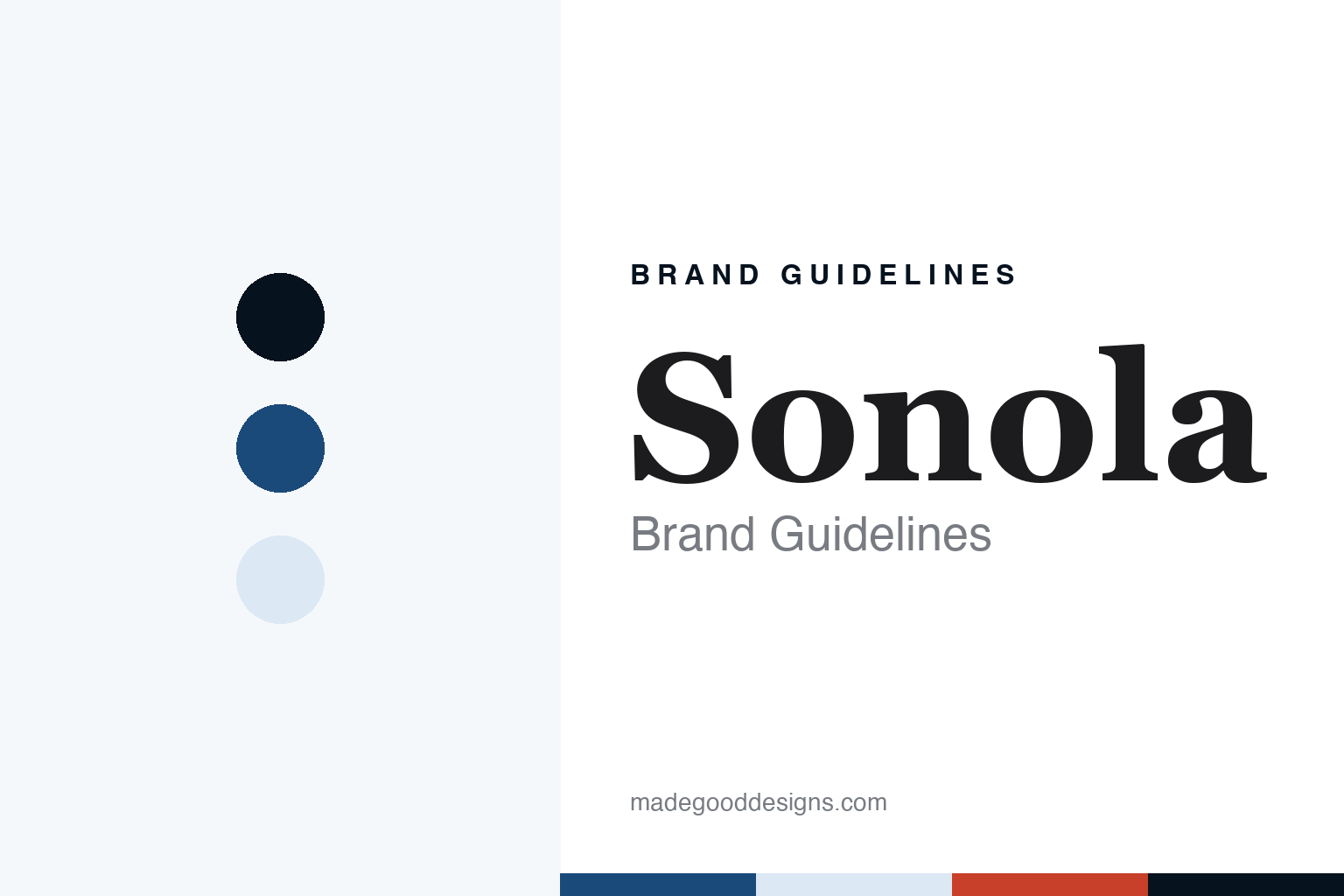
Sonola Brand Guidelines
The Castelfidardo accordion name built for America.
Aa
Two constants: a Sonola export blue and red palette and a Export serif register. Abstract homage — not a Sonola product or mark; no instrument, logo or nameplate is reproduced.
Emigrants who came home
The Cupido brothers and their partners.
Sonola was founded by emigrants. Its present owner, Maxim’s Group, a Castelfidardo accordion company, says that the brothers Aurelio and Gino Cupido, from Castelfidardo, had been in America since the 1930s, trading, repairing and selling accordions, and that with two partners, Alfredo Guidobaldi and Alfredo Petromilli, they founded “La Sonola,” “taking advantage of the favourable climate.” Maxim’s gives no founding year; accordion chronologies, including those compiled by accordion-service firms and collectors, give 1935 in Castelfidardo. We say “chronologies give 1935.” Maxim’s history does not say when the Cupido brothers returned to Italy, or how long they ran the firm.
The founders are easy to confuse with others. Alfredo Guidobaldi is not Guido Guidobaldi, the founder of Zero Sette, another Castelfidardo house; we have found nothing connecting the two.
Sonola’s market was the United States. Maxim’s describes models that were “famous in the USA” and an exclusive agreement with “the largest importer in America,” and says the firm held five patents; we give those as the owner’s claims. A British dealer’s history says Sonola instruments were made from the early 1950s to the 1990s.
Colour
Guerrini, Maxim’s and a Mexican range.
Sonola changed hands twice. Accordion chronologies record that the brand was acquired by Guerrini & Figli, another Castelfidardo maker, in 1973. Then, Maxim’s says, “subsequently in 2008 we acquired the SONOLA brand” — an acquisition, in its words, rather than a new registration. Maxim’s says the first name it registered was Settimio Soprani, in 2006, and that it acquired Crucianelli and Frontalini in 2009. With Settimio Soprani, it says, it began by rebuilding a historic model, the ARTIST VI. The sonola.it address now leads to Maxim’s website.
The modern range keeps the American connection, with a twist. Its models are named after Mexican places — Jalisco II, Michoacan II and Sinaloa II — alongside the Loreto II and the Legenda II. Maxim’s presents the relaunch as built on models “famous in the USA”; the pages we read do not explain the choice of names.
We have not found independent records of Sonola’s production volumes, its patents or its importer, and we treat those details as Maxim’s account. What is documented is the line of ownership — the founders, Guerrini and Maxim’s — and the range sold today.
The district Sonola belongs to is much smaller than it was. In 2012 the business paper Il Sole 24 Ore put the peak output of Castelfidardo and Recanati at 240,000 accordions a year, and current output at no more than 30,000. A March 2000 trade report, quoted by the accordion writer Mario Bruneau, counted 29 accordion firms in the area and found that only two could make an entire accordion themselves; the rest relied on outside suppliers for parts. A 2021 study in the European Journal of Musicology by Raffaele Pinelli named four reed makers in the Marche — Voci Armoniche, Binci, Cagnoni and Artigiana Voci — and found that the Italian reed market had fallen sharply in the 2000s. Names like Sonola now live inside that smaller trade, sold by firms that keep several historic marks at once.
Typography
From accordions to electronics.
The accordion boom on Italy’s Adriatic coast ended quickly. Italian Wikipedia, citing the national business-archive portal, records that accordion exports fell by about half between 1952 and 1962; an analysis by Franco Foschi, quoted in a 2012 presentation by the guitar maker EKO, estimated that the trade had employed at least 13,000 people while it lasted.
The district’s answer was to change instruments: in the late 1950s and 1960s, several accordion firms, and people who had worked for them, turned to electric guitars and electronic organs. Italian Wikipedia credits the guitar maker EKO with lifting Italy’s share of world guitar exports from 0.8 per cent in 1956 to 12 per cent in 1965.
Electronics followed. Farfisa, formed in 1946 from three accordion firms, made its first electronic accordions in 1962 and its Compact organs from 1964; the Castelfidardo collector Claudio Capponi puts its workforce at about 1,800 in 1963. Crumar, founded around 1970–71 by Mario Crucianelli of the accordion family, grew to about 300 staff, according to an enthusiast history based on interviews with former engineers, before it stopped trading in 1986 or 1987 — sources differ.
The industrial district of Recanati, Osimo and Castelfidardo, which covers fourteen comuni, went into crisis again at the end of the 1970s, Italian Wikipedia says, under Asian competition, and diversified into lighting, photovoltaics and telecommunications. Further north, in Romagna, the Galanti family of Mondaino made a parallel journey from accordions to organs and keyboards.
The history is kept in small places. Recanati opened a guitar museum named after EKO’s founder, Oliviero Pigini, on 22 May 2004; Castelfidardo’s international accordion museum opened in 1981; and an annual Farfisa Day, organised by Capponi’s cultural association, shows historic instruments in Castelfidardo — its fourteenth edition was held in September 2025.
Sonola is the other side of that story: a name that stayed with the accordion, passed from owner to owner, and survives because a Castelfidardo company chose to keep it.
Aa
An export serif — a Castelfidardo name with Mexican models. (Specimen set in Fraunces, a serif STAND-IN; NOT the Sonola logo.)
Sonola
A Castelfidardo name with Mexican models.
Sonola’s brand was made for export from the start. Its founders had lived in America, its sales ran through an American importer, and its current models carry the names of Mexican states.
Most of the district names in this guide carry a family surname — Galanti, Crucianelli, Bontempi. Sonola does not, and it is now on its third owner. Today it is not a separate company but a product line of Maxim’s, sold alongside Settimio Soprani, Crucianelli and Frontalini. Readers can compare its suppliers’ world in our guides to Voci Armoniche and Cagnoni, two of the reed makers that serve the district.
For a design guide, Sonola shows how a brand can be built around a destination. Compare Settimio Soprani, another Maxim’s name, and Zero Sette, founded by a different Guidobaldi. We say plainly that today’s Sonola instruments are Maxim’s products under a historic name. For this guide we use an export blue and a grille red with a serif, an unofficial interpretation; no instrument or logo is reproduced.
Explore & save
Keep Sonola’s identity on hand — save it to a board in the Made Good inspiration library.
Sonola identity set
Pin the Sonola export blue and red palette and the Export serif register to your own board.