Frontalini Brand Guidelines
The Numana accordion house revived as a Maxim’s line.
Aa
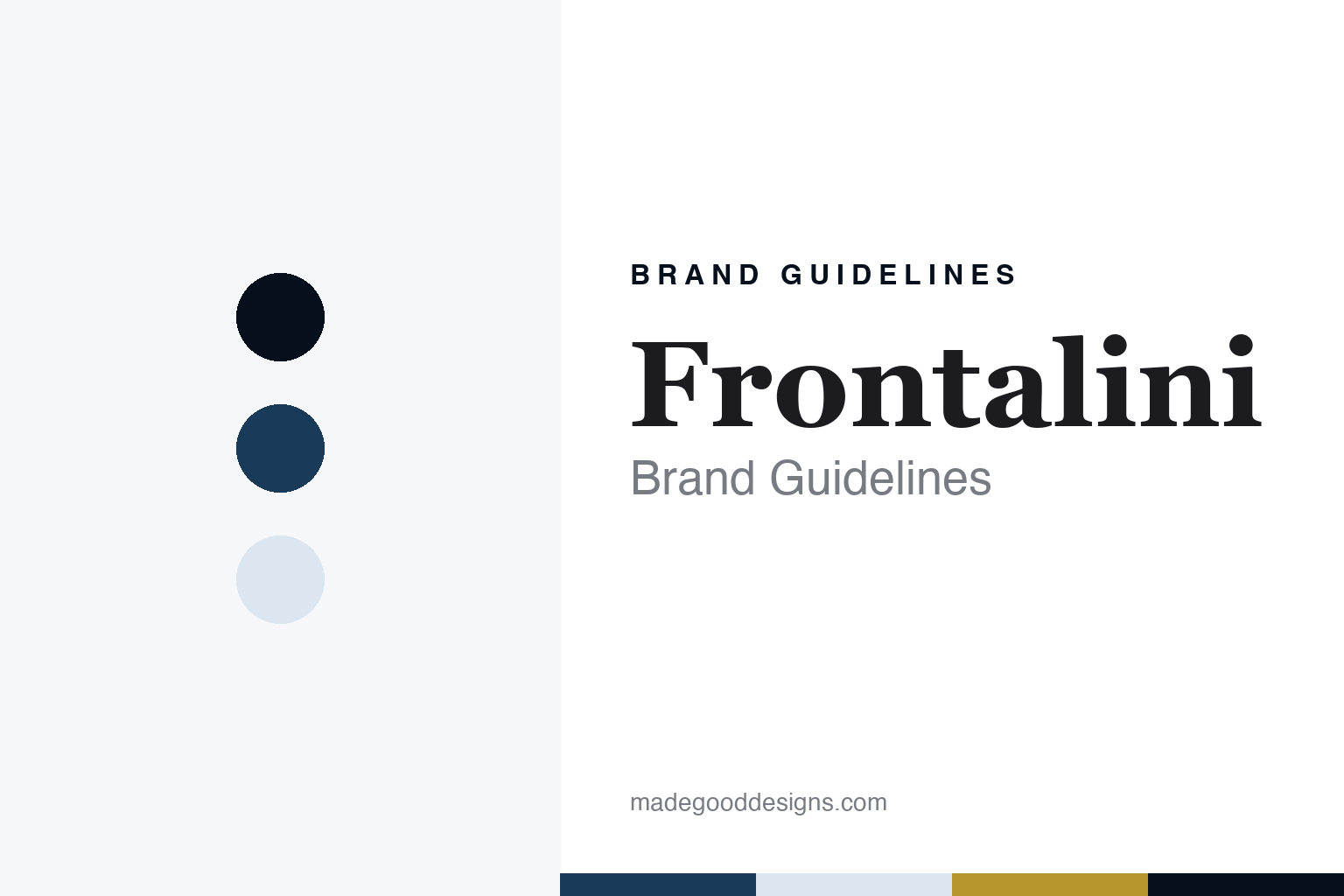
Two constants: a Frontalini Adriatic blue and brass palette and a Seaside serif register. Abstract homage — not a Frontalini product or mark; no instrument, logo or nameplate is reproduced.
A teacher who built organetti
Nazzareno Frontalini and his sons.
Frontalini came from Numana, a small coastal town in the province of Ancona, near Castelfidardo but not part of it. Its founder, Nazzareno Frontalini (1871–1944), was a music teacher and craftsman who, according to the brand’s current owner, built small diatonic accordions — organetti — for Paolo Soprani in the early twentieth century.
The start of his own firm is dated differently. A history on frontalini.com, written as a local memoir, says that in 1927 his sons Vincenzo and Alfredo and his son-in-law Pietro Massacesi persuaded him to set up on his own, in rented rooms on the ground floor of Numana’s town hall. Italian Wikipedia’s table of Italian accordion makers gives 1923. We give both.
The owner’s history names Alfredo Frontalini (1900–1967), who ran administration and sales, as the firm’s “real architect.” It says Frontalini had 25 employees in 1929, sold chromatic button accordions first in Belgium, the Netherlands and Scandinavia, and added the piano accordion in 1932.
The family was prominent locally. Italian Wikipedia’s history of the Ancona football club lists “the industrialist Frontalini” as its president in 1940–41, without a first name; we cannot say which member of the family that was.
Colour
Growth, war and Farfisa.
The firm grew fast, by its owner’s account. In 1935 it bought the buildings of the bankrupt Radicioni brothers, and the frontalini.com history claims that in that year it held “50 per cent of the English market” — a claim we have not been able to check. The same history gives about 300 staff in 1940 and 606 in 1955, with more than 20,000 instruments a year; the Maxim’s history gives different figures — 446 staff after the war and output rising from 600 to 1,800 accordions a month. We report both as the owner’s figures.
The war reached Numana. In 1944, the owner’s history says, German troops blew up the machinery; production restarted in 1945. In 1946 Frontalini was one of the founders of Farfisa, with Settimio Soprani and Scandalli, but left “a few months later,” according to Maxim’s; Italian Wikipedia also lists “N. Frontalini & F.” among Farfisa’s founders, citing Sandro Strologo’s 2009 history of the company.
Alfredo also built a stage act. His orchestrarmonica, an accordion orchestra, played at the Basilica of Maxentius in Rome in September 1947, then in Brussels, at the Palais des Beaux-Arts, and in Antwerp, Liège, Ghent and Switzerland; its conductors included Pippo Bazzizza and Gianfranco Rivoli. The firm later made a pianòla — the owner’s history claims prototypes from as early as 1926 — and church reed organs. Its end is also disputed: both Maxim’s sources say it went bankrupt in 1964, while Italian Wikipedia’s table gives 1968 to 1970. The two owner-written histories disagree on figures and dates, and both come from the brand’s present owner; we found no independent company records.
Typography
The keyboard district.
In the 1960s and 1970s the accordion towns of the Marche became a centre for electronic keyboards. Farfisa, formed in 1946 from three accordion firms, made its Compact organs from 1964; Elka was founded in 1965 by members of the Crucianelli accordion family, and Orla the same year by Nazzareno Orlandoni; Crumar followed around 1970–71. Several older accordion houses, such as Welson, also turned to organs.
Orla’s own history shows the link: it says it began in 1965 by making parts for accordions and reed organs, and moved into electronic organs after Alfio Monaci joined. The district’s products ranged from home organs and portable combo organs to string machines, synthesizers and, later, arranger keyboards.
Some of the district’s instruments reached a wide audience. Farfisa launched its FAST organs at the 1968 NAMM show in the United States, English Wikipedia records; Elka’s Synthex was used by Jean-Michel Jarre on Rendez-Vous, according to Sound On Sound; and Crumar’s DS-2 of 1978 was, English Wikipedia says, one of the earliest synthesizers with digitally controlled oscillators.
The boom did not last. The industrial district of Recanati, Osimo and Castelfidardo went into crisis at the end of the 1970s, Italian Wikipedia says, under Asian competition. Crumar stopped trading in 1986 or 1987, and Welson ceased activity in 1981, according to the guitar historian Jack Marchal. Some names survive as revived brands or distributors’ labels; and Ketron, founded in Ancona in 1981, says it still designs and makes electronic instruments there.
Frontalini was there at the start of that story — a founder of Farfisa in 1946 — and left before the electronics arrived.
Aa
A seaside serif — a coastal town’s accordion name, kept alive by a neighbour. (Specimen set in Fraunces, a serif STAND-IN; NOT the Frontalini logo.)
Frontalini
A coastal town’s accordion name, kept alive by a neighbour.
Today Frontalini is a brand of Maxim’s Group, a Castelfidardo accordion company formed, it says, “to take up and relaunch historic brands.” It registered the Settimio Soprani name in 2006 and acquired Sonola in 2008; then, it says, “in 2009 we completed the project of acquiring the brands … CRUCIANELLI and FRONTALINI.” It says it wanted Frontalini, “the historic brand of Numana,” for a schools market of smaller, cheaper accordions and for a line for Austria and the Tyrol. Its tagline is “Fisarmoniche Made in Italy”; it says it aims at “Made in Italy and Made in Marche” and claims five patents. Its full name is Maxim’s Group di Maximiliano Ciucciomei & C., and it is based on Via Cristoforo Colombo in Castelfidardo; frontalini.it does not resolve.
The modern range includes the Stradivari, the Numana IV — named after the firm’s home town — the Super Artist series in several versions, the Milano IV and the Savona IV, across piano, button, diatonic and converter models. There is no continuity of ownership with the firm that closed in the 1960s, and we say so plainly. The old frontalini.com site, marked “Powered by Maxims Group” and last updated in 2013, still describes a vintage “Frontalini remake” as coming soon.
For a design guide, Frontalini shows a place-name brand revived by a neighbour. Compare Sonola and Crucianelli, Maxim’s other historic names, and Farfisa, which it helped found. For this guide we use an Adriatic blue and a brass with a serif, an unofficial interpretation; no instrument or logo is reproduced.
Explore & save
Keep Frontalini’s identity on hand — save it to a board in the Made Good inspiration library.
Frontalini identity set
Pin the Frontalini Adriatic blue and brass palette and the Seaside serif register to your own board.