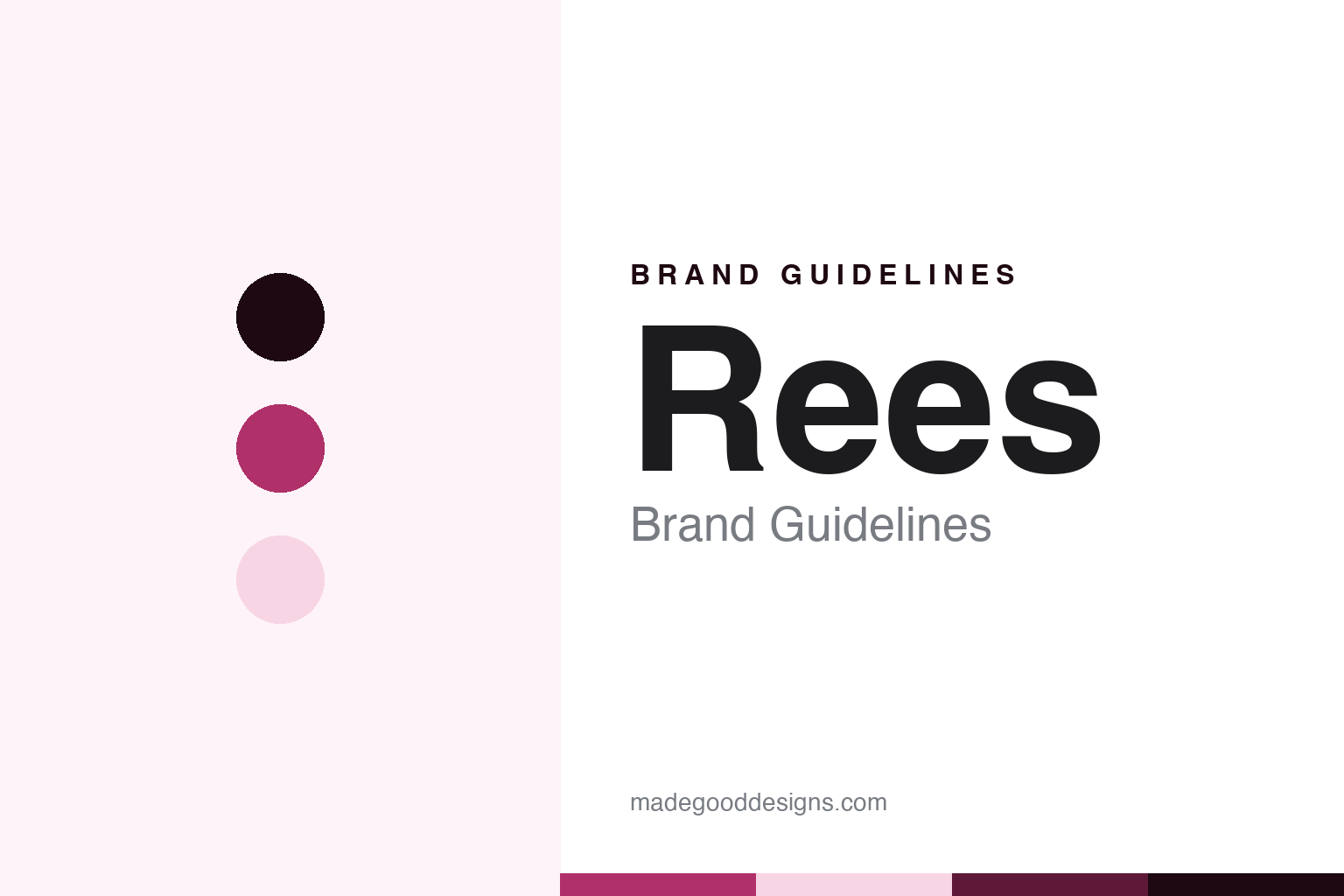
Rees Harps Brand Guidelines
The Harpsicle and the colourful harp.
Aa
Two constants: a Harpsicle magenta and pink palette and a Playful sans register. Abstract homage — not a Rees product or mark; no instrument, logo or nameplate is reproduced.
A science teacher’s harps
William Rees began selling harps in 1972.
Rees Harps began with a high-school science teacher. “Luthier William Rees began selling harps in 1972,” the company says, while he was teaching high-school science in California. In 1992 he and his wife, Pamela, formed “Wm. Rees Instruments, LLC (now Rees Harps Inc.),” and in 1996 their son Garen joined at fifteen, working on harp ornamentation — the decorative finishing of the instruments.
Then the business moved east. By 1999, the company says, the family had decided California was too expensive; they bought a 7,000-square-foot building in Rising Sun, Indiana, built in 1881, and “moved in June of 2000.” Rising Sun is a small town on the Ohio River, and the harps have been made there since. A nineteenth-century building in a river town is an apt home for a maker of a very old instrument.
The family is handing on the business. Rees’s story page says William and Pamela are retiring and that “Garen and Melissa, who already run the business on a day-to-day basis, will take the whole thing.” The page is undated, so we give no year for the handover.
Colour
The Harpsicle.
Rees’s best-known product came out of an experiment. The company says William had been working on dulcimers with asymmetrical soundboards, and that “By early 2003 he thought he had the design solidified” for a small lever harp. Then came the branding: “Pamela thought the harps should be colorful, to bring ‘fun’ to mind, and… one of the employees came up with ‘Harpsicle’ for the branding.”
The name was protected properly. The US Patent and Trademark Office record shows HARPSICLE as registration number 3,713,750, filed on 31 August 2007, registered on 24 November 2009 and renewed in December 2019, owned by Rees Harps, Inc. — “AKA THE HARPSICLE HARPS CO. OR WM. REES INSTRUMENTS” — of 222 Main Street, Rising Sun — the same town as the workshop. Its spin-offs, the Sharpsicle, Flatsicle and Fullsicle, carry only the ™ symbol, which signals a claim rather than a registration. The registration was not the family’s first try: according to Trademarkia, an earlier application for the name, filed in December 2004 by Wm. Rees Instruments, was abandoned in 2006.
The range has grown around the name: the 26-string Harpsicle, the Sharpsicle, Flatsicle, Fullsicle and SE Fullsicle, the 33-string Grand Harpsicle and the 34-string Brilliant! Harpsicle, alongside a Rees Concert Line of 27, 30, 34 and 36-string harps and double harps, with two rows of strings. Rees says its harps are “hand crafted in Rising Sun, Indiana, United States.”
Typography
An Irish emblem in candy colours.
Rees’s website calls its instruments “portable Irish lever harps made in the USA.” Lever harps like these are the descendants of the Irish harp, and that harp has its own legal life. Ireland’s government says it has “the distinction of being the only nation to have a musical instrument as a national emblem,” and Ireland’s patent office says the state harp is excluded “from registration or use as trade marks.” Guinness says it registered its own harp as a trademark in 1876, and that this is why the two face opposite ways. Guinness’s archive says the harp “has been synonymous with Guinness since 1862 when it was used as a symbol on the first bottle label,” and its Storehouse says it was trademarked in 1876, “the first year of trademark registration in the United Kingdom.” The Irish Times reported in 2013 that state archives show officials in the 1980s “feared Guinness could challenge” the state’s plans, and registered “a generic, nine-stringed harp facing in just one direction – left.”
The pedal harp is the other branch of the family. Sébastien Erard applied for an English patent, number 3332, in 1810, for a double-action mechanism with two forks per string worked by pedals; a Royal College of Music thesis by Fanny Guillaume-Castel says it “remains the standard pedal harp mechanism today.” Rees’s harps are lever harps, tuned string by string, and its Sharpsicle and Flatsicle names play on exactly that. Erard received the English patent in October 1810, sold the first double-action harps in late 1811 and, the thesis says, about a hundred in 1812, “the first complete year of sale.” His advertisement promised strings “producing three distinct tones instead of two.”
Timber law touches every maker. In 2017 the CITES convention brought the whole rosewood genus, Dalbergia, under its Appendix II controls; since 26 November 2019 it has exempted “finished musical instruments, finished musical instrument parts and finished musical instrument accessories,” though Brazilian rosewood stays in Appendix I. We found no source linking any maker in this round to those timbers. CITES defines a finished musical instrument as one “that is ready to play or needs only the installation of parts to make it playable,” and says the term “includes antique instruments.”
Aa
A playful sans — a harp named like an ice lolly. (Specimen set in Inter Tight, a sans STAND-IN; NOT the Rees logo.)
Rees
A harp named like an ice lolly.
Rees’s branding is the opposite of a concert maker’s. Where Lyon & Healy sells gilded columns, Rees sells colour: the Harpsicle name, borrowed from the ice lolly, and Pamela Rees’s idea that harps should be “colorful, to bring ‘fun’ to mind.” Its taglines — “Harps that let you…be yourself” and “Custom Concert Lever Harps” — speak to two audiences at once, and its blog is narrated by the company dog, under the title “Bark! Ellie Speaks.”
For a design guide, Rees shows how a name can create a category. “Harpsicle” turned a small lever harp into a product family, a trademark and a set of puns — Sharpsicle, Flatsicle, Fullsicle — that a buyer remembers. Compare Triplett, another American family lever-harp maker with a plainer voice.
Pamela Rees’s instinct — colour as a signal of fun — is the brand’s founding design decision. Its family story is part of the brand too: a science teacher’s side project, a son who started at fifteen, a move to a river town, and a new generation now running it day to day.
For this guide we use a magenta and a candy pink with a sans serif, an unofficial interpretation of the colourful-harp idea. No harp, colour finish or logo is reproduced.
Explore & save
Keep Rees Harps’s identity on hand — save it to a board in the Made Good inspiration library.
Rees identity set
Pin the Harpsicle magenta and pink palette and the Playful sans register to your own board.