Rodgers Instruments Brand Guidelines
American in name and series.
Aa
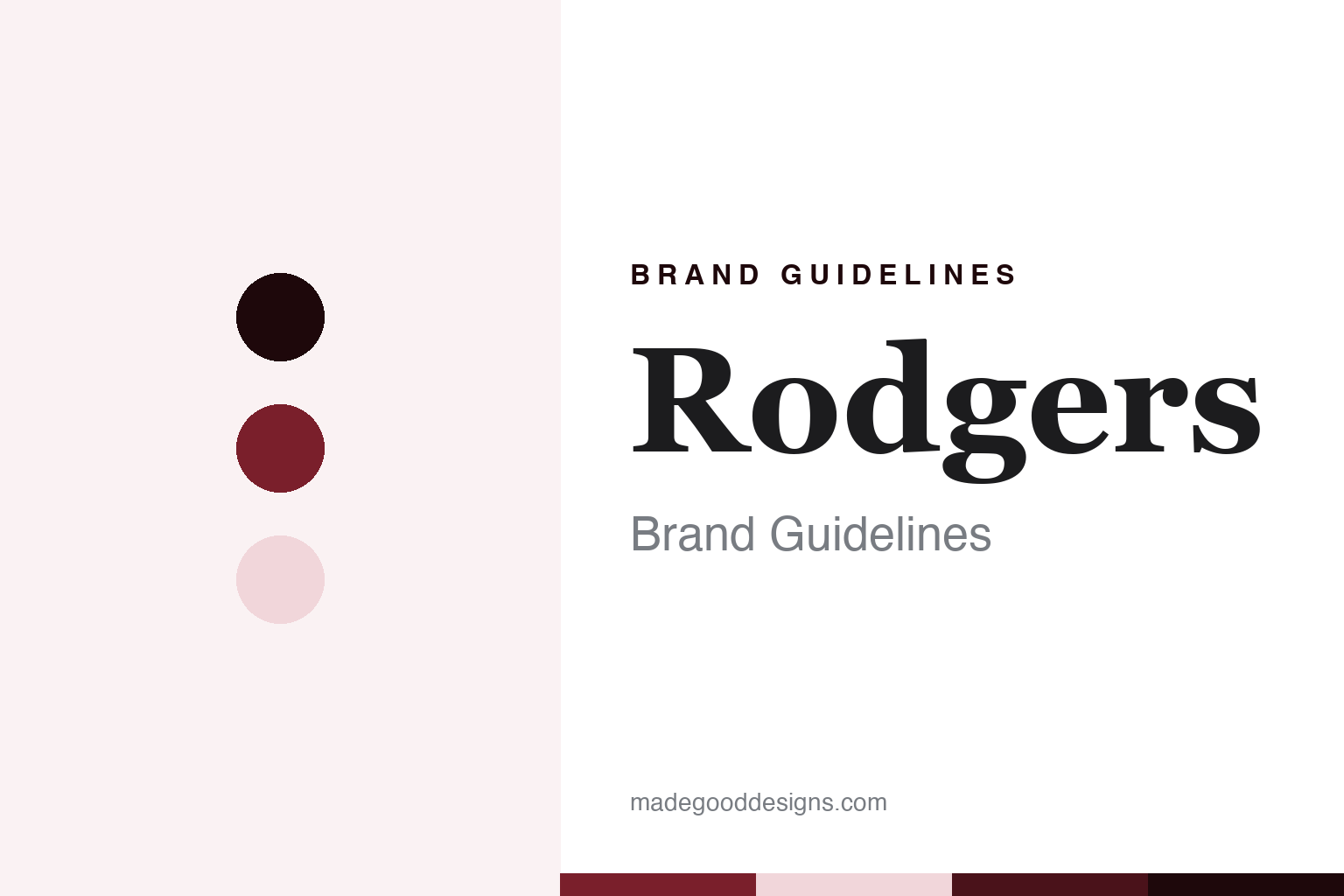
Two constants: a Rodgers red and rose palette and a Oregon serif register. Abstract homage — not a Rodgers product or mark; no instrument, logo or nameplate is reproduced.
Two engineers from Tektronix
Rodgers began in Oregon in 1958, beside a car dealership.
Rodgers Instruments builds digital and hybrid organs in Hillsboro, Oregon. It was founded by two engineers from the Oregon electronics firm Tektronix, Rodgers W. Jenkins and Fred Tinker, who began experimenting in 1955. The company was incorporated on 1 May 1958 in Beaverton, a suburb west of Portland, and its own history says it started with six employees “in a building shared with an automobile dealership.” It moved to nearby Hillsboro in 1960, and has stayed in that city through every change of owner since.
Rodgers lists a string of firsts, which we attribute to the company: the “world’s first all-transistor church organs” in 1958, single-contact diode keying in 1961, the first use of microprocessors in church organs in 1980, and of MIDI — the standard that lets electronic instruments exchange performance data — in 1987. The brand name itself is a first name, not a surname: the company is called after Rodgers Jenkins.
Its best-known early instrument was a showpiece, and a sign of how quickly a small Oregon firm reached the biggest stages. In 1974 Rodgers installed a five-manual organ at Carnegie Hall in New York, described on Wikipedia as the world’s first five-manual electronic organ — a claim we attribute rather than repeat as fact. Carnegie Hall came sixteen years after the company began beside a car showroom.
Colour
CBS, Roland, and a Dutch family.
In September 1977, according to Wikipedia, Rodgers became part of CBS Musical Instruments, alongside Steinway, Fender and Rhodes, until 1985. On 1 May 1988 the Japanese company Roland became its parent. And on 4 January 2016 Roland agreed to sell it to the van de Weerd family of the Netherlands, owners of Johannus, with effect from 15 January 2016.
Rodgers is now part of the Global Organ Group, a Dutch-led family of organ brands headquartered at Johannus in Ede, alongside Johannus and the British builders Makin (founded 1970) and Copeman Hart (founded 1960, part of the group since 2011). Rodgers published its own explainer, “What is the Global Organ Group,” in May 2023. The family behind it has run Johannus since Gert van de Weerd bought it in 1987; his sons Marco and René took over in 2009. The 2016 date matters: some accounts place the sale later, but Rodgers’s own timeline gives January 2016, after twenty-seven years of Roland ownership.
After the sale Rodgers moved within Hillsboro — in 2016 to NE Jacobson Road, and in 2021 to a larger building on NE Croeni Avenue. It describes its instruments as American, and says so plainly on its homepage: its homepage says “Rodgers doesn’t just build the finest quality American digital and hybrid organs…” and one of its ranges is called The American Series. Where each component is made we did not establish, and an uncited line on Wikipedia about consoles from the Netherlands we leave out. What can be said is that the company is headquartered, and was founded, in Oregon, and has been Dutch-owned since 2016.
Typography
From transistors to samples.
Rodgers began in the transistor era. Laurens Hammond had been granted US patent 1,956,350 for an “Electrical musical instrument” in April 1934, and the Smithsonian holds his Model A, serial number 1, made in Chicago that year. Rodgers’s first instruments, a quarter of a century later, were all-transistor, it says. The digital era followed: in 1970 the engineer Ralph Deutsch, who had filed in August 1967, was granted US patent 3,515,792 for a “Digital organ,” assigned to North American Rockwell, and the Smithsonian describes a 1971 Allen organ as “one of the first to use digital sampling,” adding that in 1971 it was “one of only two consumer products in the world to utilize digital technology.”
Rodgers’s ranges today — Infinity, Imagine, Inspire and The American Series — are digital and hybrid; in the organ trade, hybrid usually means an instrument that combines digital voices with real pipes. That puts Rodgers on both sides of a long divide.
The pipe side has its own recognition. In December 2017 UNESCO added “Organ craftsmanship and music” in Germany to its Representative List of the Intangible Cultural Heritage of Humanity; Germany’s nomination counted “Ca. 50,000 organs” in constant use there and roughly 3,500 full-time professional organists. A few weeks earlier the EU removed pipe organs from its hazardous-substances directive, saying that “Pipes in organs are built using a specific type of lead-based alloy, for which no alternative has been found so far,” and that “Most pipe organs are kept in the same place for centuries and their turnover rate is negligible.” A hybrid organ, in other words, physically joins a long-lived craft object to a fast-changing electronic one.
Aa
An Oregon serif — a founder’s first name on a console. (Specimen set in Fraunces, a serif STAND-IN; NOT the Rodgers logo.)
Rodgers
American in name and series.
Rodgers’s web title calls its range “American Series Digital Organs for Home & Church,” and the word American does a great deal of work in the brand. For a Dutch-owned company, it is the asset worth keeping: an Oregon address, an Oregon history and an American series name.
For a design guide, Rodgers is a case study in how a brand keeps its nationality through foreign ownership. Its owners have been American, Japanese and Dutch in turn; its founder’s first name and its Oregon address have stayed on the door. The name is a quiet piece of history in itself: a first name rather than a surname, chosen in 1958 and kept through three owners. Its range names — Infinity, Imagine, Inspire — share an initial and an aspiration; The American Series sits beside them, a name that states a nationality rather than a hope. Compare Johannus, now its sister company in the same group, and Allen, which has stayed in Pennsylvania under the same family’s management. Johannus sells the sound of pipes from a neoclassical building in Ede; Rodgers sells it under an American name from Oregon. Same owners, two quite different national stories, told side by side.
For this guide we use a deep red and a pale rose with a serif — a nod to church furnishings rather than to electronics — an unofficial interpretation. No organ, console or logo is reproduced.
Explore & save
Keep Rodgers Instruments’s identity on hand — save it to a board in the Made Good inspiration library.
Rodgers identity set
Pin the Rodgers red and rose palette and the Oregon serif register to your own board.