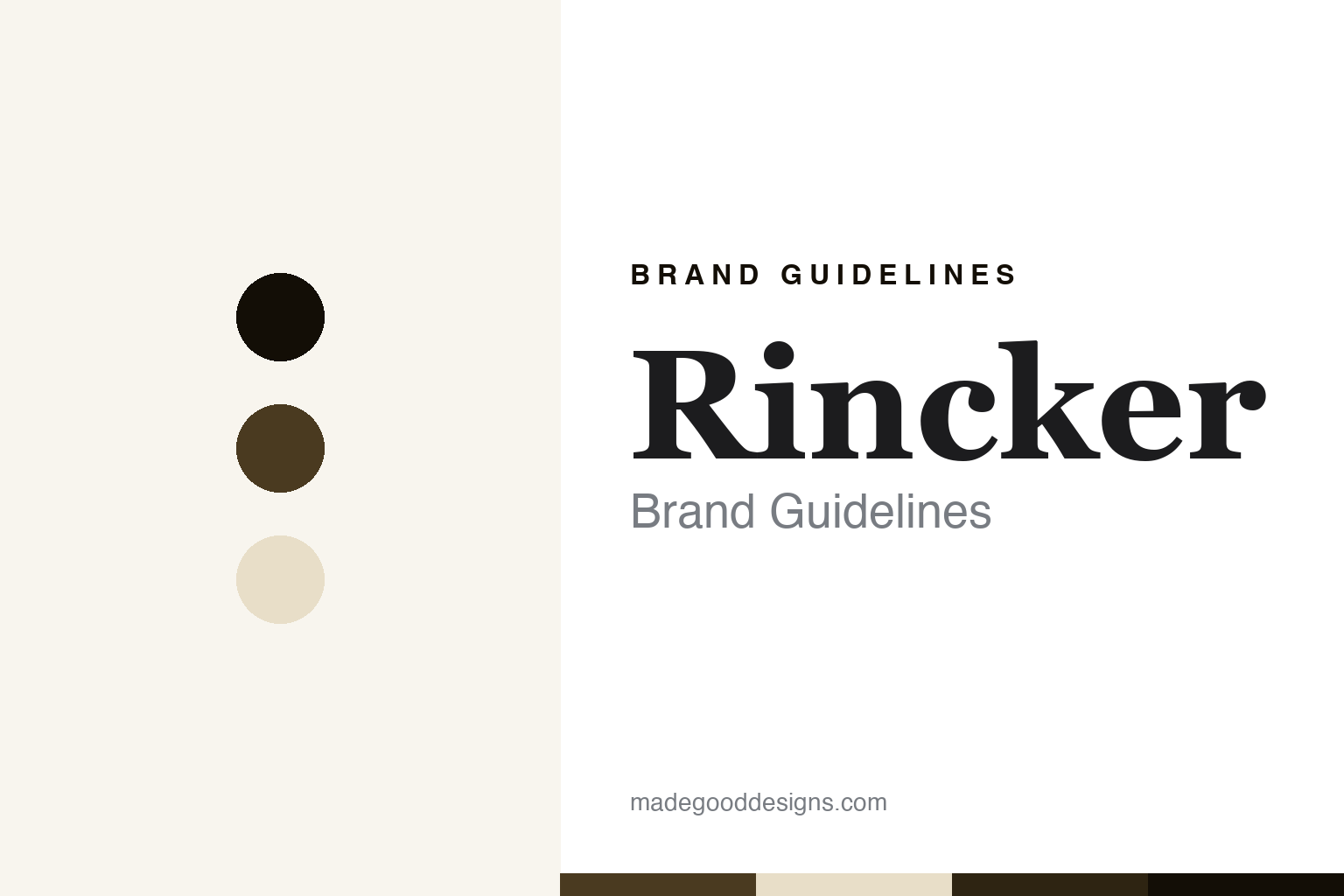
Rincker Brand Guidelines
A Hessian bell foundry since at least 1590.
Aa
Two constants: a Rincker bronze and loam palette and a Hessian serif register. Abstract homage — not a Rincker product or mark; no instrument, logo or nameplate is reproduced.
A Hessian bell foundry since at least 1590
Fourteen generations, by the family’s own count.
Rincker is a family bell foundry in Sinn, a small town in Hesse in central Germany. It traces its bell-founding a long way back: its website says the family have been bell founders “since at least 1590,” and points to an earlier bell of 1576 attributed to a “Rickern.” A regional business association profile says “Master Hans Rincker officially established the business in 1590.” We say Rincker traces its founding to at least 1590.
The generations are counted differently in different places. The company speaks of the knowledge of bell profiles — the “Glockenrippe” — being handed down through “mindestens 14 Generationen”, at least fourteen generations; the business profile calls the current managers the thirteenth. We say the family is in its thirteenth or fourteenth generation, by its own count.
The foundry has been in Sinn since 1817, the company says. Today it is run by two brothers, between them covering the craft and the business: Hanns Martin Rincker, a master bell founder, and Fritz Georg Rincker, a business graduate; the site says they took over after their father, Hans Gerd, died in 1990, and that Christian Rincker qualified as a metal and bell founder in 2015.
Colour
Loam moulds and a twenty-thousandth bell.
The legal company is Rincker Glocken- und Kunstgießerei GmbH & Co. KG, registered at the Wetzlar court, at Wetzlarer Straße 13 in Sinn; its registered purpose is “Glockengießerei sowie Metall und Kunstgießerei” — bell founding and metal and art casting. The business profile says the bells are cast in Sinn by the traditional method of loam moulds shaped by templates.
Its record is broad. The foundry says it cast bells for Berlin’s Kaiser Wilhelm Memorial Church in 1960 — the new church built beside the war-damaged tower — and for Hamburg’s St Michael’s Church, and that it cast its 20,000th bell in 2013, for Lampertheim. It has delivered bells to China, holds more than 3,500 maintenance contracts — about half its revenue, the profile says — and owns a Hamburg tower-clock firm, W. Iversen, Dimier & Cie., founded in 1819.
Regional tourism and press describe it as the “oldest bell foundry in Europe still in family ownership” and “one of only four bell foundries in Germany.” Those are their descriptions; we did not verify either ranking.
Typography
Bell cemeteries and cathedral bells.
Bells have also been treated as raw metal in wartime. A 1947 photograph in Germany’s federal archives shows the “Glockenfriedhof” — bell cemetery — in Hamburg’s free port, captioned: “Diese Glocken wurden von den Nazis während des II. Weltkrieges beschlagnahmt um sie einzuschmelzen” — these bells were confiscated by the Nazis during the Second World War to be melted down. German sources estimate that about 45,000 bells were destroyed in Germany and some 35,000 more from occupied territories; the figures vary, so we attribute them. The same German sources say some 65,000 bells were melted down in the First World War, and that after 1945 more than 13,000 surviving bells were identified and returned from Hamburg.
Notre-Dame de Paris shows what a bell’s life can involve. Eight new bells were installed in its north belfry in 2013, beside the great bourdon Emmanuel, dated 1686, and a new bourdon, Marie. After the fire of April 2019, the public body rebuilding the cathedral says, the bells “ont subi la chaleur de l’incendie” — were exposed to its heat — and had to be checked; they were taken down in July 2023, cleaned and, in two cases, restored by heat treatment in Austria, and on 12 September 2024 “les huit cloches ont fait leur retour dans la cathédrale.” The cathedral also gained new bells for its reopening: the Paris diocese says that in October 2024 two new bells, Chiara and Carlo, were cast at the Cornille-Havard foundry, joining a bell given by the Paris 2024 organisers; they first rang at Mass on 8 December 2024. Its great bourdons returned to full swinging peal only from 17 July 2025.
Bell metal is a bronze of roughly four parts copper to one of tin — “approximately 78% copper and 22% tin,” according to the Guild of Carillonneurs in North America. Tin is the costly part: the US Geological Survey says the average New York price of refined tin rose 13 per cent in 2025, to 1,600 cents a pound.
Bells are recognised as culture too. In 2014 UNESCO selected Belgium’s programme for “Safeguarding the carillon culture” for its Register of Good Safeguarding Practices, and in 2022 it inscribed manual bell ringing in Spain — extended to Italy in 2024 — on its Representative List, calling it “a form of communication that is tied to the classification, acoustics and shapes of bells, bell towers and belfries.”
Bells reach people in smaller forms too. The American Guild of English Handbell Ringers, which does business as Handbell Musicians of America, describes itself as “a non-profit organization established in 1954” to “promote the art of English Handbell Ringing”; its national mission today is “Advancing the musical art of handbell and handchime ringing.” Rincker’s work is tower bells, but the same alloy and the same tuning craft run through both trades.
Aa
A Hessian serif — a family name over a loam mould. (Specimen set in Fraunces, a serif STAND-IN; NOT the Rincker logo.)
Rincker
A family name over a loam mould.
Rincker’s brand is its surname and its dates: at least 1590 for the craft, 1817 for Sinn. Like Austria’s Grassmayr, which dates itself to 1599 and is also run by its fourteenth generation, it rests on a family secret — the bell profile passed down the generations — and on a long list of churches that carry its bells.
For a design guide, Rincker shows a heritage foundry that has diversified without diluting the name. Its maintenance work, about half its revenue by the profile’s account, keeps it in touch with thousands of towers between commissions: maintenance contracts, art casting and a tower-clock subsidiary sit beside the bells. Compare Cornille-Havard in Normandy, which turned its foundry into a visitor attraction, and Petit & Fritsen, a family foundry that ended for want of an heir.
For this guide we use a bronze and a loam brown with a serif, an unofficial interpretation. No bell, mould or mark is reproduced.
Explore & save
Keep Rincker’s identity on hand — save it to a board in the Made Good inspiration library.
Rincker identity set
Pin the Rincker bronze and loam palette and the Hessian serif register to your own board.