Rieger Orgelbau Brand Guidelines
A Silesian name rebuilt in the Alps.
Aa
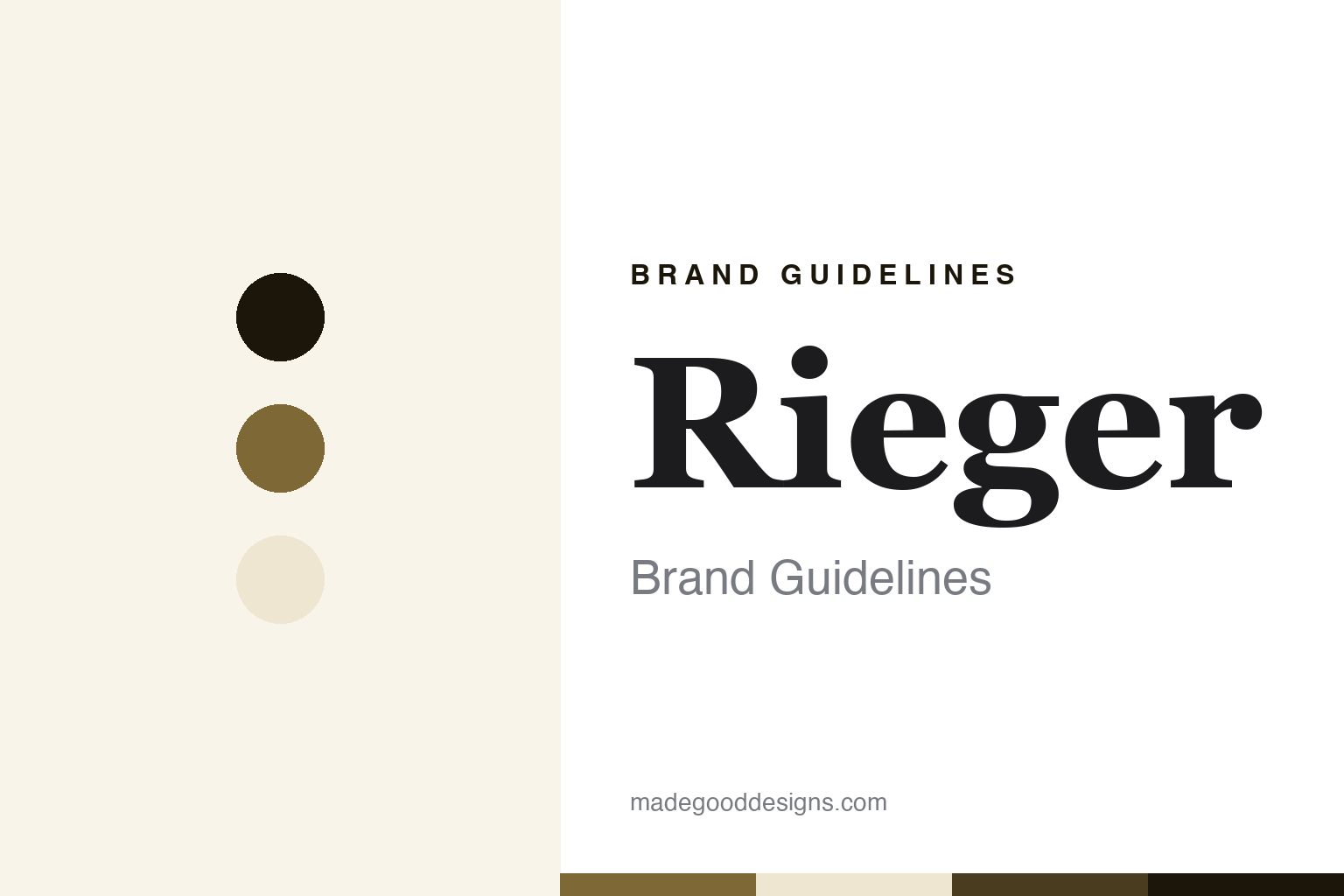
Two constants: a Rieger gold and cream palette and a Alpine serif register. Abstract homage — not a Rieger product or mark; no instrument, logo or nameplate is reproduced.
A Silesian name rebuilt in the Alps
Rieger dates itself to 1843 — and changed country in 1946.
Rieger Orgelbau builds pipe organs in Schwarzach, a village in Vorarlberg in western Austria. It was not founded there. Its story begins with Franz Rieger (1812–1885) in Jägerndorf, in what was then Austrian Silesia and is now Krnov in the Czech Republic. The firm dates itself to 1843 — “Unser Name steht seit 1843 für höchste Qualität,” its website says — while other sources, including the German-language Wikipedia, give 1845 for its first organ. Rieger says its archive holds files from Opus 1 of 1844, so the firm’s own records begin within a year of the date it claims.
Franz’s sons Otto and Gustav took over in 1873, and the firm traded as Gebrüder Rieger — Rieger Brothers — from 1879, winning medals at the Vienna exhibition of 1873 and in Paris in 1878. In 1924 the business passed to Josef von Glatter-Götz, and the Glatter-Götz family ran it for most of the twentieth century. Rieger itself counts “sieben Generationen” — seven generations — of leadership: Franz; Otto and Gustav; the younger Otto (1880–1920); Josef von Glatter-Götz; his sons Egon and Josef; Caspar, Raimund and Christoph Glatter-Götz; and today’s head, Wendelin Eberle. They are generations of a workshop, not of one family.
After the Second World War the German-speaking owners were expelled from Czechoslovakia. According to the German-language Wikipedia and Austria-Forum, Josef Glatter-Götz leased workshops in Schwarzach and re-established the firm there in 1946. The original works in Krnov did not simply disappear: nationalised, it carried on after the war as Rieger-Kloss, continuing the old opus numbers, was privatised in 1994 and later failed (Wikipedia gives an end date of 2015 and an insolvency filing in 2018), having built more than 600 organs under its own name. For decades, two organ builders in two countries drew on the same name.
Colour
One workshop, around sixty people, its own pipes.
Today’s company is Rieger Orgelbau GmbH, at Hofsteigstraße 120 in Schwarzach. Its website names Wendelin Eberle (born 1963) as head of the business and of design, with Georg Pfeifer as deputy. We could not retrieve the Austrian company register, so we describe Eberle as leading the firm rather than owning it.
Its statement of where the work happens is direct: “In unserer Werkstatt in Schwarzach, in Vorarlberg, bauen wir neue Orgeln für Kirchen, Kathedralen, Konzertsäle oder Hochschulen, sowie Kleinorgeln” — in its Schwarzach workshop it builds new organs for churches, cathedrals, concert halls and colleges, and small organs too. The staff is modest, given as “knapp 70 Personen … aus 14 Nationen” — just under 70 people from 14 countries — on one page and “over 60” with 14 apprentices on another. It has its own pipe-making department, and says it has completed 1,890 instruments around the world.
Its electronics are home-made too: an in-house control system, the Rieger Electronic Assistant, handles the memory for stop combinations on its consoles. Its paper archive goes back to Opus 1, and Rieger offers historical look-ups from it for a fee — a small service that shows how seriously the firm treats its own lineage, even though most of those papers had to travel from Krnov to reach Schwarzach.
Typography
Three halls, a cathedral and a heritage listing.
Rieger’s best-known recent instruments are in concert halls. In Vienna’s Musikverein, the Golden Hall received an 86-stop Rieger organ, inaugurated on 26 March 2011. At the Philharmonie de Paris a 91-stop Rieger with about 6,055 pipes was first heard, only partly voiced, at a concert on 28 October 2015, and finished over the following year. And in St Stephen’s Cathedral in Vienna, a new Rieger “Riesenorgel” — giant organ — was blessed by Cardinal Christoph Schönborn on 4 October 2020, with the Austrian president present. It is reported as Austria’s largest organ and the largest Rieger has built; Rieger’s homepage gives it 134 stops, while other reports give 130.
The craft behind them has an unusual kind of protection. In December 2017 UNESCO added “Organ craftsmanship and music” in Germany to its Representative List of the Intangible Cultural Heritage of Humanity, noting that each instrument “is created specifically for the architectural space in which it will be played.” The listing is German, not Austrian, but it describes the trade Rieger works in: Germany’s nomination counted around 2,800 organ builders in 400 workshops, most employing between six and eighteen people, and put the trade’s annual turnover in Germany at about 120 million euros. It also counted roughly 3,500 full-time professional organists to play what the workshops build.
A few weeks earlier, on 15 November 2017, the European Union took “pipe organs” out of the scope of its directive restricting hazardous substances in electrical equipment, explaining that “Pipes in organs are built using a specific type of lead-based alloy, for which no alternative has been found so far.” It added: “Most pipe organs are kept in the same place for centuries and their turnover rate is negligible.” For a workshop that makes its own pipes, that sentence is the difference between carrying on and reinventing the instrument.
Aa
An Alpine serif — a gold name on a cream page. (Specimen set in Fraunces, a serif STAND-IN; NOT the Rieger logo.)
Rieger
A gold name on a cream page.
Rieger’s logo is its name in a single muted gold, on a cream-and-white website whose headline is “Faszination Orgelbau” — the fascination of organ building. It is a restrained identity for a firm that makes some of the largest instruments in Europe: there is no slogan to speak of, and the photographs of organs carry the page. Among gilded cases and polished pipes, a gold wordmark simply joins in, and the homepage currently leads with the organ of St Mary’s Basilica in Kraków.
For a design guide, Rieger shows how a heritage name can survive a change of country, owner and political system. The name that began in Jägerndorf, in a town that is now Czech, now sits on organs in Paris and Vienna; the gold and the 1843 date do the work of continuity that the workshop’s address cannot. Compare Klais, which has never left its Bonn street, and Casavant, which has stayed on its Québec one since 1879.
For this guide we use a muted gold and a dark brown with a serif, an unofficial interpretation of the website’s tones. No organ, case design or logo is reproduced.
Explore & save
Keep Rieger Orgelbau’s identity on hand — save it to a board in the Made Good inspiration library.
Rieger identity set
Pin the Rieger gold and cream palette and the Alpine serif register to your own board.