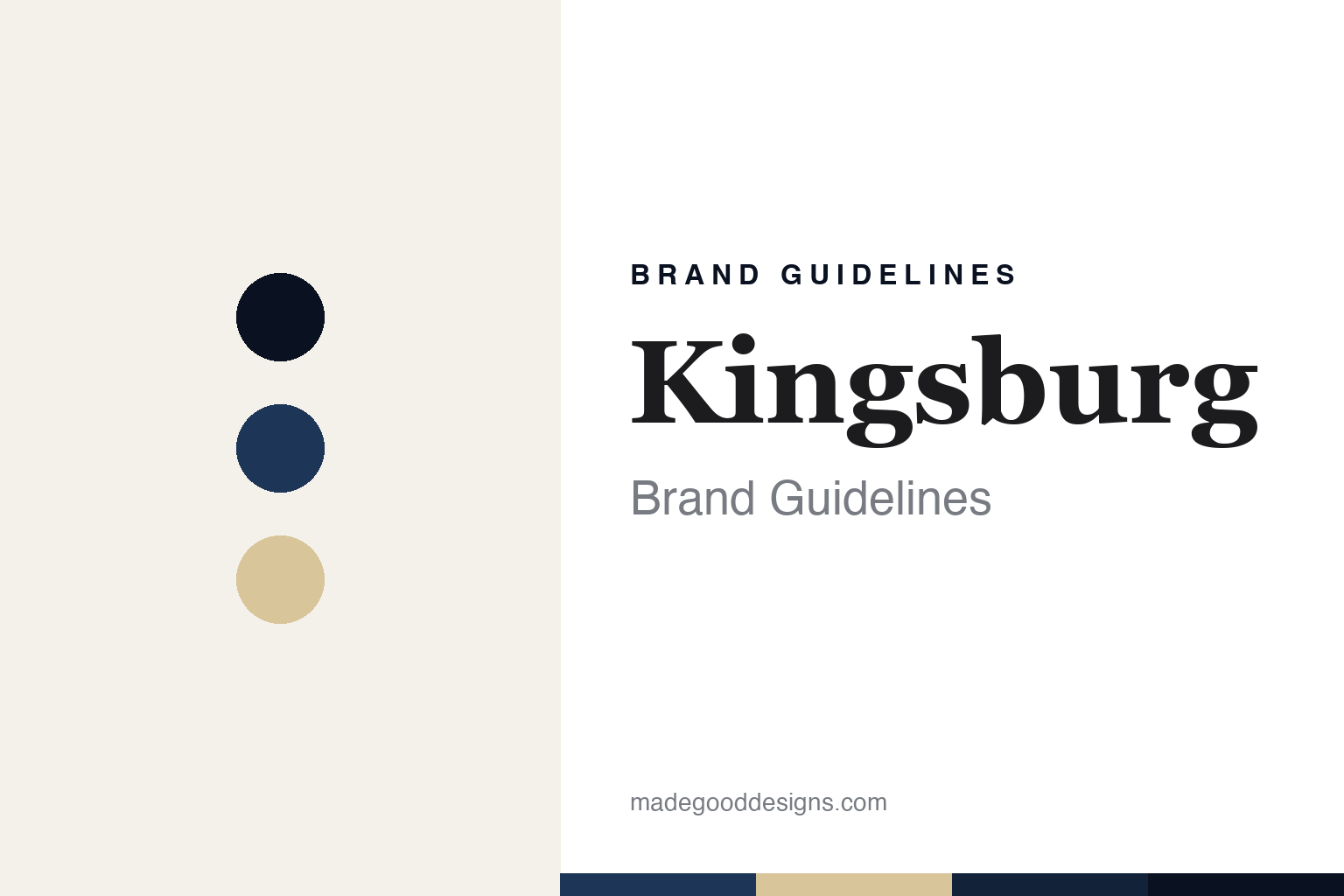
Kingsburg Brand Guidelines
A Yantai factory that made others’ pianos.
Aa
Two constants: a Yellow-Sea-blue palette and a crowned-serif register. Abstract homage — not a Kingsburg product or mark; no piano or logo is reproduced.
From Longfeng to Kingsburg
A factory that made pianos for the West, then made a name.
Piano Buyer introduces the company in two sentences: “Yantai Kingsburg Piano Co., Ltd., formerly known as Yantai Longfeng, was established in 1988,” and “The same factory, under previous ownership, made pianos for the West under various brand names for many years.” Yantai is a port city in Shandong province, in what Piano Buyer calls a “temperate area of northern China that is said to be ideal for piano making because of its moderate humidity level.”
The company described its own change in a 2009 post on a piano forum: “the former Yantai Longfeng Piano Company (China) has changed into Yantai Kingsburg piano Co.,Ltd after its reform.” Its supplier profile says the company came from a merger of the Yantai Huaxin Group and the former Longfeng factory, with a capacity of over 10,000 pianos a year and 400 employees, registered capital of 20 million yuan and total investment of 80 million, on 32,000 square metres of land — its figures. It sells under the Kingsburg, Steigerman and Melody names.
Yantai has a place elsewhere in this series. The same 2009 company post said that a manager “left Longfeng Piano and established the Gebr. Perzina with the investment from Germany” — the company’s account of how Perzina’s Yantai joint venture began. Two European-named piano brands, in other words, trace their Chinese roots to one Yantai factory, by Kingsburg’s telling. Piano Buyer’s account of Perzina is consistent with a Yantai connection: it says Perzina pianos were first made in Yantai under licence by another company, before Perzina’s Dutch owners established their own joint-venture factory there in 2003.
Colour
Klaus Fenner, and parts from three countries.
Kingsburg’s strongest claim is about design. Piano Buyer says: “All Kingsburg pianos have been designed by well-known piano-design master Klaus Fenner, and scales have been further developed by a piano-design expert from a highly regarded overseas piano manufacturer.” Fenner is a German piano-scale designer; the company says he designed its KF, KG and KU series, and a further model in February 2003. Kingsburg’s own site goes further, claiming that “About 30% pianos in the world are designed by Mr. Klaus Fenner” — its claim, which we cannot test — and its dates for his first design for the company are inconsistent, giving both 1991 and 1995. We give neither as fact.
Its parts list is international, and it is the clearest and most checkable answer the brand gives to the question of quality. Piano Buyer names Röslau wire, Abel hammers and Dehonit pinblocks from Germany, Detoa actions from the Czech Republic, and tuning pins and mineral keytops from Japan. The pianos carry a 12-year warranty for the original purchaser, and they are distributed in the United States by Piano Empire, of Orange, California. A long warranty is the natural promise of a maker selling a young name: it substitutes a guarantee for a history.
The company’s website also lists the visitors it has received and the events it has held: a concert themed on Lang Lang in 2011, a visit from the Italian maker Luigi Borgato in 2012, two visits from the president of Steinway China in 2013 “for cooperation,” and a Richard Clayderman event in 2014. No cooperation agreement with Steinway is documented, and we suggest none.
Typography
The tariff line.
Kingsburg is a Chinese-made brand, and that fixes its place in the US tariff schedule. Upright and grand pianos carry a general duty of 4.7 per cent (headings 9201.10 and 9201.20). When the US Trade Representative published “List 4A” of Chinese goods on 20 August 2019, all three piano subheadings were on it — a list reserved for products where China supplied less than 75 per cent of American imports; the extra duty went from 10 to 15 per cent that autumn and was cut to 7.5 per cent from 14 February 2020, and the 2026 schedule still carries it. Guitars, by contrast, went on a later list for products where China dominated American imports. Further duties imposed on Chinese goods in 2025 under emergency powers were ended by executive order in February 2026, and a separate 2026 trade action covering sixty economies, China among them, is in force; we do not attempt a combined rate for a Kingsburg piano.
China is a smaller supplier to America than its scale suggests. UN Comtrade data show that in 2023 China supplied 5.9 per cent of the value of upright pianos imported into the United States, down from 12.1 per cent in 2018, while Japan supplied 58.4 per cent and Indonesia 25.7 per cent. For grand pianos, China’s share fell from 12.5 per cent in 2018 to 4.2 per cent in 2023. We draw no causal line from the tariff to the fall. A 1999 US International Trade Commission study found that pianos from Japan, Korea, China and Indonesia already made up 93 per cent of American piano imports by quantity, and that “U.S. producers are major importers, buying foreign-produced pianos to complement their product lines.”
Kingsburg sits on the other side of that sentence: a factory that once made pianos for those importers’ names and now sells its own, through its own American distributor.
Aa
A crowned serif — a European-sounding name for a Chinese factory. (Specimen set in Cormorant Garamond, a serif STAND-IN; NOT the Kingsburg logo.)
Kingsburg
A European-sounding name, chosen by a Chinese factory.
Kingsburg is a European-sounding name for a Chinese factory — a choice it shares with many brands in this series, from Pearl River’s Kayserburg to the Yantai-built Perzina. Its site also tells a story that the brand “originated from the early stage of World War 2 in Germany,” which we found no evidence for and do not repeat as history.
For a design guide, Kingsburg is the factory’s side of the stencil story. For years, by Piano Buyer’s account, it made pianos for Western brands; then it put its own name on them, a European-sounding one, and credited a German designer. The documented assets are the factory, the parts list and the warranty; the founding myths are marketing, and are best treated as such.
For this guide we use a deep blue and a crown gold with a high-contrast serif. These are an unofficial interpretation, not Kingsburg’s colour values, and nothing of its logo is reproduced.
Explore & save
Keep Kingsburg’s identity on hand — save it to a board in the Made Good inspiration library.
Kingsburg identity set
Pin the Yellow-Sea-blue palette and the crowned-serif register to your own board.