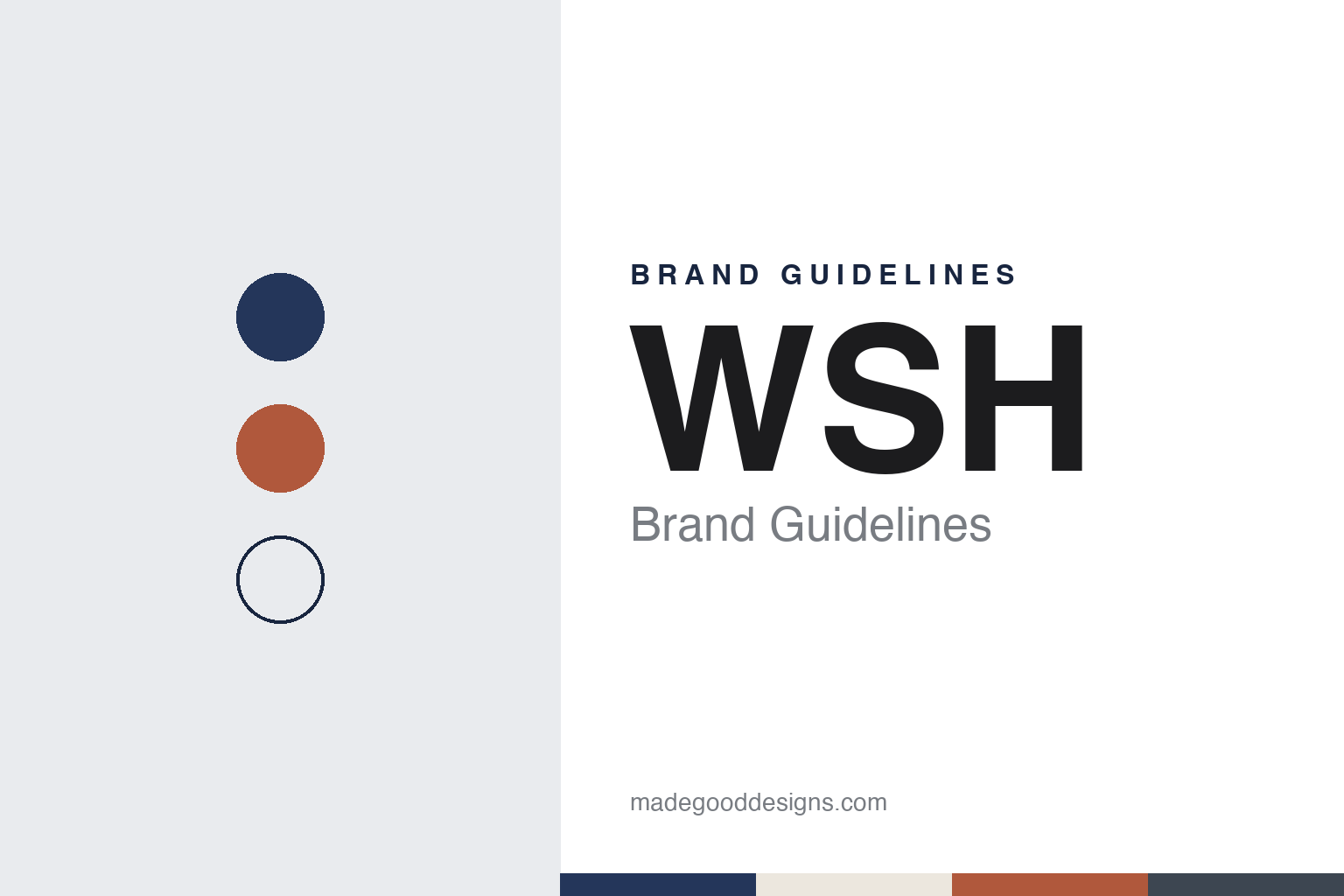
WSH Brand Guidelines
A catering group that lets each of its brands keep its own name and face.
Aa
Two constants: an ink blue, linen and terracotta palette and a quiet serif register. Abstract homage — not a WSH asset; no logo or brand mark of the group or its businesses is reproduced.
Wilson Storey Halliday
Two names behind three letters.
WSH is a British group of catering and hospitality businesses, and its three letters have stood for two names. Its parent company is WSH International Investments. In 2004 the business was Wilson Storey Halliday, Caterer & Hotelkeeper reported; by 2012 The Caterer was calling it Westbury Street Holdings, the name it still used in 2024. The Caterer reported in 2018 that Alastair Storey founded WSH in 2000 with the aim of creating a new catering offer built on fresh, seasonal food, service and training. The group’s own statement for the 2025 financial year says it was founded more than 25 years ago.
Growth was quick. In March 2004 WSH bought Cater Link, a fast-growing Kent-based caterer, according to Caterer & Hotelkeeper, which put WSH’s staff at that time at 1,600 across the UK and Ireland. Storey, then its managing director, said Cater Link’s presence in the education sector would complement WSH’s business-and-industry contracts. The same year, The Caterer reported in 2023, Wilson Storey Halliday merged with BaxterSmith to create BaxterStorey, which became the group’s main workplace caterer.
Then came brands beyond the staff restaurant. English Wikipedia says WSH bought an interest in Benugo, the café business founded in Clerkenwell in 1998 by the brothers Ben and Hugo Warner, in 2008; The Caterer called the move a game-changer for the business-and-industry sector. Ownership of Searcys, the restaurant, bar and events company, passed to WSH on 1 August 2014, The Caterer reported in 2015, when Searcys venues included Blenheim Palace, the Gherkin and St Pancras Grand. In 2017 The Caterer described WSH International Investments as the parent of a newly reorganised group.
Colour
A family of brands.
WSH says it works “through a family of independently run, entrepreneurial brands.” Its statement for the 2025 financial year sorts them into four groups. Business-and-industry catering has five brands, among them BaxterStorey, Genuine Dining Company, MRS in France and Meyers in Denmark. Education has two: Holroyd Howe, for independent schools, and Caterlink, for state schools and local authorities. Leisure and consumer covers Searcys, Benugo, Notes Coffee and Musiam in France. Hospitality and facilities covers South West Larder, Portico, a front-of-house and concierge service, and Amplify Guest Services.
Much of the recent growth abroad has come by acquisition. In October 2022 The Caterer reported that WSH France had acquired Musiam Paris, an event caterer founded in 2017 within Ducasse Culture that serves visitors at the Louvre, the Musée d’Orsay and the Château de Versailles; WSH said then that it had operated in France for twelve years. In March 2023 it acquired Meyers, the Copenhagen lunch, canteen and bakery business founded by the chef Claus Meyer, who joined WSH Denmark as a significant shareholder, The Caterer reported. In September 2024 WSH acquired the workplace caterer Genuine Dining; the deal was signed on 20 September, The Caterer reported, with the business keeping its own structure and its chief executive. The magazine said Genuine Dining had grown to more than 45 sites in sectors such as law, consulting and media.
WSH has also worked with chefs on restaurants of their own. In 2018 The Caterer listed joint ventures with John Campbell at the Woodspeen restaurant and cookery school in Berkshire, with Mark Hix through Restaurants Etc and with Monica and David Galetti at Mere in London.
Size figures come from WSH itself. Its 2025 statement gives about 30,000 people and around 4,000 locations across seven countries: the UK, Ireland, France, Belgium, the Netherlands, Denmark and Norway, with the UK and Ireland making up most of the workforce. It describes the group as the UK’s largest independent contract catering company for business and industry, education and events. The Caterer used similar words in 2012, calling WSH “the UK’s largest independent contract catering firm,” and placed Alastair Storey first in its 2012 Top 100 of influential people in hospitality, a ranking it repeated in 2018.
Typography
How contract caterers present themselves.
Contract caterers sell a service that happens inside someone else’s building, so their brands have to work in two places at once: on the corporate pages where owners and clients read about them, and on the counters, menus and uniforms that guests see. Most of their public material shows food and venues rather than the company itself. Delaware North’s history page, for example, tells its story as a slide show of dated photographs, and Levy’s press room is a run of venue announcements.
Large groups split that work into sectors. Compass Group says it organises its business by market, a model it calls “sectorisation,” delivered through a portfolio of brands; its sectors include business and industry, healthcare and senior living, education, and sports and leisure. In that model a workplace canteen, a school kitchen and a stadium concourse can each carry a different name, even when one parent owns them all.
Some companies go the other way. In November 2014 Delaware North announced one global identity, dropped “Companies” and the DNC initials from its logo, and folded most of its operating units into a single name, keeping Sportservice as a named exception. Levy, owned by Compass since 2006, has instead added named units of its own, from E15 to Rank + Rally, each with its own launch year.
For a reader trying to understand these brands, the most useful sources are the companies’ own history and ownership pages, read alongside dated reporting. This guide gives founding dates, owners and contracts only as those sources state them, attributes each claim, and treats the visual identity described here as an unofficial interpretation rather than a reproduction of any company’s mark.
Aa
A quiet display serif for a holding name. (Specimen set in DM Serif Display, a serif STAND-IN; NOT the WSH logo.)
A house of brands
The parent stays in the background.
WSH’s 2025 statement sets out a “decentralised model” in which each brand keeps “their own identity, leadership team and operational autonomy,” while central teams run legal, finance, people, procurement, technical, IT and ESG work. Its executives make the same point in trade interviews. When Genuine Dining joined in 2024, executive director Noel Mahony told The Caterer that “WSH businesses work autonomously, with independent leadership,” and when Meyers joined in 2023 he said WSH brands “continue to operate autonomously.”
Where WSH speaks as a group, it is mostly about governance and sustainability. Its sustainability strategy is called “Second Nature,” which the statement says is aligned with the Global Reporting Initiative, the UN Sustainable Development Goals and the SASB standards. WSH says it is a signatory of the UN Global Compact, that an ESG committee reporting to the WSH board meets quarterly, and that in 2025 it completed a double materiality assessment with more than 120 internal and external stakeholders. The statement itself is published on the websites of its brands, including BaxterStorey’s.
For a design guide, WSH shows a house-of-brands approach to catering: a plain holding name with a short, initial-based form, while each operating brand carries its own look, voice and venue identity. Compare BaxterStorey, its workplace caterer, and Compass Group, another British group that runs caterers under separate names. For this guide we use ink blue, slate, linen and a terracotta accent with a serif, an unofficial interpretation; no product or logo is reproduced.
Explore & save
Keep WSH’s identity on hand — save it to a board in the Made Good inspiration library.
WSH identity set
Save the ink blue, linen and terracotta palette and the quiet serif register to your own board.