Metalor Brand Guidelines
A Jura rolling mill that became a global refiner under one hallmark.
Aa
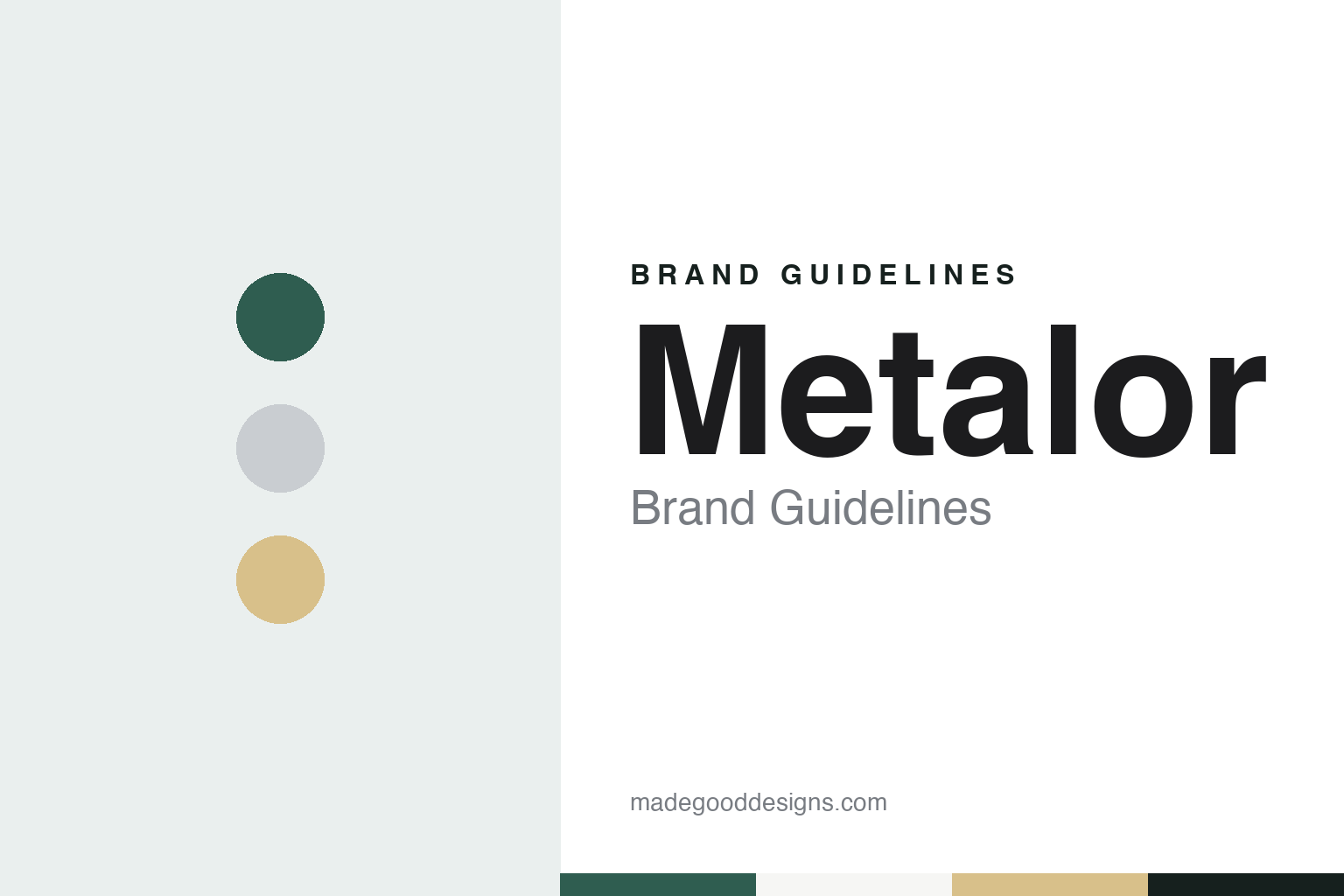
Two constants: a teal, graphite and silver grey palette and an Industrial sans register. Abstract homage — not a Metalor product or mark; no bar, hallmark or logo is reproduced.
Le Locle
A watchmakers’ rolling mill and a bank.
Metalor traces its roots to the watchmaking town of Le Locle, in the Swiss Jura. English, French and German Wikipedia date its beginnings to 1852, when Martin de Pury & Cie founded a “preparatory rolling mill” there that smelted gold and made watch cases, and swissinfo.ch also gave 1852 as the founding year in 2023. The company’s own history puts the start of Martin de Pury & Cie six years earlier, in 1846. Both accounts agree that the Banque du Locle bought the business, then employing five people, in 1864; the company says it served many local watchmakers.
In 1918 the Banque du Locle was taken over by the Swiss Bank Corporation, and the works, by then about 30 people, became a subsidiary of the bank and began making bullion for the banking sector. The company says it hired a chemist in 1921 to set up a precious-metal refinery, which opened in 1924 two kilometres from the main factory; that in 1926 it developed a white gold and nickel alloy for luxury watches; and that in 1934 it was admitted to the London Good Delivery list, the list later run by the London Bullion Market Association. In 1936 the bank formed the business into Métaux Précieux SA Metalor, as Wikipedia gives the name, which it kept until 2001.
The company’s account continues with new lines: a scientific research division was set up in 1938, and dental alloys sold under an “MP” brand followed in 1939. In 1947 it opened a new headquarters and factory in Neuchâtel, closer to the watchmaking centres and the university, and by 1953 all of its refining had moved there.
Colour
MP in an inverted triangle.
Metalor’s most lasting mark is a hallmark rather than a logo. The company says its current hallmark, the letters “MP” in an inverted triangle, dates from 1952, and its archive shows a one-kilo gold bar made in Neuchâtel in 1975 bearing that mark. Bars, it says, are delivered with an individual certificate, and the stamping can be personalised with a customer’s own logo.
French Wikipedia describes three business units: refining, advanced coatings and electrotechnics, the last turning silver alloys into electrical contacts; German Wikipedia adds that Metalor supplies the Swiss luxury watch industry with alloys for watch parts. For banks and investors the company makes cast gold bars from 100 grams up to the 400-troy-ounce bar of about 12.5 kilos, silver bars up to 1,000 ounces, minted gold bars from 1 gram to 100 grams, and grains. Minted bars above 20 grams carry a laser-engraved serial number and DataMatrix code and come sealed in a credit-card-sized blister with a certificate, the company says. With the Swiss company SICPA it developed a verification feature called BullionProtect; French Wikipedia also notes the two companies’ work against counterfeit gold products.
Production is spread widely. Metalor says its bullion is made at LBMA- or LPPM-accredited sites in Switzerland, the United States, Hong Kong, Singapore and China, with 400-ounce gold Good Delivery bars made at all five and silver, platinum and palladium Good Delivery bars in Switzerland, and that Metalor Switzerland is one of five LBMA referees and one of five LPPM referees. When swissinfo.ch visited the Swiss refinery at Marin, near Neuchâtel, in August 2023, it reported a refining capacity of 800 tonnes of precious metals a year and described bars refined to 999.9 parts per thousand and metal rings destined for banks and watchmakers; in a photo report the same month it described Metalor as one of the largest refineries anywhere.
Typography
Design and documentation.
Bullion dealers, refiners and mints sell goods that are deliberately standardised: a one-ounce coin or a kilo bar is defined by its metal, weight and purity before any design choice is made. So their identities live in a narrow set of places — the way products are photographed, the marks struck into the metal, the shop interface and the pages that explain who owns whom.
Product photography in this category is usually plain and repetitive by design. Companies tend to show each coin or bar on its own against a light or neutral background, often obverse and reverse side by side, sometimes still in a sealed card or capsule, so that the buyer can read the design, the weight and the fineness at a glance. Special editions are told apart by small details, such as the privy marks that mints add to coins for a particular dealer or occasion.
On the metal itself, the hallmark does the branding. A refiner’s bar typically carries its maker’s mark, its weight, its fineness and a serial number, and minted bars are often sold in an assay card that repeats those details. Accreditation is part of the same language: English Wikipedia, for example, lists the Swiss refiner MKS PAMP on the London Bullion Market Association and London Platinum and Palladium Market Good Delivery lists.
Online, the price chart sits close to the logo. Gold.com, the owner of JM Bullion, runs a strip of gold, silver, platinum and palladium prices across the top of its corporate site, and JM Bullion has kept separate sites named for gold and silver prices. Corporate pages carry the rest of the story: Gold.com publishes a year-by-year timeline of its acquisitions, and Bullion International Group, the owner of APMEX, signs its site “An MKS PAMP GROUP Company,” linking a retail name to a refinery.
Aa
An industrial sans, in keeping with a refiner’s stamped hallmark. (Specimen set in Archivo, a sans STAND-IN; NOT the Metalor logo.)
Metalor Technologies
From a bank subsidiary to a Japanese group.
Expansion abroad began in 1960 with a stake in CMP of Paris, followed in 1963 by a plant for silver electrical contacts at Courville in France, the company says. In 1987 it built a new factory at Marin, in the La Tène area, where construction work turned up Iron Age artefacts showing that gold had been worked on the site more than 2,000 years earlier; the headquarters moved there in 2016. The company lists acquisitions in the United States in 1989 and 1997, a first plant in Suzhou, China, in 2003 and a Hong Kong refinery bought in 2007; English Wikipedia dates the opening of its Singapore refinery to June 2014.
Ownership changed three times in two decades. In 1998, after the Swiss Bank Corporation merged with Union Bank of Switzerland, a group of Swiss private investors led by Ernst Thomke bought a majority, ending what the company counts as 134 years as a bank subsidiary; the group took the name Metalor Technologies in 2001. The French private equity firm Astorg Partners took over in 2009, and in September 2016 the whole group was sold to Tanaka Kikinzoku, the Japanese precious-metals group, according to English, French and German Wikipedia. Metalor describes Tanaka as a family-owned company founded in 1885. In March 2023 Metalor said it had completed the purchase of a refinery site in Hong Kong from Wing Fung Precious Metals, and on 1 March 2026 it announced that, after regulatory approval, it had completed its acquisition of Gannon & Scott, a Rhode Island refiner founded in 1919.
For a design guide, Metalor shows how a stamped hallmark can outlast a change of name and several owners. Compare PAMP, the Ticino refiner known for its minted-bar designs, and Valcambi, another Swiss refiner. For this guide we use a deep teal-green, graphite and silver grey with a sans, an unofficial interpretation; no product or logo is reproduced.
Explore & save
Keep Metalor’s identity on hand — save it to a board in the Made Good inspiration library.
Metalor identity set
Keep the Metalor teal, graphite and silver grey palette and the Industrial sans register for your own reference.