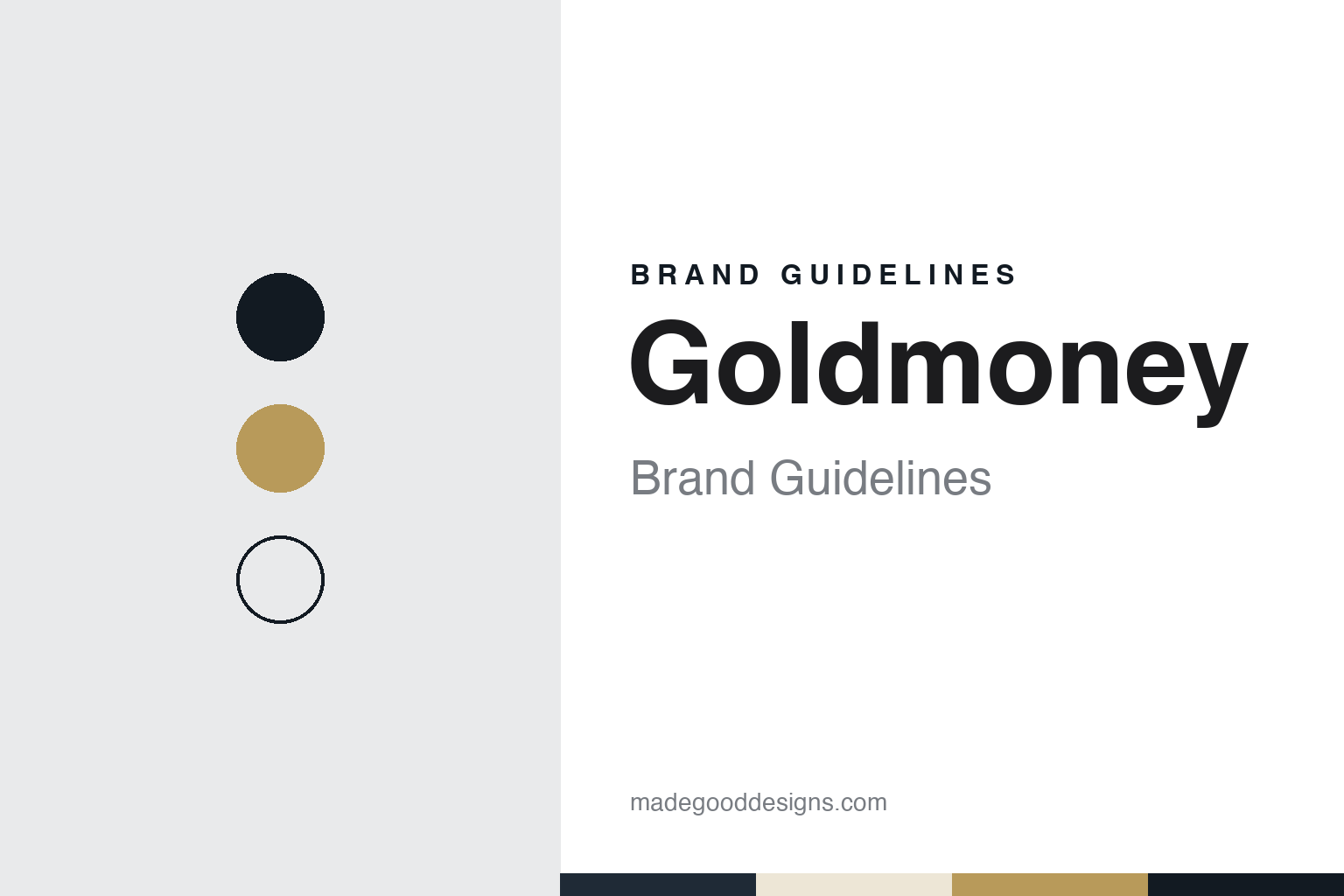
Goldmoney Brand Guidelines
An online vault for allocated metal, renamed and listed in Toronto.
Aa
Two constants: an ink, bullion and ivory palette and a ledger serif register. Abstract homage — not a Goldmoney product or mark; no bar, logo or interface is reproduced.
Since 2001
Two origin stories meet in one name.
Goldmoney is an online service for buying, holding and selling physical precious metals. The company dates the business to 2001: its investor page says Goldmoney Inc. was “founded in 2001 and listed on the Toronto Stock Exchange,” and its home page carries the line “Physical precious metals · Since 2001.” The same investor page names Roy Sebag as chief executive and James Turk as lead director of the board.
The listed company has a second origin story. English Wikipedia says Sebag and Josh Crumb, then a senior metals strategist at Goldman Sachs, developed the idea of a gold-based financial institution after the 2008 financial crisis, that this led to the launch of BitGold, and that BitGold went on to acquire GoldMoney in 2015 as a reverse merger. BetaKit reported in June 2016 that BitGold had acquired Goldmoney in May 2015, and in April 2016 that BitGold, a Toronto platform for buying, storing and spending vaulted gold, had launched in May 2015.
Early BitGold users bought gold held in Brink’s vaults and could redeem it as bars, small “GoldCubes” or coins, BetaKit reported in April 2016. That month the company added business accounts, with invoicing, payment and developer tools, announced at the Money 20/20 Europe conference in Copenhagen. Users holding at least one gram of gold could apply for a GoldMoney Mastercard, according to the same report.
In June 2016 the company folded the two names together. BetaKit reported that the BitGold brand was being phased out and the business reorganised into Goldmoney Personal, Goldmoney Business and Goldmoney Wealth, the last built on the Jersey-based precious-metal custodian that had traded as Goldmoney. Sebag told the publication that “a new brand identity is a fundamental step” in uniting the operations, and that a new look for Goldmoney.com would be unveiled later that year.
Colour
A Toronto listing and vaults in six markets.
The listing came quickly. BetaKit reported on 20 April 2016 that GoldMoney had moved to the main board of the Toronto Stock Exchange less than a year after its initial listing on the TSX Venture Exchange. The company’s investor page today gives its primary listing as TSX: XAU, with a second line in Frankfurt.
The vault network grew in the same period. In December 2016 BetaKit reported that the Royal Canadian Mint’s storage facility in Ottawa had joined the Goldmoney network, alongside Brink’s vaults elsewhere, so that users could buy gold held in the Mint’s vault. Goldmoney now says client metal sits in insured vaults in Canada, Hong Kong, Singapore, Switzerland, the United Kingdom and the United States, run by operators including Brink’s, Loomis International and the Mint, and that it serves clients in more than 100 countries.
The company describes its model in plain terms. Metal bought through an online “Holding” is fully allocated, held in the client’s name and kept off Goldmoney’s balance sheet, the company says, and clients can register specific bars for an extra fee or take delivery once they hold enough metal for a whole bar. Goldmoney says the bars it holds meet the London Good Delivery standard of the London Bullion Market Association for gold and silver, and the London Platinum and Palladium Market standard for those two metals, and that each bar carries its fineness, year of production, serial number and the assay stamp of its refiner.
The group has also changed shape. English Wikipedia says the company announced in March 2019 that it was closing its cryptocurrency business. BetaKit reported in November 2018 that the jewellery brand Menē, which sells gold and platinum pieces priced by gram weight, had separated from Goldmoney in 2017 and begun trading on the TSX Venture Exchange; Goldmoney’s investor page now lists Menē among its businesses, together with Goldmoney Properties, set up in 2023 to invest in UK property.
The legal home moved too. At its September 2024 annual and special meeting, shareholders approved continuing the company from the laws of British Columbia into those of the British Virgin Islands, according to a Goldmoney announcement, and its releases since November 2024 have been datelined Tortola rather than Toronto.
Typography
Bullion, custody and the screen.
Bullion dealers, refiners and mints sell goods that are deliberately standardised: a one-ounce coin or a kilo bar is defined by its metal, weight and purity before any design choice is made. So their identities live in a narrow set of places — the way products are photographed, the marks struck into the metal, the shop interface and the pages that explain who owns whom.
Product photography in this category is usually plain and repetitive by design. Companies tend to show each coin or bar on its own against a light or neutral background, often obverse and reverse side by side, sometimes still in a sealed card or capsule, so that the buyer can read the design, the weight and the fineness at a glance. Special editions are told apart by small details, such as the privy marks that mints add to coins for a particular dealer or occasion.
On the metal itself, the hallmark does the branding. A refiner’s bar typically carries its maker’s mark, its weight, its fineness and a serial number, and minted bars are often sold in an assay card that repeats those details. Accreditation is part of the same language: English Wikipedia, for example, lists the Swiss refiner MKS PAMP on the London Bullion Market Association and London Platinum and Palladium Market Good Delivery lists.
Online, the price chart sits close to the logo. Gold.com, the owner of JM Bullion, runs a strip of gold, silver, platinum and palladium prices across the top of its corporate site, and JM Bullion has kept separate sites named for gold and silver prices. Corporate pages carry the rest of the story: Gold.com publishes a year-by-year timeline of its acquisitions, and Bullion International Group, the owner of APMEX, signs its site “An MKS PAMP GROUP Company,” linking a retail name to a refinery.
Aa
A ledger serif for a custody brand. (Specimen set in DM Serif Display, a serif STAND-IN; NOT the Goldmoney logo.)
Goldmoney
Statements of ownership instead of shop windows.
Goldmoney’s public face is quiet and text-led. Its site sets out ownership, custody, audits, account security and fees in short headed sections, offers its fee schedule as a dated PDF, and keeps a research section of essays on money and markets. The investor pages follow the same pattern, with annual reports, shareholder letters and board committees laid out as plain lists.
The bar standard it publishes is the closest thing to a visual signature. Goldmoney gives weight, purity and size ranges for the large gold and silver bars it buys and names the four marks each bar carries, which makes the page a straightforward reference for anyone drawing bullion without inventing details.
The brand also shows how one name can absorb another. BitGold’s identity was retired about a year after the 2015 merger, and the older Goldmoney name, written GoldMoney in some 2016 press coverage, carried on as the single brand for personal, business and wealth services.
For a design guide, Goldmoney shows how a custody business can present itself through plain statements of ownership, vault locations and bar standards. Compare BullionVault and Sprott Money in the same series. For this guide we use deep ink, muted bullion gold, vault grey and ivory with a serif, an unofficial interpretation; no product or logo is reproduced.
Explore & save
Keep Goldmoney’s identity on hand — save it to a board in the Made Good inspiration library.
Goldmoney identity set
Pin the Goldmoney ink, bullion and ivory palette and the ledger serif register to your own board.