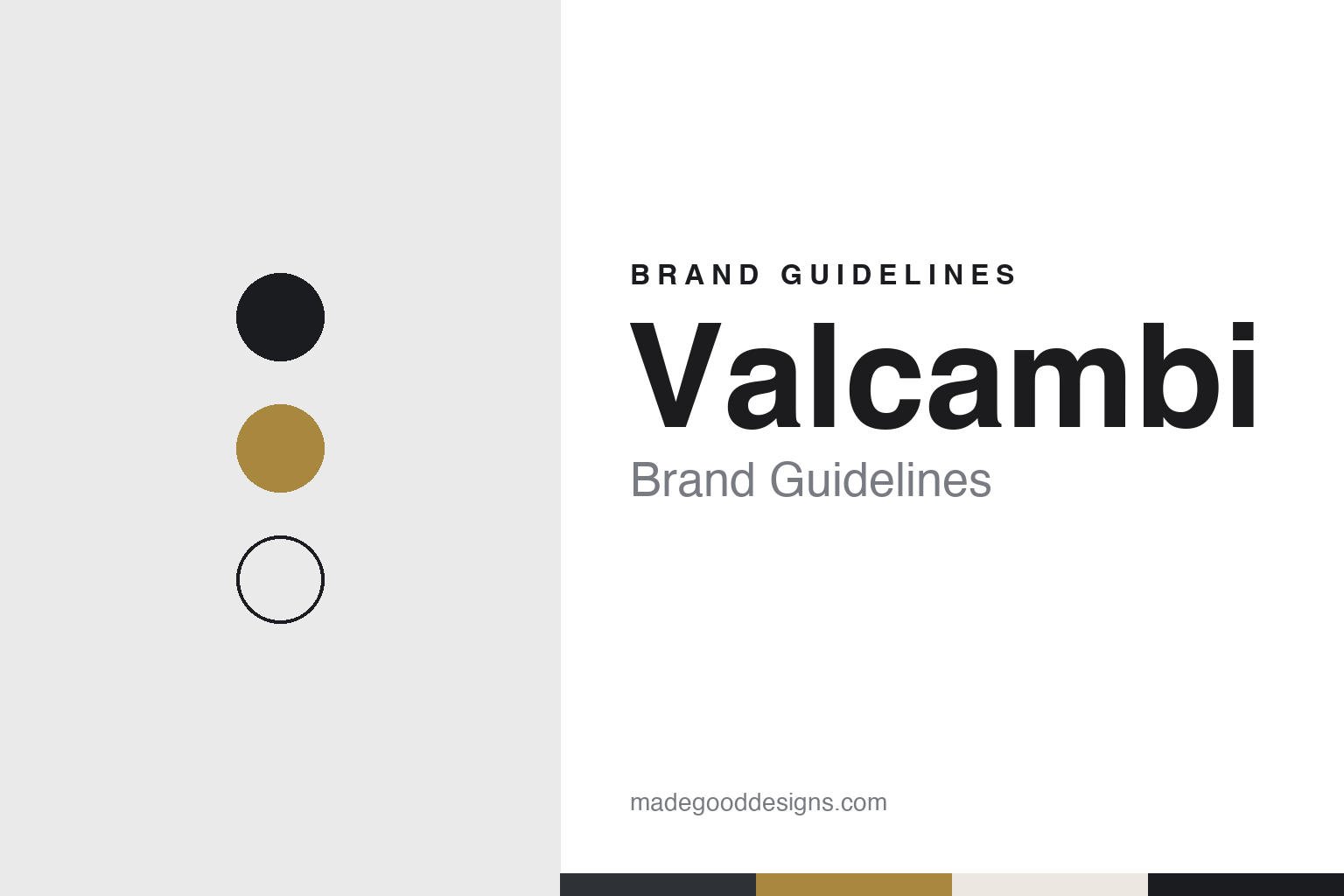
Valcambi Brand Guidelines
A Swiss refinery whose identity is struck into the bar.
Aa
Two constants: a graphite, gold and stone palette and a Swiss sans register. Abstract homage — not a Valcambi product or mark; no bar, stamp or logo is reproduced.
Valori & Cambi
Five investors and a refinery near the Italian border.
Valcambi began in Balerna, in the Swiss canton of Ticino, close to the Italian border. English Wikipedia and a July 2015 analysis by Ronan Manly for the bullion dealer BullionStar both give its date of incorporation as 15 May 1961 and its first name as Valori & Cambi SA, and both say it was formed by five Swiss businessmen from nearby Mendrisio. Manly noted that little in the public record identifies them.
The company’s own history says the five private investors built a precious metals refinery under that name, which it translates as “exchange of valuables,” and that the business was founded on trading precious metals and banknotes. The first years were hard, it says: demand outran supply, and the company struggled to meet tight delivery deadlines. Credit Suisse became a lender of gold to the plant, and the company recalls a routine in which a 200 kg loan of metal arrived each morning and went back to the bank as new kilo bars each evening. Its timeline lists the first refinery building in 1962, a melter’s licence and the hallmark “Essayeur Fondeur” in 1965, and the completion of the refinery in 1967.
The name changed to Valcambi SA on 30 June 1967, according to English Wikipedia and BullionStar. That year Credit Suisse bought half of the company; it added a further 30% in 1968 and the remaining 20% in 1980, making Valcambi a wholly owned subsidiary. Manly noted that in that era the other two large Swiss banks of the day also owned refineries: UBS owned Argor and the Swiss Bank Corporation owned Metalor. Valcambi’s own timeline adds that in 1997 it became a full subsidiary of Credit Suisse First Boston.
Colour
A name, an assay stamp and four triangles.
A refinery’s brand lives on its bars, and Valcambi’s is documented outside its own website. The London Bullion Market Association’s current Good Delivery list for gold, read in November 2026, gives Valcambi SA of Balerna a first listing date of 20 May 1968. It describes the current bar mark as the words “Valcambi SUISSE,” an assay stamp in the form of a rectangle enclosing “CHI” in a circle with the words “Essayeur Fondeur,” and a brand mark shaped as a diamond made of four scalene triangles.
The company describes the same emblem in its own words: a frame of four equal triangles that stands for a stylised 400-ounce LBMA Good Delivery gold bar, cut diagonally. The two descriptions differ on the shape of the triangles; both build the mark from four of them.
The company’s timeline lists the markets and standards it joined over the years: COMEX acceptance for gold under the Credit Suisse brand in 1974, the Tokyo commodity exchange for palladium under the Valcambi brand in 1992, a laboratory accreditation from the Swiss Federal Office of Metrology (Metas) in 1995 and ISO 9001 certification in 1996. Its 2026 “at a glance” page says it is an LBMA Good Delivery refiner for gold and silver and an LPPM Good Delivery refiner for platinum and palladium.
Its product menu names cast bars, minted bars, round bars and the CombiBar, which the company introduced in 2011 as a bar that can be broken into 1 g pieces. It also lists grain, coins and medals, and semi-finished products, and says it makes specialist semi-finished parts for the watch industry, as well as blanks and complex alloys. In 2008, it says, it introduced gold traceable from mine to client under the name Valcambi GreenGold; it says it began working with artisanal and small-scale mines from 2014 and received Fairtrade certification in 2015.
Typography
Bullion dealers, refiners and mints.
Bullion dealers, refiners and mints sell goods that are deliberately standardised: a one-ounce coin or a kilo bar is defined by its metal, weight and purity before any design choice is made. So their identities live in a narrow set of places — the way products are photographed, the marks struck into the metal, the shop interface and the pages that explain who owns whom.
Product photography in this category is usually plain and repetitive by design. Companies tend to show each coin or bar on its own against a light or neutral background, often obverse and reverse side by side, sometimes still in a sealed card or capsule, so that the buyer can read the design, the weight and the fineness at a glance. Special editions are told apart by small details, such as the privy marks that mints add to coins for a particular dealer or occasion.
On the metal itself, the hallmark does the branding. A refiner’s bar typically carries its maker’s mark, its weight, its fineness and a serial number, and minted bars are often sold in an assay card that repeats those details. Accreditation is part of the same language: English Wikipedia, for example, lists the Swiss refiner MKS PAMP on the London Bullion Market Association and London Platinum and Palladium Market Good Delivery lists.
Online, the price chart sits close to the logo. Gold.com, the owner of JM Bullion, runs a strip of gold, silver, platinum and palladium prices across the top of its corporate site, and JM Bullion has kept separate sites named for gold and silver prices. Corporate pages carry the rest of the story: Gold.com publishes a year-by-year timeline of its acquisitions, and Bullion International Group, the owner of APMEX, signs its site “An MKS PAMP GROUP Company,” linking a retail name to a refinery.
Aa
A plain Swiss sans for a refinery’s stamp. (Specimen set in IBM Plex Sans, a sans STAND-IN; NOT the Valcambi logo.)
Valcambi
From a Swiss bank to an Indian jeweller.
Credit Suisse withdrew from much of its bullion business in October 2001, the company says, and in December 2003 a new company, European Gold Refineries SA (EGR), bought all of Valcambi from the bank. BullionStar reported that EGR was owned half by the US gold miner Newmont and half by a group of Swiss investors, some of them linked to the 1961 founders; Mitsubishi International held a small stake between 2007 and 2008, and Newmont’s share later rose to about 60%. Valcambi’s profile gives the split until July 2015 as 60.6% Newmont and 39.4% private investors.
In July 2015 the Bengaluru jeweller Rajesh Exports bought the business, English Wikipedia and BullionStar say. It did so through a new Swiss holding company, Global Gold Refineries, owned 95% by REL Singapore and 5% by Rajesh Exports, which is listed on India’s National Stock Exchange and Bombay Stock Exchange. The company says EGR was absorbed into Global Gold Refineries on 26 July 2017, and that Valcambi is fully owned by it today.
The refinery has stayed in Balerna, a 15-minute drive from Lugano and 30 minutes from Milan, the company says, on a 3.3-hectare site that holds both its headquarters and its refining. It gives its annual combined refining capacity for gold, silver and platinum group metals as about 2,000 tonnes, and says many of its staff speak Italian as well as English, French and German. It describes itself as a firm that “deliberately keeps a low profile,” little known outside refining circles.
For a design guide, Valcambi shows how a refiner’s identity is carried by marks struck into metal: a name, an assay stamp and a geometric emblem that the market’s own lists describe in words. Compare PAMP and Metalor, two other Swiss refiners in this series. For this guide we use a deep graphite, an assay gold and a pale stone with a sans, an unofficial interpretation; no product or logo is reproduced.
Explore & save
Keep Valcambi’s identity on hand — save it to a board in the Made Good inspiration library.
Valcambi identity set
Pin the Valcambi graphite, gold and stone palette and the Swiss sans register to your own board.