Kemble Brand Guidelines
Britain’s last piano factory.
Aa
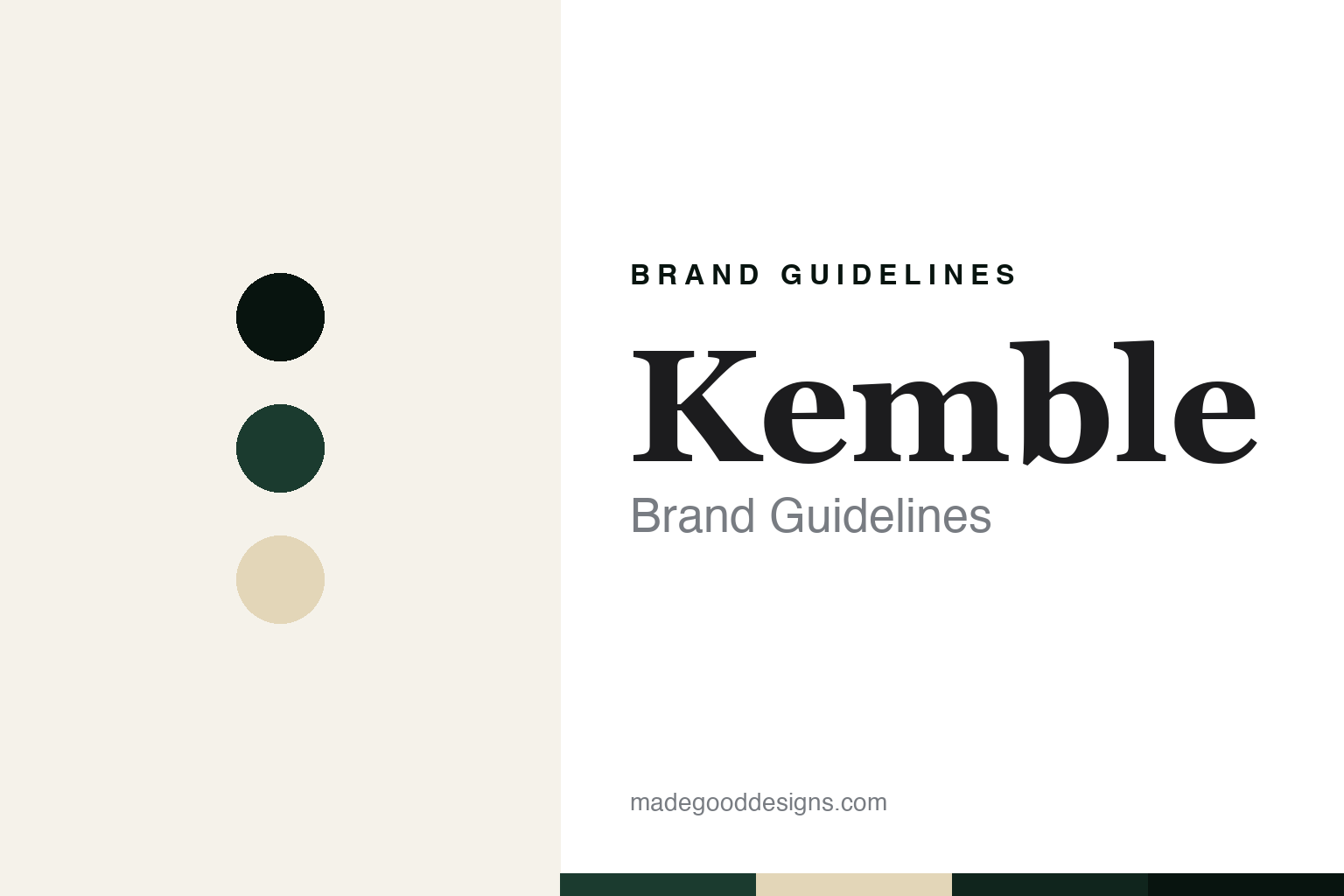
Two constants: a British-racing-green palette and an English-serif register. Abstract homage — not a Kemble or Yamaha product or mark; no piano or logo is reproduced.
A family firm in Bletchley
Kemble was a London name that became a Buckinghamshire factory.
Kemble began in London in the early 1900s; dealer histories give 1911 and name the founder as Michael Kemble, details we give as theirs. The family business later moved to Bletchley, in Milton Keynes, and the company that ran the factory, Kemble & Company Limited, was incorporated in November 1947. Its business, Companies House records, was the manufacture of musical instruments. A separate Kemble company, Kemble Music Ltd, is easily confused with it: that was the family’s retail business, and its register entry shows that from 1936 to 1986 it had carried the name of another London maker — John Brinsmead Pianoforte Manufacturers Limited. Two old British piano names, in other words, ended up inside the Kemble group.
The family built a second business alongside the factory. English Wikipedia says Kemble became a distributor of Yamaha organs in 1966 and later bought the Chappell piano business and its London shop; we give those details as Wikipedia’s, which does not cite them. A distribution joint venture, Yamaha-Kemble Music (U.K.) Ltd, was established in 1968, Yamaha later said, and grew into the British arm of the Japanese group.
Kemble made upright pianos, chiefly, for the British home, school and teaching market — the everyday instrument found in front rooms and school halls rather than the concert grand — sold under model names such as Classic, Oxford and Cambridge. The family stayed involved to the end: Brian Kemble, a long-serving director of the manufacturing company, was described by the BBC in 2009 as joint managing director and “grandson of the founder.”
Colour
Yamaha, and the last day.
Yamaha came into the factory in the 1980s. The BBC reported in 2009 that Yamaha “became involved” in 1986; a trade report said Yamaha bought a 90 per cent share that year, and dealer histories say it took control in 1988 — accounts differ, and we give the range. Companies House shows Yamaha executives on the board of the manufacturing company by the 2000s, among them directors appointed in 2005 and 2008, alongside members of the Kemble family.
The distribution side changed first. In July 2007, Yamaha announced that its European holding company had cancelled the joint-venture contracts and bought out the local minority in Yamaha-Kemble Music (U.K.) Ltd — a business with 146 employees and net sales of £60.1 million, engaged, Yamaha said, in the “Import and sales of musical instruments and professional audio equipment.” Its joint managing directors were Yoshichika Sakai and Andrew Kemble, and it was renamed Yamaha Music (U.K.) Ltd that autumn. That buyout concerned the distribution company, not the piano factory.
The factory followed two years later. In 2009 the BBC reported the closure of what it called the UK’s last piano maker, with 90 jobs lost, saying Yamaha had decided the operation was “no longer viable.” “Since 1986, when Yamaha became involved, the company had made and sold more than 120,000 pianos and won a Queen’s award for exports,” the BBC said. A Yamaha spokesman explained: “As the marketplace for mid-range pianos comes under increasing pressure, and in order to improve our long term competitiveness, the best solution is to fully utilise our manufacturing capacity in other locations.” Brian Kemble said: “It is a very sad day for my staff, the Kemble family and for manufacturing in UK.” The Guardian quoted him calling it the worst day of his life. The Bletchley factory closed for good in October 2009. Its last filed accounts were for the year to March 2009. The manufacturing company entered a members’ voluntary liquidation — a solvent winding-up — in December 2009, and was dissolved in 2014.
Typography
Where the pianos come from now.
Kemble’s pianos, once made in Buckinghamshire, became imports from Yamaha’s plants abroad, and the trade figures show where such pianos come from. In 2023, according to UN Comtrade data, Japan supplied 58.4 per cent of the value of upright pianos imported into the United States and Indonesia 25.7 per cent; China supplied 5.9 per cent. Indonesia is where, dealers say, Kemble pianos were made after 2009.
Tariffs shape that map. The US tariff schedule charges a general duty of 4.7 per cent on upright and grand pianos; pianos from China carry an extra 7.5 per cent under the “List 4A” duties first imposed in 2019, which remain in the 2026 schedule. Pianos from Japan and Indonesia were not on that list. For grand pianos, the 2023 figures were similar: Japan 45.9 per cent, Indonesia 24.0, and China 4.2. A 1999 US International Trade Commission study had already observed that “U.S. producers are major importers, buying foreign-produced pianos to complement their product lines” — the same pattern that, a decade later, ended piano-making in Bletchley. The study found that pianos from Japan, Korea, China and Indonesia already made up 93 per cent of American imports by quantity in 1998.
Aa
An English serif — the lettering of a British upright. (Specimen set in Fraunces, a serif STAND-IN; NOT the Kemble logo.)
Classic, Oxford, Cambridge
English place names on an English piano — then on an imported one.
Kemble’s model names were quietly English: Classic, Oxford, Cambridge. After 2009, by the BBC’s account, Kemble pianos were made at Yamaha factories outside the UK — dealers say in Indonesia — so the same English place names travelled on imported instruments. A piano forum post of 2020 said Yamaha had stopped making Kemble-branded pianos altogether, which would end a name that had been on British pianos for most of a century; we found no Yamaha confirmation and say only that the brand was reportedly discontinued around then.
For a design guide, Kemble is the end of a story that many brands in this series have told in part: a national name, a family factory, a foreign partner, a closure and a move abroad. Its distinction is that it was widely described, at the end, as the last of its kind in Britain. Its Queen’s Award for exports and its 120,000 pianos are the record of a brand that worked; the closure is the record of an industry that moved.
For this guide we use a British racing green and an Oxford cream with an English serif. These are an unofficial interpretation, not Kemble’s or Yamaha’s colour values, and nothing of the Kemble logo is reproduced.
Explore & save
Keep Kemble’s identity on hand — save it to a board in the Made Good inspiration library.
Kemble identity set
Pin the British-racing-green palette and the English-serif register to your own board.