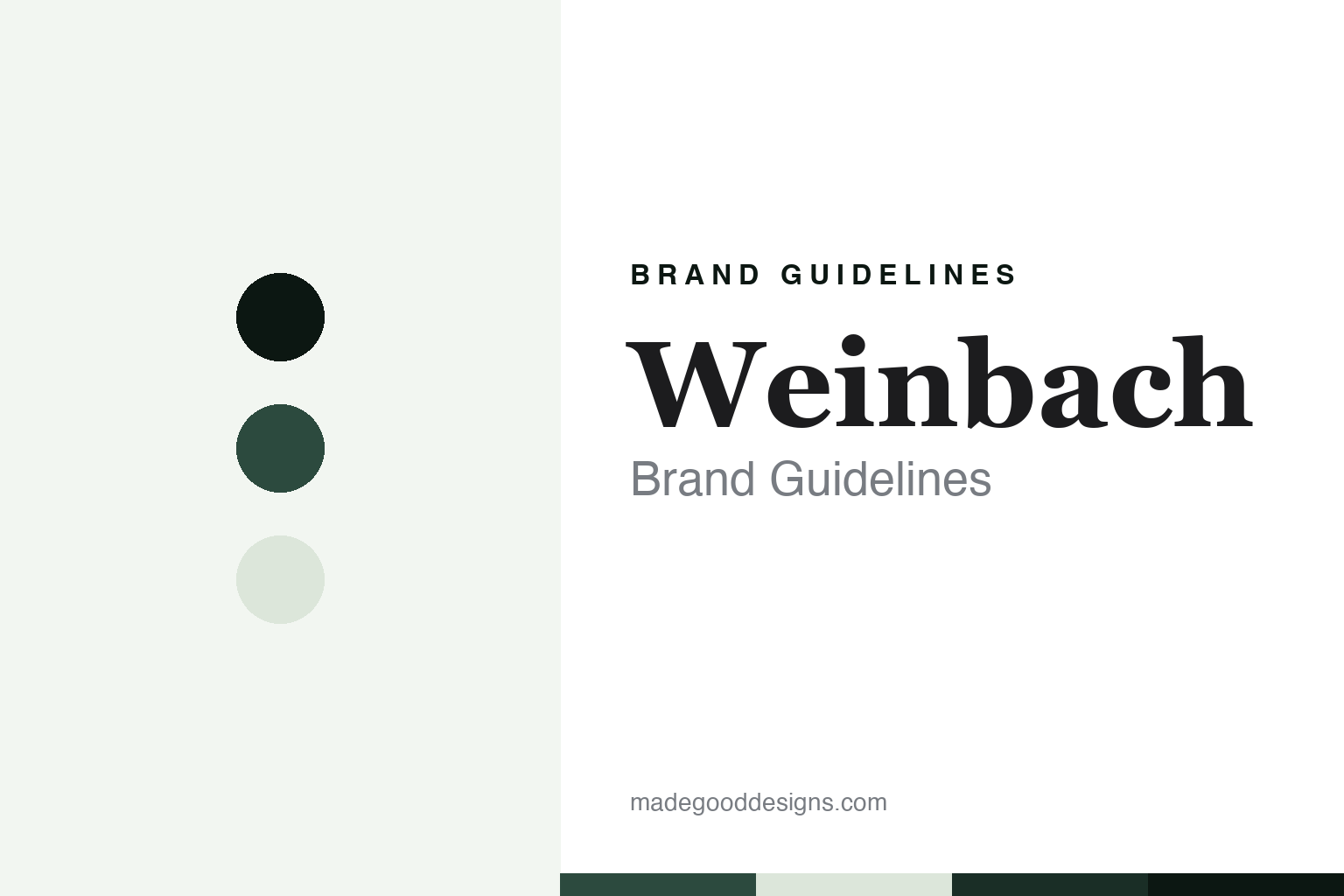
Weinbach Brand Guidelines
Petrof’s second line, and a rewritten past.
Aa
Two constants: a Bohemian-green palette and a Bohemian-serif register. Abstract homage — not a Weinbach or Petrof product or mark; no piano or logo is reproduced.
A name in the Petrof family
Weinbach is one of several names Petrof keeps.
Petrof, the Czech piano maker of Hradec Králové, sells more than one name. Its brand page lists a family — Rösler (dated by Petrof to 1878), Scholze (1876), Akord (1919), Fibich (1948) and Weinbach — and says: “The Weinbach brand has an irreplaceable role in the PETROF company portfolio. The basis of Weinbach instruments is based on the construction of PETROF instruments… Weinbach pianos are perfect for music schools.” — a clear statement of the intended buyer. Weinbach’s own site, titled as part of the “PETROF Brand Family,” says simply that Petrof “took Weinbach into its portfolio, and now sells middle-range pianos under that name.” It gives no year.
Petrof itself is a family firm with an interrupted history. Its timeline records the company’s nationalisation in 1948, privatisation completed in 1998, and the factory’s return “to hands of Petrof family” in 2001. Zuzana Ceralová Petrofová became president in 2004, and in 2022 Anna Petrof Prousková, “6th generation of the Petrof family, becomes the CEO.” The company says it has made 635,000 instruments under the Petrof name since 1864.
Piano Buyer describes the old relationship between the two names bluntly: “For years, Weinbach pianos were made by the Petrof company and were virtually identical to Petrof brand pianos.” It adds that “The Weinbach name is no longer being used in North America.” Weinbach was, for much of its life, a second label on a Petrof piano.
Colour
Petrof’s Weinbach site once told a different history.
In August 2020, an archived copy shows, Weinbach’s website told a founding story: “The history of the Weinbach name dates back to 1887 when Gerhard Wein set up his original organ-making workshop in the Weinbach region of Germany. By 1893 they were exclusively producing pianos… In 1956 PETROF took Weinbach into its portfolio.” The current site no longer contains that history, or any date. We found no independent record of Gerhard Wein’s workshop, and we do not repeat the story as fact; we note only that Petrof once told it and has since set it aside. (Weinbach is the name of a municipality in Hesse; we found no “Weinbach region.”)
The date in the old story raises its own question. Petrof’s timeline says the company was nationalised in 1948, so a 1956 acquisition would have fallen in the state-enterprise era. Whatever its origin, the name’s present is clear: it is a Petrof brand. Hradec Králové, where Petrof finishes it, is also where Bechstein builds its Czech line, W. Hoffmann — one Bohemian town hosting two famous makers’ second-line work, each describing it differently. Bechstein says “Made in Europe by C. Bechstein”; Petrof says “our foreign partner,” and adds what it does itself.
The quietly dropped founding story is a useful lesson for any heritage brand. A dated origin is a strong marketing asset — this series has seen many — but only while it can be supported. Removing an unsupported one is better than defending it, and the current Weinbach site no longer makes the claim at all; the current site’s plainer line, that Petrof took the name into its portfolio, is the one it can stand behind.
Typography
Made elsewhere, finished in Hradec Králové.
Weinbach’s current model pages describe a two-stage production. For the 128 Z3 upright: “The piano is manufactured by our foreign partner. Finishing operations, including inspection, tuning, and voicing, are performed by experienced PETROF employees.” For the 120 Z3: “manufactured in cooperation with our foreign partner… under the supervision of experienced experts from the PETROF company,” with “Surface treatment control, regulation, tuning, and voicing” performed by Petrof. All four current models — two uprights and the 162 and 180 grands — carry the line: “Action installation, regulation, tuning, and voicing are made in PETROF.” The pages do not name the partner or its country. A Malaysian dealer’s copy of Petrof brand text says the pianos are “semi-finished in a leading Chinese piano factory” and completed “in the PETROF factory”; we give that as the dealer’s text.
The country matters at the border. The US tariff schedule charges a general duty of 4.7 per cent on upright and grand pianos; pianos from China carry an extra 7.5 per cent under the “List 4A” duties imposed in 2019 and still in the 2026 schedule — a list the US Trade Representative reserved for products where China supplied less than 75 per cent of American imports. Which rate a piano attracts depends on its country of origin, not on the brand on its fallboard. Weinbach is no longer sold in North America, Piano Buyer says, so the point is about the principle rather than this brand’s current imports.
A 1999 US International Trade Commission study captured the principle: “U.S. producers are major importers, buying foreign-produced pianos to complement their product lines.” The same study found that pianos from Japan, Korea, China and Indonesia made up 93 per cent of American piano imports by quantity in 1998. Petrof’s Weinbach arrangement is the European version: a historic maker buying in a body and adding its own finishing. The American import figures show how much of the market comes from Asia: in 2023, UN Comtrade data show, Japan supplied 58.4 per cent of the value of upright pianos imported into the United States and Indonesia 25.7 per cent, with China at 5.9 per cent.
Aa
A Bohemian serif — the lettering of a Czech nameboard. (Specimen set in Fraunces, a serif STAND-IN; NOT the Weinbach or Petrof logo.)
Weinbach Limited Edition
A brand family, and a story set aside.
Weinbach’s current tagline is “WEINBACH LIMITED EDITION · PETROF brand family,” and its pages speak of the “Favorable price of the limited edition Weinbach.” The identity rests on the parent: the Petrof name appears more prominently than any story of Weinbach’s own.
For a design guide, Weinbach shows two good habits and one cautionary tale. It names its parent openly; it describes, model by model, which stages Petrof performs; and its owner has withdrawn a founding story it could not support. What it still does not do is name the country where the body of the piano is built.
For this guide we use a Bohemian green and a pale sage with a traditional serif. These are an unofficial interpretation, not Petrof’s colour values, and nothing of the Weinbach or Petrof logos is reproduced.
Explore & save
Keep Weinbach’s identity on hand — save it to a board in the Made Good inspiration library.
Weinbach identity set
Pin the Bohemian-green palette and the Bohemian-serif register to your own board.