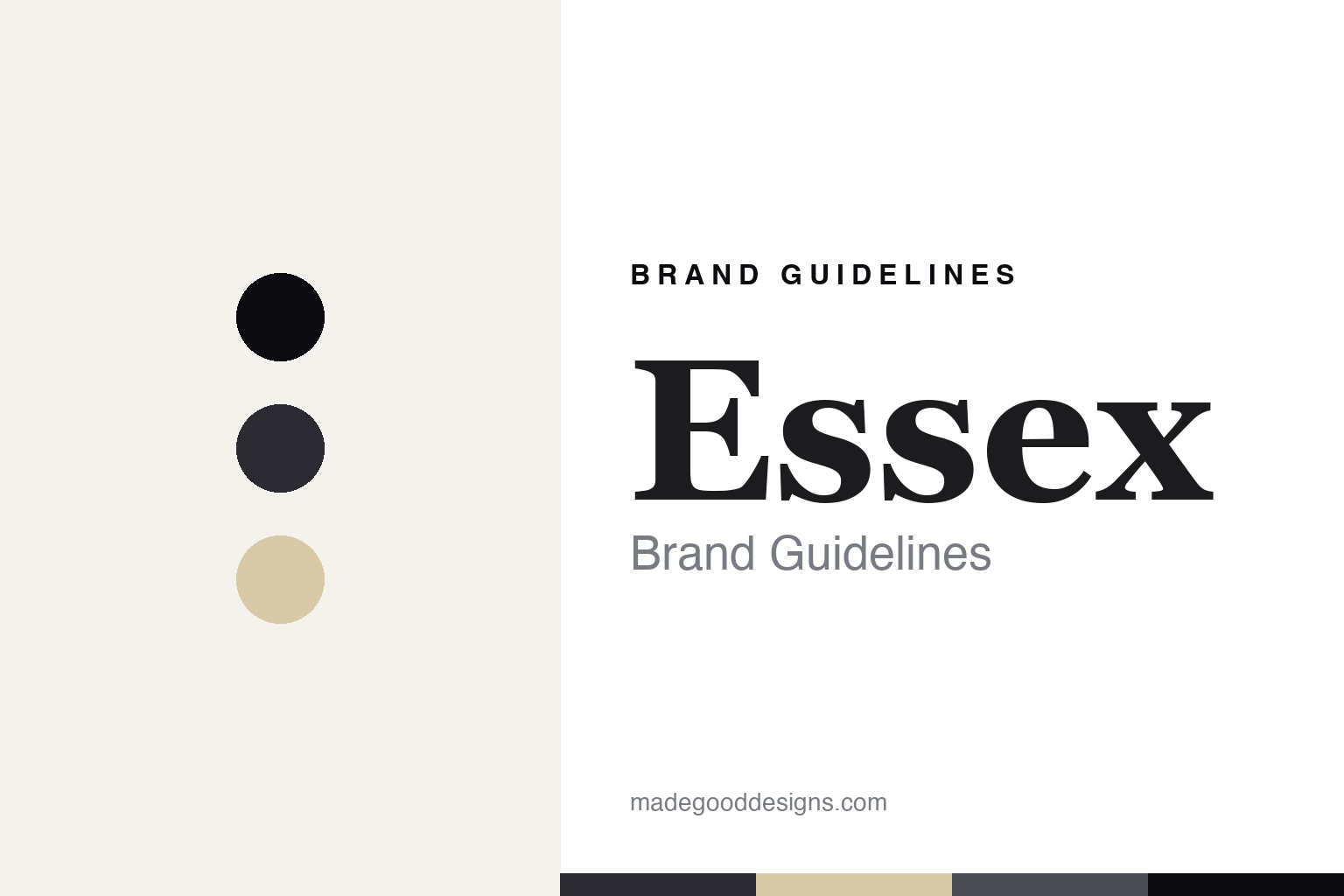
Essex Brand Guidelines
“Designed by Steinway & Sons.”
Aa
Two constants: an ebony palette and a nameboard-serif register. Abstract homage — not an Essex or Steinway product or mark; no piano or lyre is reproduced.
A Steinway line without the Steinway name
Essex is how the world’s most famous piano brand sells a cheaper piano.
Steinway & Sons has two lower-priced lines, and neither carries its name on the fallboard. Boston, the middle line, is made by Kawai in Japan. Essex is the entry line. Steinway’s annual report for 2000, filed in April 2001, already described it: “The Essex line is comprised of four upright and grand piano models with retail prices ranging from $5,200 to $17,800.” Piano Buyer dates the launch to early 2001, “with a limited offering of models made by Young Chang” — the Korean maker. We date it to around 2000–01.
The first maker is Piano Buyer’s account, not Steinway’s; Steinway’s filings do not name the factory. They do name the second. Steinway’s annual report for 2005 says: “In 2005, we established a relationship with Pearl River Piano Group, the largest piano manufacturer in China, to build pianos for our Essex line.” The next year’s report adds: “In June of 2006, we successfully re-launched our Essex line.” Piano Buyer says the relaunch offered 35 grand and 31 upright models and finishes, and that over 75,000 Essex pianos had been sold since 2001. Pearl River itself is a listed company in Shenzhen whose largest shareholder, with 51 per cent at the end of 2025, is the state-owned Guangzhou City Construction Investment Group — so the entry line of America’s best-known piano brand is built by a Chinese state-controlled manufacturer.
The line mattered to Steinway’s numbers. Its 2007 report said Boston and Essex together were “approximately 20% of our piano division revenue and nearly 70% of piano unit sales in 2007,” with Essex retailing between $4,000 and $20,000. Since September 2013 Steinway itself has been owned by an affiliate of the investment firm Paulson & Co.
Colour
“The Steinway-Designed Essex.”
Steinway’s own page for the line — steinway.com now redirects to essexpianos.com — chooses its verb with care. Its heading is “The Steinway-Designed Essex.” The body says the pianos are “Designed by Steinway & Sons in collaboration with renowned furniture designer William Faber,” and that “Every Essex instrument is inspected by a team of highly experienced Steinway & Sons technicians before it leaves the factory.” The footer reads: “Boston | Essex — Designed by Steinway & Sons.”
The page we read does not name a country or a factory. Piano Buyer does: “Designed by Steinway & Sons, made in Guangzhou, Guangdong Province, China by Guangzhou Pearl River Piano Group Ltd.” Both statements are accurate; they answer different questions. Steinway tells the buyer who designed and inspected the piano. Piano Buyer tells the buyer who built it.
The page also offers a promise that only a parent brand could make: Essex owners may trade in their piano for its full original price toward a new Steinway grand within ten years. That is the line’s real brand position. Essex is sold as a first step on a ladder whose top rung carries the famous name, and the trade-in offer turns a cheaper piano into a deposit on a dearer one. The furniture designer’s name, William Faber, appears where a factory’s might; the page’s credits are all about design, styling and inspection.
Typography
Where “designed” meets the law.
“Designed by” is a deliberate phrase, and the law around it is precise. In the United States, the Federal Trade Commission’s Made in USA Labeling Rule, in force since August 2021, forbids an unqualified “Made in the United States” claim unless “all or virtually all ingredients or components” are American. Its guidance gives an example that could have been written for Essex: a company that designs a product in New York City and has it made in Finland may label it “Designed in USA — Made in Finland,” because “such a specific processing claim would not lead a reasonable consumer to believe that the whole product was made in the U.S.” The same guidance calls “Created in USA” deceptive, because shoppers read “created” as “made.” The verb matters.
Imports carry a second rule. Under 19 U.S.C. §1304, every foreign-made article must be marked with “the English name of the country of origin,” and US Customs regulations add that where a US place name or a foreign place other than the true origin appears and “may mislead or deceive,” the real country must appear “in close proximity… and in at least a comparable size.” That rule turns on place names, not brand names, and we know of no ruling on any piano. In Europe, the Unfair Commercial Practices Directive of 2005 treats as misleading a practice that deceives about “geographical or commercial origin” — or about a trader’s “affiliation or connection” — “even if the information is factually correct.”
None of this suggests that Essex breaks any rule; we found no regulator action against it. It explains why the line’s marketing is built on design and inspection, not on manufacture. Piano Buyer, surveying the American market in 2022, noted that “Many American distributors and dealers contract with Beijing, Pearl River, and other makers, selling pianos in the U.S. under a multitude of names,” and put Steinway’s arrangement in a sentence: “Steinway & Sons markets the Essex brand, designed by Steinway and manufactured by Pearl River.”
Aa
A classical nameboard serif — the gilt lettering of a fallboard. (Specimen set in Fraunces, a serif STAND-IN; NOT the Essex or Steinway logo.)
Boston | Essex
Three brands, one design credit.
Steinway’s brand architecture is unusually explicit. The parent name sits on the most expensive pianos; two different names sit on the others; and a shared credit — “Designed by Steinway & Sons” — ties them together. The arrangement lets Steinway sell at three prices without putting its own name on a piano made by another company, and it lets Essex borrow the parent’s authority through a single word.
Even the parent’s age wavers on the page: one block speaks of “over 160 years” of craftsmanship and another of “over 170 years.” The second is closer to the truth for a company founded in New York in 1853. Small inconsistencies like that are common on a brand site; we note it only because the Essex page is otherwise so carefully worded.
For this guide we use an ebony and a fallboard gilt with a classical serif. These are an unofficial interpretation, not Steinway’s colour values, and nothing of its logos is reproduced.
Explore & save
Keep Essex’s identity on hand — save it to a board in the Made Good inspiration library.
Essex identity set
Pin the ebony palette and the nameboard-serif register to your own board.