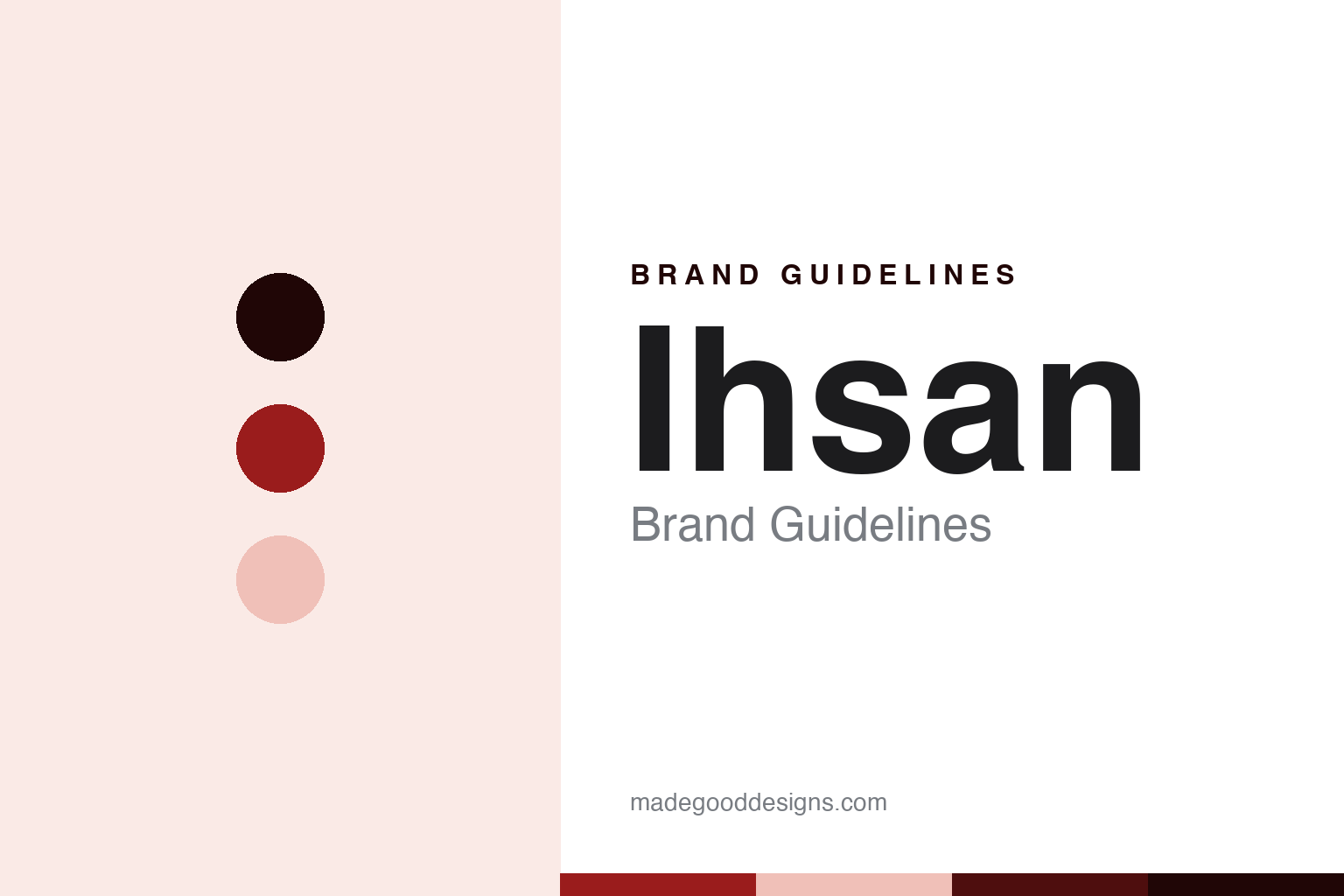
Ihsan Brand Guidelines
Pakistani willow, then English.
Aa
Two constants: an Ihsan-red palette and a heavy-grotesque register. Abstract homage — not an Ihsan product or mark; no bat, sticker or logo is reproduced.
A founder’s name on the bat
Ihsan dates itself to 1957 and to one man.
Ihsan’s own history is brief: “Ihsan Sports was started in 1957 by Mr. Ihsan Khan,” it says, and the company launched “its registered Trade-Mark Ihsan (IS).” The firm is based in Sialkot, the sports-goods city of Pakistan’s Punjab, on Daska Road — the same road given by CA Sports, founded a year later. The two are separate companies; Sialkot’s sports trade has always clustered.
Its English willow supplier tells the story in a little more detail. In May 2026 J.S. Wright & Sons, the Essex willow grower, profiled Ihsan in a series on its overseas customers. It wrote that the firm was “Founded in 1957 by the late Mr Ihsan Ullah Khan and nephew Sana Ullah Khan,” and that “they began their journey crafting bats from Pakistani willow.” English willow came in the 1980s, Wright said, through its own supply, “facilitated initially through Hardwood Dimensions.” The two accounts agree on the year and the founder; Wright’s adds a nephew and the willow.
That arc — from local willow to imported English clefts — is the arc of the South Asian bat trade. Pakistani and Kashmiri willow are generally used for cheaper, heavier bats; English willow, Salix alba var. caerulea, is the wood that top players use. The tree is a specialised crop: the Forestry Commission’s 1936 bulletin on its cultivation stressed “the necessity of careful selection of the right kind of willow,” which, properly tended, reached the size bat-makers need “in twelve to eighteen years.” A Sialkot maker selling to international players has, for decades, bought that wood from England — and Wright, one of its suppliers, is a firm that says it was founded in 1894 to supply willow for W.G. Grace’s bats.
Colour
Bangladesh, Kenya, Zimbabwe: a maker for the smaller Test nations.
Ihsan’s sponsorships have followed the newer and smaller cricket nations. The company says it sponsored Bangladesh’s national and age-group teams, “including the WorldCup team in 2007,” and that it was the “first company to sponsor all 5 teams.” It says it supported Kenya “before and during the ICC WorldCup 2007.” Those are its claims.
Its Zimbabwe deal is documented. On 15 October 2020, Zimbabwe’s Herald reported, Zimbabwe Cricket signed a US$30,000 kit agreement with Ihsan International for the national team’s tour of Pakistan, on top of an existing US$70,000 deal covering four women’s provincial teams and two men’s regional sides. The team shirt had been presented at State House in Harare two days earlier. Ihsan says it is “one of the biggest sporting brands in Zimbabwe”; Wright, in 2026, called it the “official kit sponsor for Zimbabwe Cricket” — Wright’s words.
The company’s ambassador page lists past and present players, among them Wasim Akram, Misbah-ul-Haq, Mohammad Hafeez, Chris Gayle and Zimbabwe’s Craig Ervine and Brian Bennett. The list is undated, and we do not present any name as a current endorsement. Ihsan sells English-willow bats in Classic, X Series and Victory ranges, as well as composite and tape-ball bats, and lists exports to fourteen countries, from the United Kingdom and Australia to Afghanistan.
Typography
The willow is the rationed ingredient.
Every bat in this round starts as a tree, and the tree is now the hard part. Wright says that “Approximately 75% of the world’s English Cricket Bat Willow comes from us” — its claim, and a statement about English willow, not all willow. English bat willow is grown mainly in East Anglia, where it is subject to an unusual law. Under the Watermark Disease (Local Authorities) Order 1974, an officer may examine a willow “by cutting into the wood or otherwise,” and may require an infected tree to be cut down and its branches “destroy[ed] by fire at the premises.” The disease, a bacterial stain that ruins the timber, has been recognised in Britain since 1924, and the Forestry Commission notes that “No chemical cure exists.” Since an amendment of 1992, the order has applied in Bedfordshire, Essex, Hertfordshire, Norfolk, Suffolk and Wiltshire, and an officer can even forbid an infected nursery from passing on young willows for up to three years. Few raw materials of sport are policed so closely at the root.
Scarcity has changed the Laws themselves. In October 2025 the Marylebone Cricket Club held a conference at Lord’s on what it called the “cricket bat emergency” — “a shortage of willow and spiralling prices.” From 1 October 2026, MCC’s new Laws allow laminated bats in open-age cricket, “as part of an attempt to slow the rising costs of bats around the world.” MCC had suggested an English-willow face backed by Kashmir willow “or even other woods.” For a maker whose founders, by Wright’s account, began with Pakistani willow, that is a rule change worth watching.
Ihsan says every product “is in compliance with the highest international quality standards and labour regulations” — its claim. Sialkot’s industry has a documented history on that subject: in 1997 its chamber of commerce signed the Atlanta Agreement with the ILO and UNICEF to end child labour in football stitching.
IS
A heavy grotesque — the “IS” of a registered trade mark. (Specimen set in Archivo Black, a sans STAND-IN; NOT the Ihsan logo.)
Ihsan (IS)
A founder’s first name, registered as a mark.
Ihsan’s brand is its founder’s first name, registered, the company says, as “Ihsan (IS)” — a name and its two-letter abbreviation. In Arabic and Urdu, ihsan means excellence or doing good, a meaning that gives the name a second life on a bat. The trade press calls the company Ihsan International; its site calls it Ihsan Sports. Either way, the founder’s name stays at the front, as it has for nearly seventy years.
For a design guide, Ihsan is a case of a brand that grew sideways. Its reputation was built not in the largest cricket markets but in Bangladesh, Kenya and Zimbabwe, through national-team kit as much as through bats. A brand that dresses a whole team is seen on every player in every frame of a broadcast; a bat logo is seen only when its owner is batting.
For this guide we use a deep red and a pale rose with a heavy grotesque. These are an unofficial interpretation — we did not verify Ihsan’s own colours or tagline — and nothing of its logo is reproduced.
Explore & save
Keep Ihsan’s identity on hand — save it to a board in the Made Good inspiration library.
Ihsan identity set
Pin the Ihsan-red palette and the heavy-grotesque register to your own board.